From Click to Doorstep: How a Delivery Promise Becomes Real
Follow a hypothetical book order from Maya to Sathya's door—and learn how stock, capacity, time, and recovery make a promise possible.

I am Sathya Narayanan. In our hypothetical story, I order Maya’s book from eComm Inc, our fictional ecommerce company. Maya runs Stories Inc., our book vendor. The screen promises delivery tomorrow evening. For me, that is a date to plan around. Behind it sits a chain of work that has to happen in the right place and in the right order.
Someone needs an eligible copy of the book, the capacity to prepare it, space on compatible departures, and a workable final delivery. A copy in the wrong place or a truck that left five minutes ago cannot keep the promise. More inventory, a faster robot, and a fuller truck can each help—and can each fail to improve the outcome.
This is the Outbound Finished Product to End Consumer series within Supply Chain Management in hyperscale ecommerce. Behind the Buy Button covers the Procure-to-Pay lifecycle. Before the Shelf covers the inbound inventory supply chain. From Click to Doorstep begins with the customer sale and delivery promise, then follows inventory assignment, fulfillment, transport, the final handoff, recovery and returns.
The three lifecycles overlap. Supplier settlement is a different question from inventory readiness, and both differ from fulfilling my order. At hyperscale, many products, locations, sellers and simultaneous promises make those distinctions especially useful.
The journey gives us a way to learn the enduring concepts and judge newer capabilities. We will use small calculations to see why a decision works, then change an assumption to discover when it stops working.
The three series share a cast, with distinct worked transactions. In the commercial equipment case, eComm Inc buys a machine for its own print-on-demand operation. In the inbound case, Mayan supplies a machine to Maya at Stories Inc. Our outbound order is a separate teaching case; its inventory and cost figures are not a continuation of either companion's ledger.
Why this matters before we learn the vocabulary
As a customer, I care whether the book arrives when I need it and in a usable condition. Maya needs to know which markets she can serve, how much inventory she must finance, and what remains after delivery costs and returns. Mayan needs to know which specialist capabilities make a machine delivery safe and complete.
A business leader has to decide where another dollar, minute, or unit of capacity changes the result. An investor has to ask whether the improvement survives the cost of the assets and services required to produce it. Understanding the flow makes those questions more precise; it does not by itself establish an investment's value.
A warehouse can look busy while customer orders wait. A full truck can leave too late. A cheaper shipment today can consume the last nearby book that would have prevented an expensive urgent shipment tomorrow. These are decisions about the whole system, not isolated efficiency scores.
Our cast and the boundary of the story
I am Sathya Narayanan, the author and customer in the hypothetical scenes. Maya of Stories Inc. is our basic book vendor. Mayan of Sapiens Inc. is the sophisticated supplier of printing machines. eComm Inc is the fictional ecommerce company. Maya and Mayan are different people with different products and fulfillment needs.
The operating network, timings, choices, and numbers that follow are invented teaching models. They explain decisions an order-fulfillment system must confront; they do not reconstruct Amazon's current private systems or report an actual purchase. Public examples are identified and cited separately.
Most calculations concern Maya's books and ordinary parcels. Mayan's printing machine needs a different handling path: lifting capability, appointment delivery, site access, and potentially installation. That contrast is deliberate. The product and service determine which logistics model is appropriate.
Ownership matters too. A retailer may buy Maya's books and resell them, or Maya may retain ownership while a provider stores and ships them for a fee. Physical custody does not settle that commercial question.
One journey, two directions of information
View the full-size diagram →
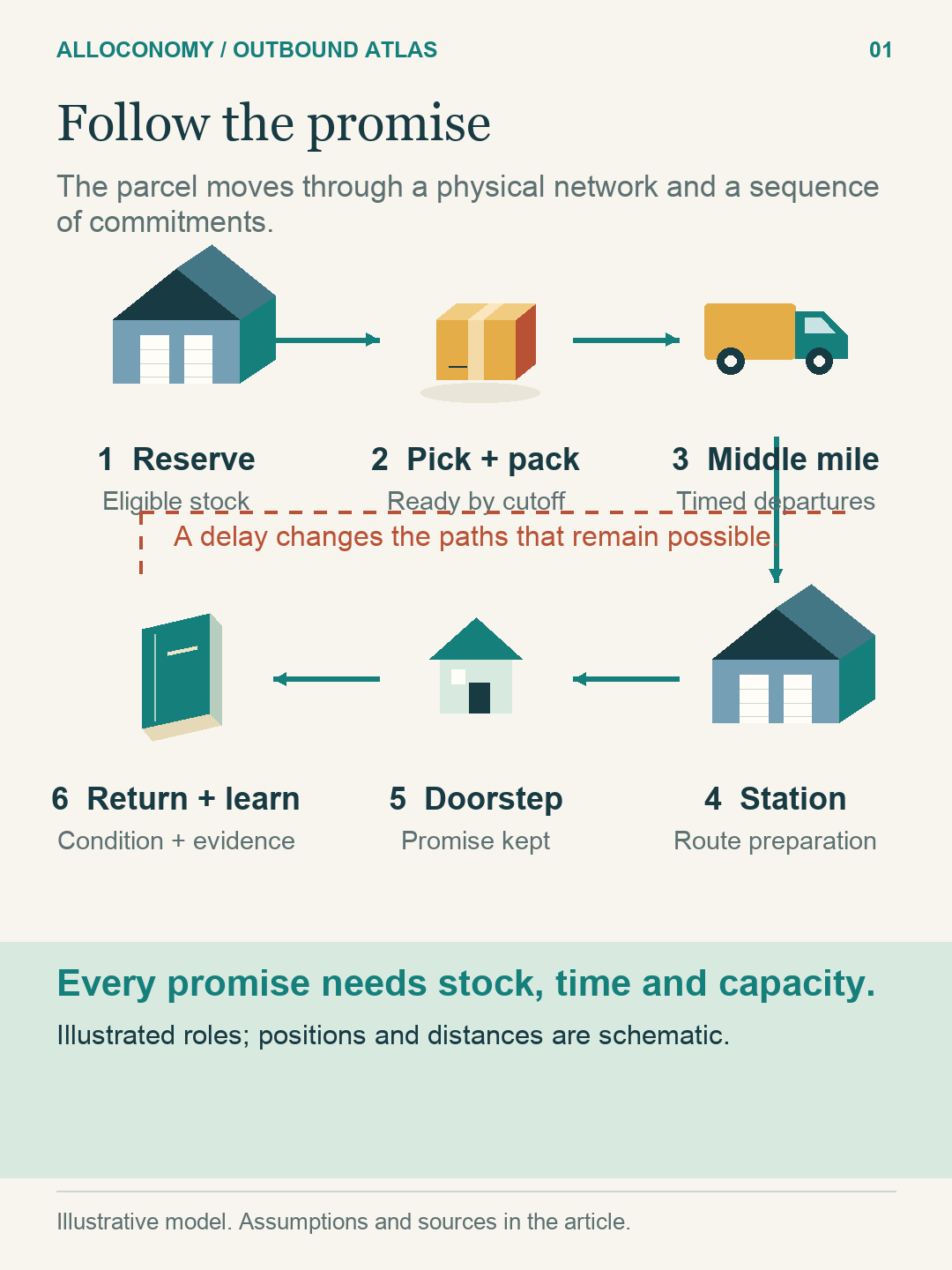
Physical goods move from usable inventory through picking, packing, transport, sorting, and delivery. Information runs both ways. The delivery route sets a station cutoff. The station cutoff sets an upstream departure requirement. That departure sets the warehouse's packed-ready deadline. A promise made at checkout must be supported by this chain.
An order is the customer's purchase. A unit is one physical item. A shipment is a planned movement; a package is a physical parcel. A stop is a place the delivery vehicle serves. My order for two books can use two units, one package, and one stop. It can also use two packages at the same stop. Keep the populations separate before calculating cost or reliability.
The cheat sheet I want beside me
| Concept | Plain meaning | The question it helps answer |
|---|---|---|
| Network design | Choose facility roles, locations, and connections | What service is physically possible? |
| Forecast and assortment | Estimate demand and choose local product presence | Which books deserve nearby space? |
| Inventory placement | Put eligible units where they create useful options | How much stock belongs at each node? |
| Available to promise | Stock and capacity usable within a specific time window | Can this offer be honored? |
| Assignment | Choose a compatible set of sources and shipments | Which plan serves this order once? |
| Flow and queues | Work moves through constrained operations | Where will waiting consume the deadline? |
| Middle mile | Scheduled movement between facilities | Which connection can this package catch? |
| Last mile | Routes, people, vehicles, access, and handover | Can it reach this customer on time? |
| Opportunity cost | Value of the alternative use we give up | Should we consume the last nearby copy? |
| Control and recovery | Revise what can still change after new evidence | What can we do when a departure fails? |
| Economic reconciliation | Connect activity, cost, and its revisions | Did the whole system improve? |
The full reading path above takes each idea further. The detailed essays explain the equations, their units, and the assumptions that can reverse each answer.
The old ideas inside the newer capabilities
Consolidation, safety stock, queues, routing, and fixed dispatch costs are durable concepts. Newer systems can observe more events, forecast distributions, coordinate decisions more frequently, and automate specific physical tasks. None of that makes time, conservation, or uncertainty disappear.
Here is my working equation, expressed as a decision rule rather than a universal formula: choose the lowest expected total cost among plans that satisfy the required service, safety, eligibility, and resource constraints. The time horizon and treatment of uncertainty must be stated. A score that silently trades away those requirements answers a different question.
Public accounts of inventory planning and delivery control help establish that these are real areas of operational research. They do not reveal a complete current implementation. Our worked examples remain independent teaching constructions. S1 S2
The business models behind the machinery
Local inventory and timed capacity can support faster offers. Shared fulfillment can let Maya sell through several storefronts without building a separate warehouse for each. Accurate stock records can support ship-from-store or pickup. Cross-border service adds customs information, eligibility, and a different returns problem. These are conditional possibilities: the process capability must exist before the business promise is credible.
My goal is to leave this series able to ask five questions: what is promised, what makes it feasible, which option it consumes, how the system recovers, and what evidence proves the improvement. That is a more useful understanding than memorizing the names of warehouse software.
The fulfillment map: steps and the records they create
When I buy the book, I see an order number and later a tracking number. Between them sit several other records. Order routing, wave processing, picking and packing are steps. Fulfillment order, wave, warehouse work and container are names a reader can actually encounter in software.
This map uses Shopify’s published order-routing object and Microsoft Dynamics’ warehouse objects to explain different layers. It is a teaching synthesis, not a claim that these products share a single schema or that every retailer installs them together. Here eComm Inc is the seller fulfilling Sathya’s order. Payment and any return have their own records alongside the physical journey.

Capture the order and assign the work
| Step | Digital record created or updated | What I should recognize |
|---|---|---|
| Order capture | Seller creates a customer order, usually a sales order (SO) in an enterprise system. | Items, quantities, price, customer, destination and promised service. A consumer need not issue a business PO. |
| Payment authorization / capture | Payment system creates and updates payment objects and transactions; Stripe uses PaymentIntent and Charge. | Authorization holds eligible funds; capture collects against that authorization. They are distinct states/actions, not evidence of shipment. |
| Inventory reservation | Inventory system creates or updates a reservation against order demand. | Quantity committed to that demand. Reservation timing and the use of on-hand versus future supply depend on policy. |
| Order routing | Shopify creates one or more FulfillmentOrder records, shown here as fulfillment orders. | Items assigned to a fulfillment location as intended work. One customer order can split. This is not the customer order itself. |
Shopify’s object documentation distinguishes FulfillmentOrder, the intended work, from Fulfillment, the ongoing or completed execution. Microsoft’s reservation documentation shows why reservation is not universally one fixed step before routing. Stripe separates authorization and capture; their timing follows the payment method and merchant policy.
Release, pick, pack and deliver
| Step | Digital record created or updated | What I should recognize |
|---|---|---|
| Release to warehouse | Dynamics creates shipment and load-line records; configured processing can create loads, waves and work. | A shipment groups order lines for a receiver/address. A load can contain several shipments. These records can exist before packing. |
| Wave planning and processing | Warehouse creates and processes a wave. | A batch of demand used to organize warehouse execution. Processing can generate picking work; a wave is not a parcel or a truck. |
| Pick work creation / picking | System creates warehouse work with a work ID; operators confirm its pick/put work lines. | Instructions specifying the inventory movement and its execution status. SAP’s warehouse task (WT) is a related operational concept, not an interchangeable record format. |
| Packing | Warehouse creates or updates a container or package record and its item contents. | The actual parcel grouping. Here “container” can mean a parcel carton, not necessarily a sea container. |
| Shipment manifesting / label generation | Carrier integration returns a shipping label and tracking number; updates shipping/manifest information. | The selected carrier service and package identity. A label can exist before physical carrier handoff. |
| Transport execution / delivery confirmation | Carrier records tracking events and, where available, proof of delivery (POD). | Scans, attempts and handover evidence associated with the tracking ID. A delivery estimate and delivery evidence are different things. |
Microsoft documents release to warehouse, wave processing, packing containers and small-parcel shipping. FedEx’s tracking documentation illustrates the later events and delivery evidence. The diagram shows a wave-based warehouse example; other operations organize work differently.
A manifest describes shipments or packages presented for transport. A route plan assigns travel and stops. They are not synonyms. Likewise, the creation of a shipment record is not the event “shipped.”
Return and refund, when needed
| Step | Digital record created or updated | What I should recognize |
|---|---|---|
| Return authorization | Seller creates a return order, commonly identified by an RMA—return material authorization. | The authorized return and its order lines/reason. Microsoft models it as a return-type sales order. |
| Return receiving and disposition | Receiver records a return receipt; Dynamics can use an item arrival journal/registration, with disposition information. | What came back and its treatment: restock, quarantine, scrap or another permitted route. Physical receipt does not automatically authorize a refund. |
| Refund processing | Payment system creates a refund linked to the original payment or charge. | Money being returned and its actual processing status. This differs from cancelling an uncaptured payment. |
Microsoft documents physical-return and credit-only paths and return-receipt records. Stripe documents refunds against the original payment. The dashed arrows are conditional: a merchant may approve a refund without requiring goods back, or require receipt and inspection first. A replacement creates a linked new order, not an arrow that erases the old one.
The long tail, when I need it
Available to promise (ATP) is an availability calculation supporting the promise; it is not necessarily a new document per order. Product, location and carrier-service master data also sit behind the records. Replenishment tasks, cartonization, sorting, transport loads, route plans, delivery stops, claims and credit notes become useful as the question becomes more specific.
Follow assignment and the delivery promise, the complete reading path above or the inbound graph for the preceding warehouse journey. The commercial graph explains the separate business purchase from Maya.
Sources checked October 22, 2026. Each card pairs a named step with a record created or updated. Arrows show selected handoffs/references, not a universal creation order. This directed acyclic view leaves repeated planning, cancellations and many exceptions to the detailed essays.
Public sources and evidence boundaries
The calculations and operating scenes above are fictional teaching models. These public references support the limited background claims identified in the text. Checked 18 October 2026.
- S1: The evolution of Amazon’s inventory planning system (2021-10-01). Historical company account: coordinated multi-echelon inventory. No current coefficients or universal deployment claim.
- S2: Maximizing the efficiency of Amazon’s own delivery networks (2022-10-14). Public approach and techniques being tested. Not proof that every discussed component was deployed.
Next: A Network Is More Than a Map · Return to the opening guide