Follow the Book Home: A Leader’s Review
Two items, one parcel, one kept promise. Reassemble the case and learn what evidence a leader should request at each decision.

I began as Sathya Narayanan, a customer looking at eComm Inc's delivery promise. In our hypothetical case, Maya's book and workbook now arrive together at 19:15, forty-five minutes before the accepted deadline. Along the way, the cheaper current shipment was rejected and a planned departure was canceled.
To understand the outcome, we have to follow the connected decisions: what was predicted, what was promised, what was reserved, what physically happened, and what it finally cost. This final review ties the teaching case together; it does not describe an actual transaction or any real company's private operating system.
Start with the options already created
Before checkout, eComm Inc selected local assortment, placed inventory, planned labor, and secured transport. In our shared case, A holds one book; B holds three books and one workbook. C's inventory is outside the feasible time horizon. Replenishment cannot become ready until tomorrow noon.
Those are stipulated starting conditions, not proof of an optimal inventory policy. Earlier placement costs belong in the end-to-end period economics, even when they are already sunk for the current assignment decision.
Accept the promise, then commit a plan
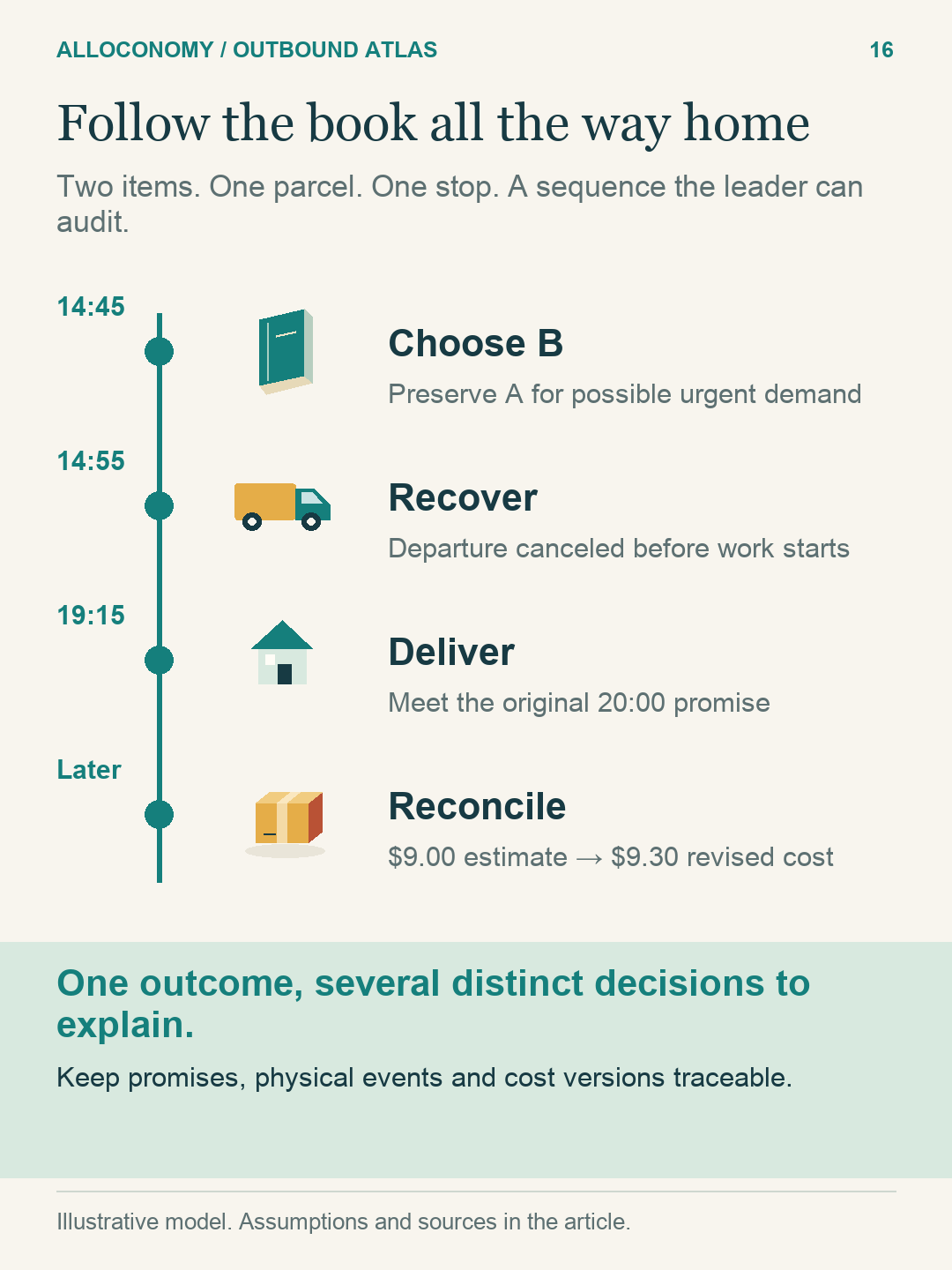
My two-item order is due at 20:00. Splitting A's book and B's workbook costs $5; combining at B costs $6. With a 60% chance of one urgent book order before replenishment, preserving A reduces expected total cost from $9.80 to $7.20 under the stated assumptions.
eComm Inc reserves B's two units and the required timed capacities. The plan is a set of linked claims, not merely a source-facility name. A second order cannot spend the same book or departure position.
Recover before the work freezes
At 14:55 the 15:30 departure is canceled, before warehouse work starts at 15:00. A later regular departure misses the hub connection and reaches me at 20:45. That alternative fails the original promise.
The direct combined expedite costs $9, reaches the station in time for the 18:30 route, and delivers at 19:15. Its expected total, including the possible urgent order, is $10.20 versus $12.80 for split recovery. eComm Inc changes the route reservations while retaining the order's eligible stock claims.
View the full-size diagram →
All times are in one fictional local timezone. Processing and loading are included in the stated readiness times. This is deterministic feasibility; it does not establish a real service-reliability percentage.
Reconcile what happened
After B dispatches, A still has its one book. B has two books and no workbook. If the urgent order occurs, A's book then ships and A becomes empty. The current order consumed two units, one parcel, and one customer stop. These are three different counts.
The current recovery estimate is $9, split into $1.50 warehouse handling, $4.50 transport, and $3 last mile. A later transport correction raises it to $9.30. Keep both versions and the reason for the change. The forecasted $3.60 scarcity value is not another invoice.
If my book returns damaged, receipt and inspection create a new chain of events. A refund does not itself put the book back on a shelf. The service outcome extends beyond the first delivery scan.
The leader's review card
| Review question | Evidence I would ask to see |
|---|---|
| What decision and horizon are changing? | Current commitments, alternatives, and action-specific freeze points |
| What was known at the time? | State versions, demand assumptions, and uncertainty |
| What must remain feasible? | Service, safety, eligibility, stock, and timed capacity |
| What is the objective? | Units, priorities, cost boundary, and treatment of future consequences |
| What reverses the answer? | Sensitivity calculation and a credible counterexample |
| Can the plan be executed and recovered? | Reservations, event sequence, exception path, and ownership |
| Did the system improve? | Defined comparison, service guardrails, reconciled cost, and benefit realization |
Connect the three Supply Chain series
Behind the Buy Button asks who promised what, which evidence supports it, and what is owed. Before the Shelf asks how goods become usable in the right place and condition. This outbound series asks how those goods and other resources support a customer commitment.
The interfaces matter as much as the chapters. Supplier reliability influences usable inventory. Usable inventory influences the offer. The offer influences demand. Demand consumes warehouse and transport capacity. Delivery and return outcomes revise both economics and future planning.
The newer capabilities—richer forecasts, shared events, robotic tasks, frequent optimization, and fulfillment services—operate inside this older logic of flow, scarcity, uncertainty, and commitments. They can enable smaller sellers, broader selection, faster service, and cross-border business when the complete system supports those promises. S10 S11 S13
What I would ask Maya, Mayan, and the fulfillment leader
For Maya of Stories Inc., I would ask which inventory and service commitments let her sell the next book profitably—and which risks remain hers when fulfillment is outsourced. For Mayan of Sapiens Inc., I would ask what makes the printing-machine delivery complete: safe handling, access, an appointment, and any agreed installation work. I would not copy parcel economics into that decision.
For the fulfillment leader, I would ask which scarce resource changes the answer and what evidence shows that the whole service improved. As Sathya, the customer, I need the promise to be clear, the product usable, and the remedy understandable when something goes wrong. The same system looks different from each role; a useful decision has to reconcile those views.
A final check of understanding
A nearby warehouse can be slower when its processing or connection misses the deadline. Fewer packages can cost more when consolidation requires extra handling or waiting. A more expensive shipment now can preserve a valuable future option. An exact optimum can fail in practice when its candidates, state, or physical assumptions are incomplete. Each conclusion follows from a constraint or a tradeoff that we can inspect.
For me, understanding the subject means being able to explain the decision with a small calculation, name the assumption that could reverse it, and ask for the evidence needed to act. The book at my door is the visible result. The work underneath is a system of promises, physical constraints, and choices that someone must be able to account for.
Public sources and evidence boundaries
The calculations and operating scenes above are fictional teaching models. These public references support the limited background claims identified in the text. Checked 18 October 2026.
- S10: GS1 EPCIS Standard 2.0.1 (version 2.0.1). Public event-data standard. Interoperability does not certify completeness or truth.
- S11: Amazon Multichannel Fulfillment (living page). Evidence for service model existence. Fees, eligibility and promises must be checked for actual use.
- S13: WCO cross-border e-commerce framework (framework and living collection). Advance electronic data and risk management. Not transaction-specific legal or tax guidance.
Previous: Did We Really Save Money? · Return to the opening guide