Stock Is an Option with a Location and a Clock
Sixteen books exist, but not all sixteen can be promised tonight. Follow ownership, readiness, reservations, and replenishment.

In our teaching network, twelve of Maya's books sit in bulk storage, three at West, and one at East. Sixteen copies exist. Yet a customer may still be unable to receive even one tonight.
Inventory needs a location, an owner, a condition, a reservation state, and a ready time. A copy in transit is real inventory. It is not yet ready to pick at its destination.
Follow the physical units
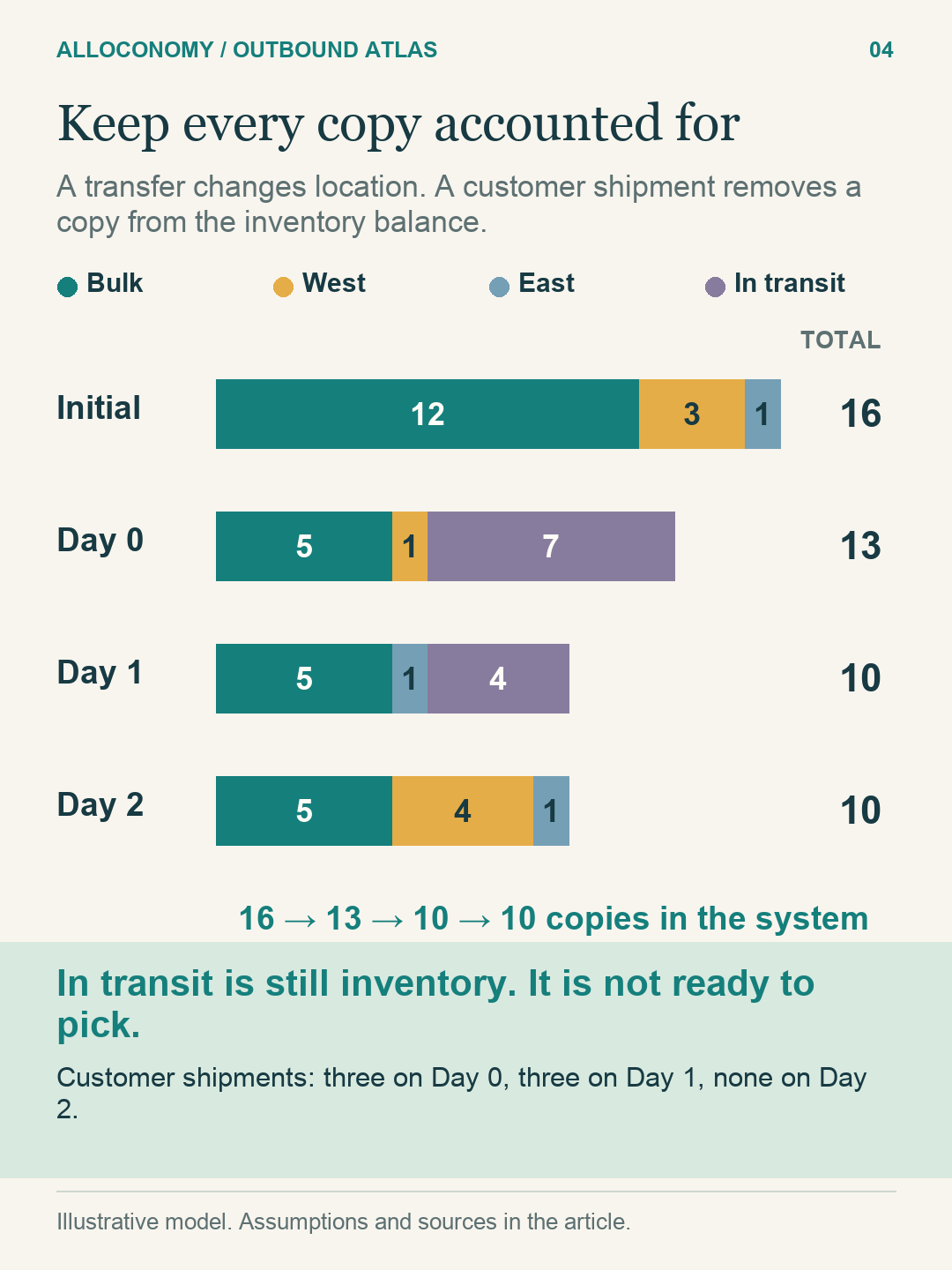
At the start of day zero, eComm Inc sends four copies from bulk storage to West on a two-day movement and three to East on a one-day movement. Two West copies and one East copy then ship to customers.
| State | Bulk | West | East | In transit | Network units |
|---|---|---|---|---|---|
| Initial | 12 | 3 | 1 | 0 | 16 |
| Day 0 after transfers and sales | 5 | 1 | 0 | 7 | 13 |
| Day 1 after East receipt and sales of 1 West, 2 East | 5 | 0 | 1 | 4 | 10 |
| Day 2 after West receipt | 5 | 4 | 1 | 0 | 10 |
View the full-size diagram →
Transfers preserve the network total. Customer shipments reduce it. A late day-one West order cannot use books that become ready on day two. The inventory equation is a conservation statement: closing stock = opening stock + usable receipts − customer dispatches − outbound transfers, with transit tracked separately.
Reservations are claims on units, not additional units. Damage holds and owner restrictions affect eligibility. A system that counts the same copy as both on-hand and incoming creates apparent availability without physical supply.
Why several inventory levels exist
A bulk pool can hold a broad assortment while forward centers keep the selection needed for faster delivery. This is multi-echelon inventory: inventory at levels with different roles. It trades forward stock and service against replenishment effort, transit inventory, and dependence on timely receiving.
One node's inventory position often includes usable on-hand stock plus eligible inbound supply minus commitments, under a stated convention. An echelon view includes downstream stock within a defined boundary. These views overlap; adding every echelon position would count some books more than once.
The public inventory-planning account describes coordinated placement across products and facilities under constraints. It supports the relevance of these ideas, not our example quantities or a claim about present internal formulas. S1
A replenishment target is still a request
Suppose West expects two books a day, replenishment takes two days, and orders are reviewed daily. A stipulated buffer of two gives a target of 2 × (2 + 1) + 2 = 8 books. If West has one usable copy and two eligible incoming copies, with no other commitments, its position is three and its replenishment request is five.
The three-day protection interval includes both lead time and the time before another review. The two-copy buffer is a policy assumption, not a calculated guarantee of any service percentage.
If East requests three more and the bulk pool has only six, the requests cannot both be filled. eComm Inc needs a rationing policy. Serving the loudest center first may waste the shared inventory. Compare marginal service consequences, transport and receiving limits, and the next replenishment opportunity.
Replenishment restores stock for expected demand. Rebalancing moves excess toward a shortage elsewhere. An order-specific transfer assembles supply for a known order. Each movement must justify its transport, receiving, handling, and displaced capacity, and become ready before it is needed. A service agreement may allow movement in only one direction; drawing a reverse arrow does not make it eligible.
Ownership does not travel with the diagram
Maya can own stock while eComm Inc stores and ships it for a fee. Alternatively, a retailer can own books it purchased. The physical record answers where the goods are; the commercial record answers whose inventory and obligations they represent.
Seller fees are Maya's expenses and the provider's revenue. They are not automatically equal to the network's resource cost. Adding both as if they were separate physical consumption would double count a payment across the chosen boundary.
The record that makes shared fulfillment possible
Keeping custody, ownership, and eligibility separate lets a provider operate a shared building without treating every seller's goods as interchangeable. That distinction enables fulfillment as a service. Better event records make the arrangement easier to coordinate; the older obligation remains to account for every unit and every claim on it.
The decision to carry forward
Maya should ask when inventory becomes eligible for each offer and who bears delays, loss, and obsolescence. The network leader should insist that assignment receives quantity, readiness, ownership class, and reservation version together. A stock count without those fields is an incomplete promise input.
For the customer, this is why an apparently available product can still have a later delivery date. For an investor, more inventory levels can support better service but also tie up more capital. The useful measure is the service and economics the inventory enables, not simply the number of units stored.
Public sources and evidence boundaries
The calculations and operating scenes above are fictional teaching models. These public references support the limited background claims identified in the text. Checked 18 October 2026.
- S1: The evolution of Amazon’s inventory planning system (2021-10-01). Historical company account: coordinated multi-echelon inventory. No current coefficients or universal deployment claim.
Previous: Before the Order: Which Books Belong Nearby? · Next: A Promise Is a Path Through Time · Return to the opening guide