A Promise Is a Path Through Time
A date at checkout commits a sequence of unfinished work. Work backward from the doorstep to find the cutoffs that matter.

At checkout, I see a delivery date. I do not see the packing queue, the hub connection, or the driver waiting for a route to be ready. Yet all of them are part of the promise being made to me.
The useful question is whether the unfinished work still fits before the deadline. Stock readiness, processing, departures, intermediate handling, and delivery must form one feasible sequence. Travel time is only part of it.
Work backward from the customer
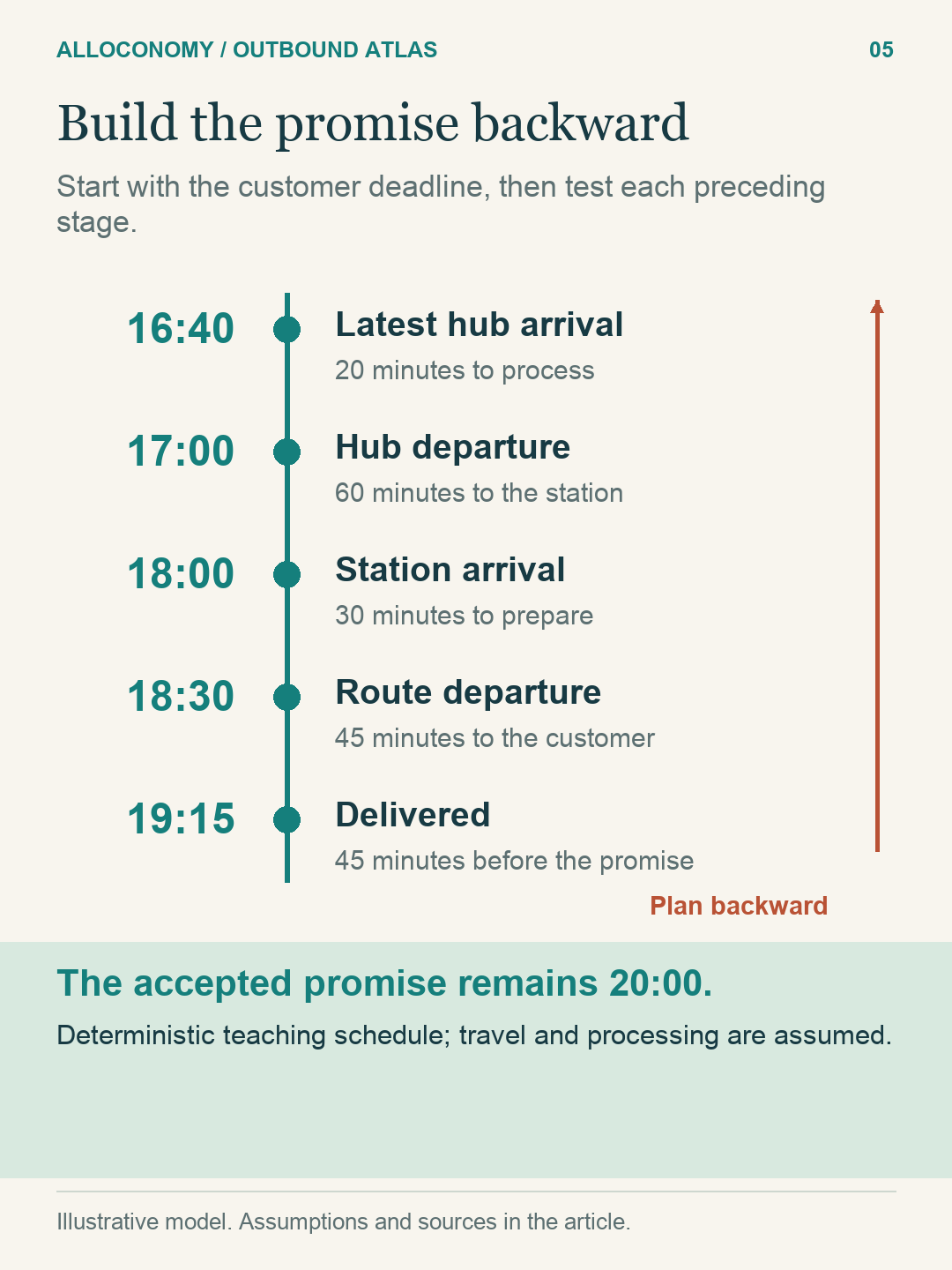
In an invented local schedule, the delivery truck leaves at 18:30 and reaches me at 19:15, before a 20:00 promise. The station needs 30 minutes for receiving and loading, so the package must arrive by 18:00. Its upstream truck leaves the hub at 17:00. Hub work takes 20 minutes, so arrival must be no later than 16:40.
View the full-size diagram →
These are internal cutoffs supporting an external commitment. A package arriving at the hub at 16:45 misses the connection even though the customer deadline is hours away. More urgency in a dashboard does not reverse time.
Real planning needs uncertainty protection. Our times are deterministic teaching inputs, not operating benchmarks. A schedule that fits exactly has no spare allowance for a queue, loading delay, or traffic.
Available stock is only one input
Available to promise commonly focuses on supply eligible for an offer. Capable to promise emphasizes whether the required production or processing capacity can also support it. Implementations vary, so eComm Inc must define its actual contract rather than rely on the labels.
At the product page, a system may estimate a feasible offer without reserving every resource. At checkout, it needs a policy for rechecking and committing. Two customers cannot both receive the last unreserved book merely because they saw the same earlier page.
The accepted promise and the operational plan are separate records. The plan may change when a truck is canceled; the original commitment should remain visible. Replacing the promised date after a delay must not erase the evidence used to assess service.
Reliability belongs to the whole order
An average journey time is not a reliable deadline. If many journeys take an hour and a few take much longer, the mean can hide the failures that matter to customers.
A teaching rule is: offer a deadline only when the probability of completing the eligible path by that time meets a stated reliability target. The target, its uncertainty estimate, and the fallback policy belong in the decision record. We do not assert a real company's threshold.
Suppose my order has two parcels, each independently 95% likely to arrive on time. Complete-order reliability is 0.95 × 0.95 = 90.25%. Independence is an assumption; shared weather or processing can change the result. A per-parcel target alone does not establish an order-level target.
Adding a separate weather buffer to every leg can also overstate risk if each buffer protects against the same storm. Use a coherent end-to-end uncertainty model where possible. Conservatism should be explicit rather than accidentally repeated.
A more current picture can support a different offer
Traditional lead-time tables remain useful for stable lanes. Richer event data and models can make offers depend on current inventory, processing, geography, and scheduled capacity. This can enable narrower windows, pickup choices, or a slower consolidated option. It also creates responsibility for stale data and rapidly changing offers.
Public work on fulfillment planning describes coordination between plans and execution. Our promise contract is a teaching design, not a disclosed production interface. S2
What leaders should inspect
Maya needs to understand which readiness failures affect the offer her customers see. eComm Inc should measure promise accuracy alongside promised speed, cancellations, failed attempts, and date revisions. A slower offer can improve on-time percentage without improving the proposition.
For me, a clear delivery window and honest exception message matter more than an unexplained optimistic badge. For an investor, faster promises may increase demand but require additional inventory and capacity; revenue effects and fulfillment costs should be analyzed together.
Try the idea: a warehouse reports spare capacity today. Can it accept this order? The answer remains unknown until the capacity is expressed for the relevant operation, product, and interval before the necessary departure.
Public sources and evidence boundaries
The calculations and operating scenes above are fictional teaching models. These public references support the limited background claims identified in the text. Checked 18 October 2026.
- S2: Maximizing the efficiency of Amazon’s own delivery networks (2022-10-14). Public approach and techniques being tested. Not proof that every discussed component was deployed.
Previous: Stock Is an Option with a Location and a Clock · Next: One Order, Several Plans · Return to the opening guide