The Last Mile Has More Than Miles
A route can fit the clock and still fail its energy limit. Connect channels, stops, labor, vehicles, and charging to delivery economics.

My house is one dot on the route map. At street level, that dot can mean parking, a locked gate, stairs, a delivery window, and a handover that may fail. Two boxes can share the visit; two neighboring addresses can take very different amounts of work.
Last-mile planning has to choose a channel, match available people and vehicles, group stops, and fit the work on a clock. Miles matter. They cannot tell us whether the route is executable.
A route is more than a line on a map
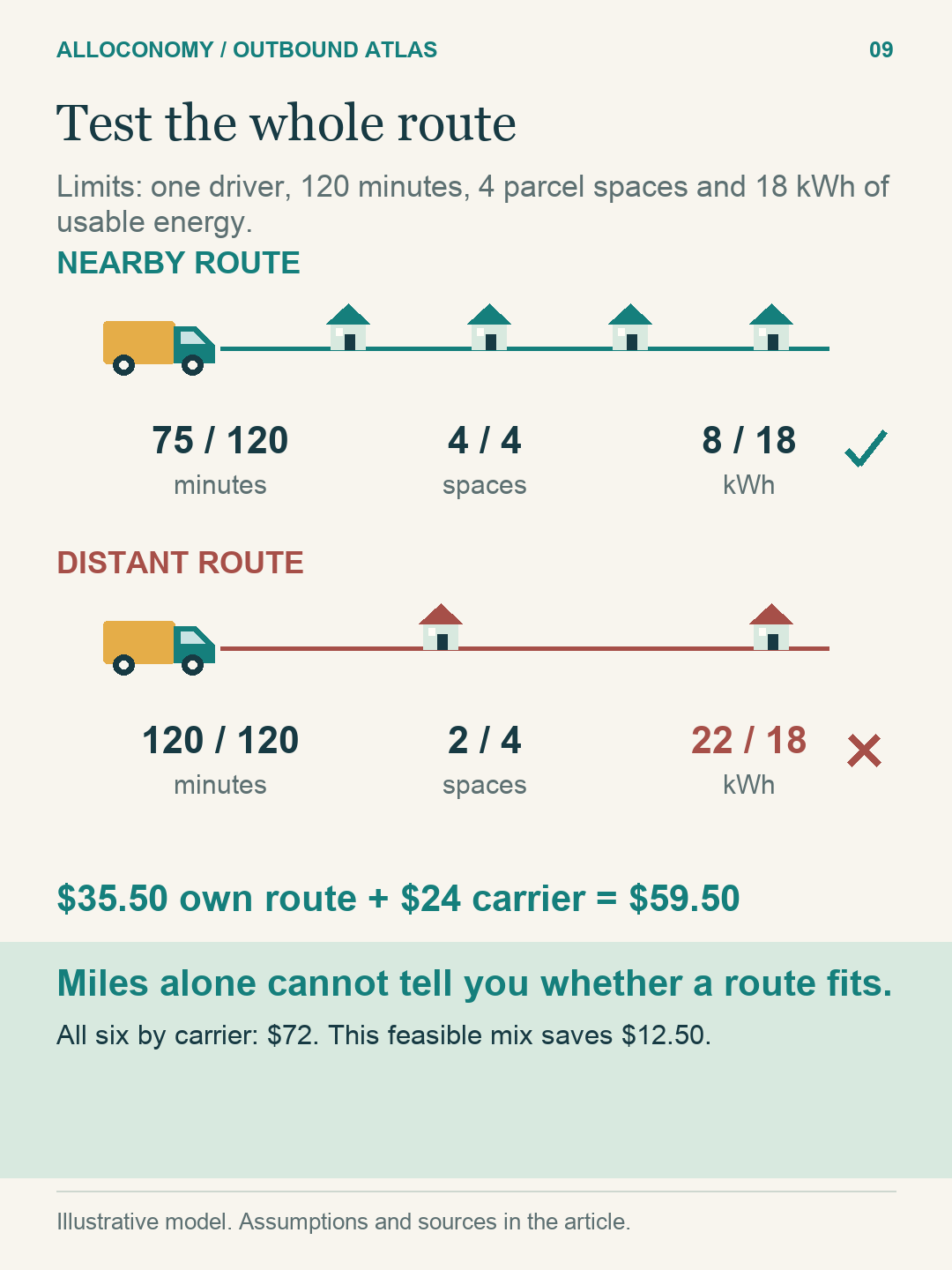
Our fictional station has six packages for six stops. Four nearby stops form a 12-mile route; two distant stops form a 40-mile route. One electric van and one driver are available from 10:00 to noon, including return. The van holds four packages and has 18 kWh available above its required return reserve.
All packages meet the 09:45 station cutoff. Each route includes ten loading minutes, five service minutes per stop, and a stipulated fifteen-minute break. These are teaching assumptions, not legal work rules.
| Route | Driving including return | Total route time | Energy at 0.5 kWh/mile + 2 kWh |
|---|---|---|---|
| Four nearby stops | 30 minutes | 10 + 30 + 20 + 15 = 75 minutes | 8 kWh |
| Two distant stops | 85 minutes | 10 + 85 + 10 + 15 = 120 minutes | 22 kWh |
View the full-size diagram →
The distant route fits the deterministic time window but fails the energy limit. Loading all six packages fails capacity. A low quoted vehicle cost cannot fix either problem.
Compare feasible channels
Assume an outside carrier can accept eligible packages until 10:20, meet the same customer promise, and charges $12 per package. Our own nearby route has a $10 avoidable dispatch charge, $0.30 per actually avoidable billed labor minute, and $0.25 per mile.
Own-route cost is $10 + 75 × $0.30 + 12 × $0.25 = $35.50. Sending the distant pair through the carrier adds $24. The total is $59.50 versus $72 to send all six through that carrier, a $12.50 difference within these stated choices.
The labor assumption is consequential. If the shift is already paid regardless of use, those minutes may represent opportunity value rather than cash avoided. Rebuild the comparison for that situation. Do not label a decision score a cash saving.
Upstream lateness changes last-mile economics
Now one nearby package misses the station cutoff but can still meet the carrier cutoff. Assume the three-stop route retains the same mileage and driving time. It takes 70 minutes and costs $34; three carrier packages cost $36. Total cost rises to $70.
The missed cutoff costs $10.50, reflecting the $12 carrier charge less $1.50 of avoided service time. A warehouse delay has become a delivery expense. If the carrier cutoff is also missed, more money may not restore the original promise.
This also shows why average and marginal cost differ. Four nearby packages averaged $8.875 each, while the fourth stop added only $1.50 under the fixed-geometry assumptions. A detour, extra shift, or access delay changes that marginal amount.
New vehicles still need energy and people
Fleet planning must match vehicle capacity, driver availability, charging time, charger ports, and site power. Two vans each needing 8 kWh require 16 kWh. One 11 kW charger operating for one hour at 90% efficiency supplies only 9.9 kWh. A second van alone does not make both routes ready.
Power is measured in kW; energy in kWh. Charging cannot simultaneously count as route time. Weather, load, terrain, and delayed return affect readiness. Public operations-planning work discusses this broader set of uncertainties. S9
Density is useful when the work can be completed
Route density can make a delivery service economical for merchants whose individual volumes are too scattered to support their own fleet. Integrated planning and electric vehicles can change the available choices. The basic service still needs ready parcels, a feasible route, a qualified driver, and a vehicle able to finish and return.
The decision to inspect
For Maya, package quality and address data affect delivery exceptions. For eComm Inc, route density must be evaluated with first-attempt success, paid minutes, rescue work, external-carrier spend, and deferred packages. A team can improve its own packages-per-route by exporting difficult stops to someone else's budget.
For the customer, delivery includes a usable handover, not merely a vehicle near the address. For an investor, an attractive route average needs a bridge to fleet utilization, capital costs, and total service economics. Which constraints make the route executable, and which costs disappear if it changes?
Public sources and evidence boundaries
The calculations and operating scenes above are fictional teaching models. These public references support the limited background claims identified in the text. Checked 18 October 2026.
- S9: The science of operations planning under uncertainty (2021-11-09). Public planning discussion; fictional vehicle, charging, and labor inputs are not company data.
Previous: The Truck That Left Five Minutes Ago · Next: Why Preserve the Last Nearby Book? · Return to the opening guide