Why Preserve the Last Nearby Book?
Paying one dollar more for today's order can save $2.60 in expectation. See the calculation—and the assumption that reverses it.

There is one copy of Maya's book nearby. My order could use it cheaply, yet the planner sends my book and workbook together from farther away. The current shipment costs one dollar more.
That can be a rational choice if the nearby copy protects a more valuable future order. The decision is a wager on what may happen before replenishment. We can make the wager explicit, calculate its value, and find the probability at which the answer reverses.
One order and one possible future order
I order a book and a workbook, both due by 20:00. West center A has one eligible book and no workbook. Center B has three books and one workbook. Center C has more stock but no path that meets either of the relevant promises. Replenishment cannot become ready before tomorrow noon.
Two current plans are feasible. Split sourcing uses A's book for $2 and B's workbook for $3, totaling $5. A combined parcel from B costs $6. Prices are stipulated incremental physical fulfillment cost through delivery, already including any shared-stop effect. No extra consolidation discount is added later.
Before replenishment, there is a 60% chance of one urgent book order. If A's book remains, it serves that order for $2. Otherwise B can expedite an eligible copy for $8. Both urgent paths meet their window; there is at most one urgent order and no other differential consequences. Remaining stock has the same incremental terminal value in both comparisons.
Spend a dollar to preserve an option
| Current plan | Current cost | Expected urgent-order cost | Expected combined cost |
|---|---|---|---|
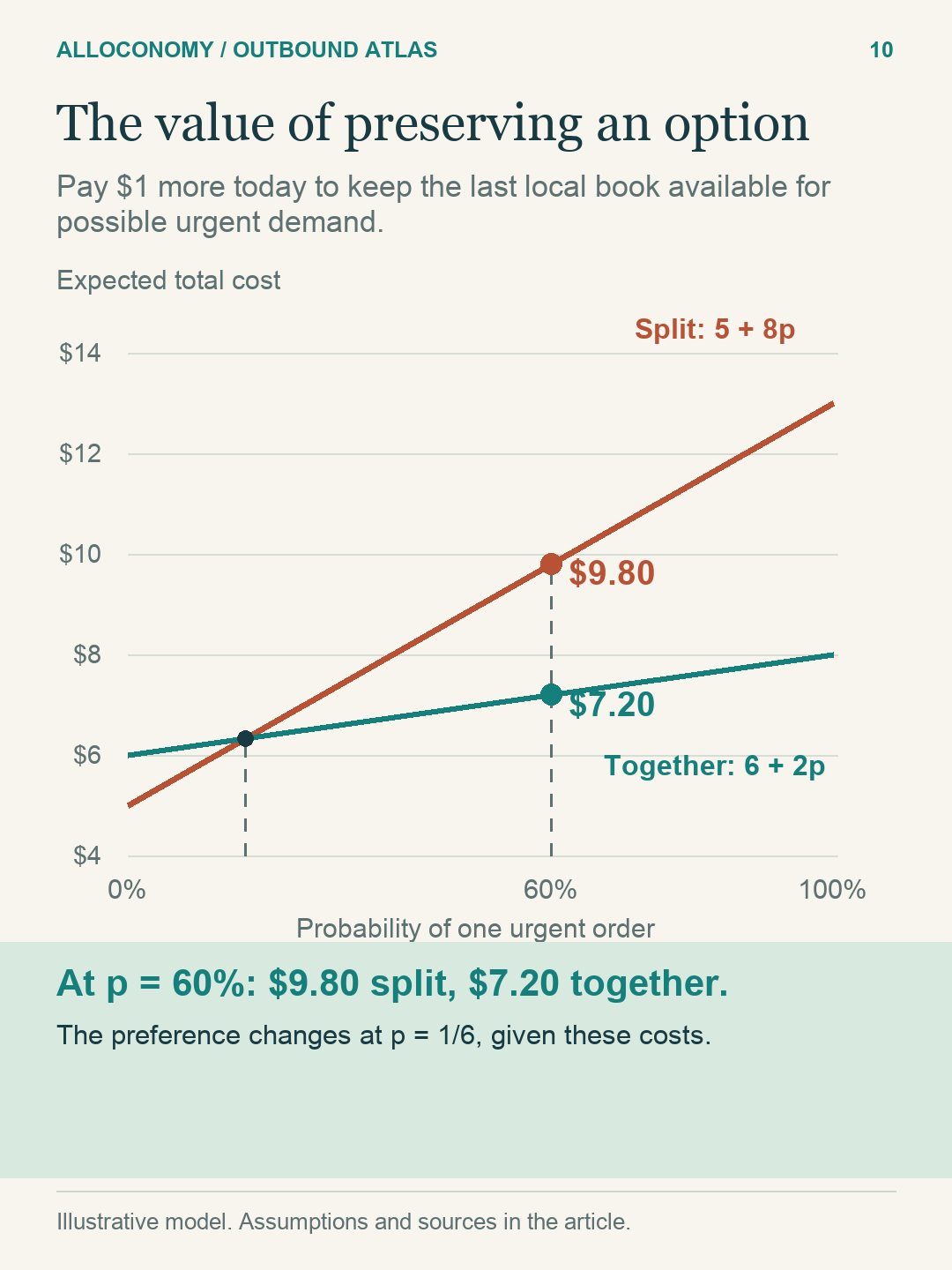
| Split A + B | $5.00 | 60% × $8 = $4.80 | $9.80 |
| Both from B | $6.00 | 60% × $2 = $1.20 | $7.20 |
View the full-size diagram →
Spending an extra dollar now reduces expected total cost by $2.60. Preserving A's copy has a future advantage of 60% × ($8 − $2) = $3.60. The extra dollar buys that option.
The $3.60 is not a physical expense to add to the final ledger. We can compare current cost plus explicit expected future cost, or use an equivalent opportunity-cost score. Adding both would count the future consequence twice.
The answer has a boundary
Let p be the urgent-order probability. Preserve A when 6 + 2p < 5 + 8p, which simplifies to p > 1/6, about 16.7%. At 10%, split expected cost is $5.80 and combined cost is $6.20. The answer reverses.
A probability estimate is therefore not decoration. Earlier replenishment, a cheaper expedite, another high-value use of A, a second urgent order, or different residual inventory value can change the result. A leader should inspect these assumptions rather than memorize “always preserve the last local unit.”
This is the intuition behind look-ahead fulfillment decisions: immediate cost plus the expected consequences of the next state. Public research and inventory-planning descriptions discuss related coordination and opportunity-cost ideas. Our exact example and values are fictional. S1 S2
Scarcity includes time-specific capacity
The same reasoning applies to the last packing slot before a departure or the last compatible vehicle position. A low-cost ordinary order can consume capacity that would otherwise handle an urgent one. But independently estimated scarcity prices can overlap: an inventory price and a departure price might both represent the same future missed order. Their sum needs a coherent model.
Fixed dispatch thresholds and complementary products can also make a simple price inaccurate. A local approximation is useful only when tested against the consequences it is intended to represent.
A better offer depends on preserving the right options
Opportunity cost is an old concept. More frequent forecasting and coordinated assignment can apply it to many stock and capacity choices. Used well, this can preserve scarce resources for urgent service while ordinary orders take other feasible paths. Used badly, a speculative future benefit can become an excuse for a worse present promise. The accepted customer commitment stays a constraint.
What changes for the reader
Maya can ask why the platform's chosen origin differs from the nearest site and whether the policy accounts for her service commitments. eComm Inc should measure total future consequences over a declared horizon, with sensitivity to forecast error. I should still receive the accepted promise; preserving an option is not permission to quietly degrade it.
An investor can use this idea to understand why local cost reductions do not always maximize network value. It does not supply a stock recommendation or reveal a company's proprietary optimization objective.
Try the idea: suppose B's urgent expedite falls from $8 to $3. At 60% demand probability, preserving A saves only $0.60 in expected future cost. Paying $1 extra now would no longer be worthwhile under the other unchanged assumptions.
Public sources and evidence boundaries
The calculations and operating scenes above are fictional teaching models. These public references support the limited background claims identified in the text. Checked 18 October 2026.
- S1: The evolution of Amazon’s inventory planning system (2021-10-01). Historical company account: coordinated multi-echelon inventory. No current coefficients or universal deployment claim.
- S2: Maximizing the efficiency of Amazon’s own delivery networks (2022-10-14). Public approach and techniques being tested. Not proof that every discussed component was deployed.
Previous: The Last Mile Has More Than Miles · Next: When the Plan Breaks, What Can Still Change? · Return to the opening guide