One Order, Several Plans
The cheapest plan is late; the fewest parcels are late too. Build an order plan that fits stock, capacity, and the promise.

I order three of Maya's titles: X, Y, and Z. Three parcels look wasteful; one looks efficient. But the single parcel may need a transfer that misses my deadline. Even the cheapest source for each title can overload the same departure.
Assignment turns a menu of possible shipments into one executable plan. Every requested unit must be served exactly once, the selected shipments must fit together, and the complete order must meet its promise. The smallest price in the list is only a candidate.
A candidate is a complete proposal
A useful candidate specifies the units, eligible source inventory, package, processing path, transport timing, and delivery feasibility. It includes its resource footprint and cost. Until selected and committed, it is an option, not an actual shipment.
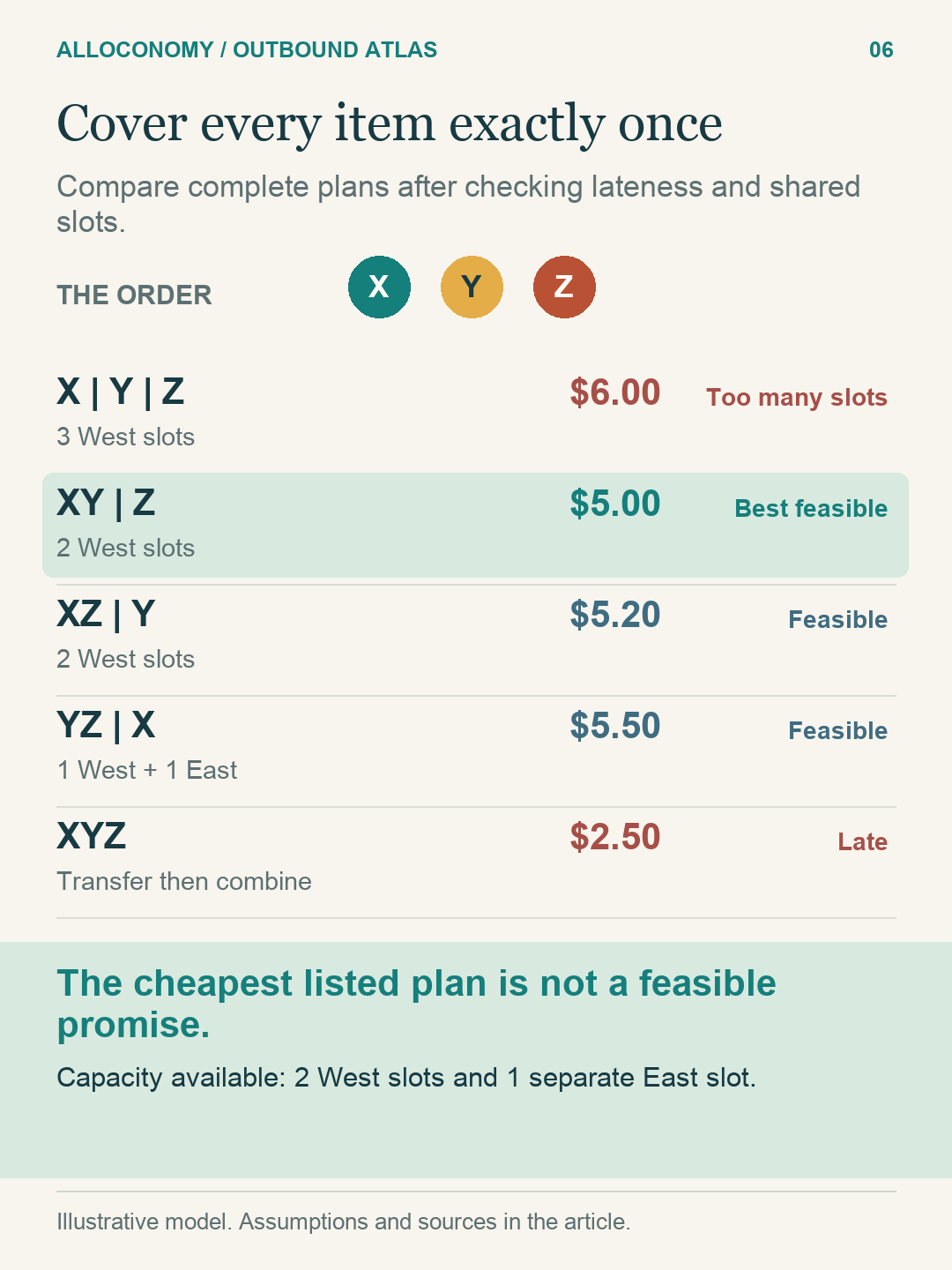
Our invented example has these five ways to cover the whole order. All prices are incremental physical fulfillment costs through delivery; they are additive by construction. Any shared-stop effect is already included.
| Complete plan | Cost | Parcels | West departure slots | Result |
|---|---|---|---|---|
| X from A, Y from A, Z from B | $6.00 | 3 | 3 | Too many West slots |
| X and Y together from A; Z from B | $5.00 | 2 | 2 | Feasible |
| X and Z together from B; Y from A | $5.20 | 2 | 2 | Feasible |
| Y and Z together from C; X from A | $5.50 | 2 | 1 | Feasible using one separate East slot |
| All together after a transfer | $2.50 | 1 | 0 | Late |
There are two West slots and one East slot. Other capacities are nonbinding. The best feasible listed plan costs $5.00. With only one West slot, it changes to $5.50. If the East slot also disappears, no listed on-time plan works.
View the full-size diagram →
The cheapest plan is late. The plan with the fewest parcels is late. Choosing the cheapest single-title option exceeds departure capacity. These rules each miss part of the actual decision.
Exact coverage and shared constraints
In mathematical language, we select candidates so that the number of selected candidates containing each requested unit equals one. This is an exact-cover condition. “At least one” would allow duplicate fulfillment. Two copies of the same title need two units represented, even if their product identifier is identical.
Then add stock and timed-capacity constraints. Individual feasibility is insufficient: two individually valid candidates can both consume the last available departure slot. Concurrent orders need a reliable reservation mechanism for the same reason.
A solver can be exact within the candidate set and still miss a better physical plan that was never generated. For three distinct units there are seven nonempty subsets before considering locations and times; for ten there are 1,023. Practical systems need controlled search, good candidate generation, and useful fallbacks.
Make priorities visible
If the promise is a hard requirement, remove late plans before comparing cost. If no compliant plan exists, enter an explicit exception process. A weighted score can silently change that policy.
For example, the late combined plan saves $2.50 against the $5.00 on-time choice and makes three units late. Under a score of cost plus a penalty per late unit, the on-time choice wins only when the penalty exceeds $2.50 ÷ 3, or about $0.8333 per late unit. That is a property of this toy calculation, not an acceptable customer-compensation rule.
Leaders can instead set an explicit hierarchy: satisfy required service and eligibility, minimize cost, then consider package count within a declared cost allowance. Safety is never a tradable inconvenience in this hierarchy.
A frontier makes the tradeoff inspectable
Consider three separate feasible outcomes: $8 with three packages, $10 with two, and $11 with one. None improves both cost and package count over another; all are Pareto efficient. Yet a score of cost plus a positive weight per package cannot select the middle choice. It needs a weight of at least $2 to beat the first and at most $1 to beat the last. An explicit $10 budget followed by minimizing packages does select it. In discrete decisions, one weighted score can hide a reasonable compromise. State the constraints or show the frontier.
Consolidation can happen at different levels
Combining units into one parcel differs from grouping multiple parcels onto one stop or route. Requiring one box can force transfers and waiting. Two boxes arriving together may still share a visit. Public delivery-grouping research illustrates the connection between upstream choices and downstream route density. S5
Maya should ask how packaging and product compatibility affect candidate options. The network leader should inspect missing alternatives, rejected constraints, and failed reservations separately. An investor should ask whether fewer parcels reduced physical expense, merely moved work, or slowed the service.
Try the idea: when West capacity falls, should the system simply pick the previously second-cheapest plan? No. The $5.20 alternative also needs two West slots. Reevaluate feasibility before ranking.
Public sources and evidence boundaries
The calculations and operating scenes above are fictional teaching models. These public references support the limited background claims identified in the text. Checked 18 October 2026.
- S5: The science behind grouping package deliveries (2022-08-24). Dated account of upstream/downstream grouping. No reproduced universal savings claim.
Previous: A Promise Is a Path Through Time · Next: The Queue After the Robot · Return to the opening guide