The Journey Back: Returns, Safety, and Resilience
On time is not enough when the book arrives damaged. Connect returns, condition, safe handling, and resilience to the complete customer outcome.

Maya's book reaches my door on time. Its cover is damaged. The delivery dashboard can show success while I still need a remedy.
The next journey has a different purpose: recover the customer's trust, establish the item's condition, and decide what value can safely be recovered. A return request, a refund, a received parcel, and a sellable book are four different events.
Reverse logistics has its own uncertainty
A return begins with a request, not with sellable inventory. Authorization, collection, transit, receipt, inspection, and disposition are separate events. Some goods can return to sale; others need repair, a different condition classification, recycling, or disposal under applicable rules.
View the full-size diagram →
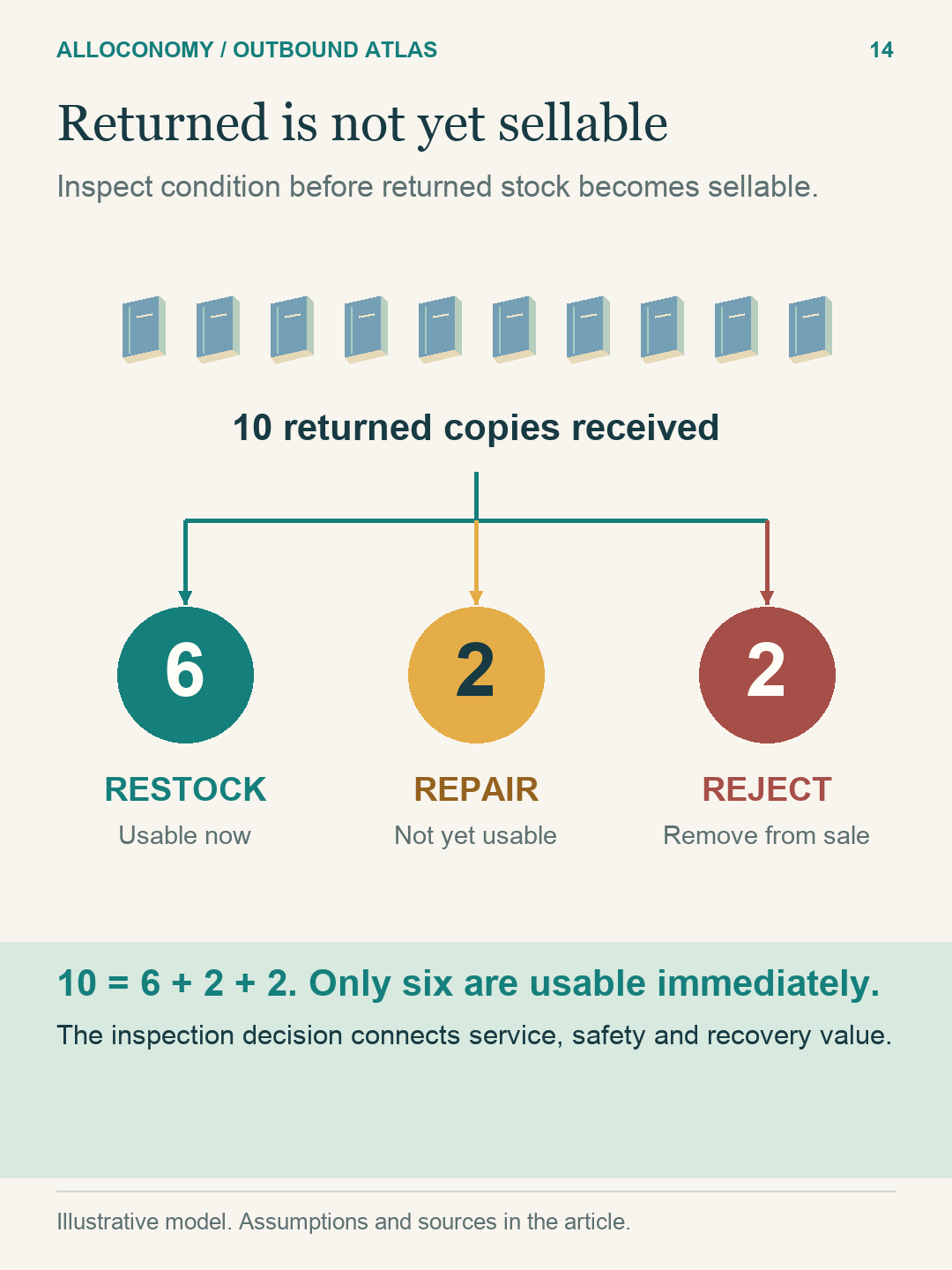
In an invented batch of ten returned books, inspection finds six suitable for restocking, two requiring minor repair, and two damaged beyond sale. Before inspection, none should be counted as newly available merely because a customer initiated a return. After inspection, only the six approved copies enter the sellable balance immediately. Repair outcomes need their own completion evidence.
The arithmetic is simple: 10 received = 6 approved + 2 awaiting repair + 2 rejected. The discipline is keeping identities, condition, ownership, and decisions linked. A refund decision and physical disposition may occur at different times under the applicable policy.
Returns change forward economics
Suppose a fictional product has an 8% return probability and each return causes an average $10 of incremental reverse-handling and value-loss cost, defined without double counting the original sale or refund. Expected return burden is 0.08 × $10 = $0.80 per original order.
That is a planning estimate. Product condition, reason, shipping distance, and policy can create a different distribution. The $10 must be built from a clear boundary; adding a refund and the entire lost product value carelessly can count the same loss twice.
Better packaging may reduce damage but increase material, cube, and handling. A smaller package may improve transport economics while harming protection. Evaluate the whole consequence rather than optimize one dimension.
Safety is part of feasible capacity
Workers, drivers, and customers are not residual variables in the cost calculation. Handling method, qualified labor, equipment condition, ergonomic exposure, safe access, and required breaks limit what work is feasible. OSHA's warehouse guidance identifies material handling, ergonomics, powered vehicles, and robotics as relevant hazard areas. S7
Mayan's printing machine should therefore leave the parcel model. It may need specialist lifting, appointments, access verification, installation boundaries, and a different return process. The correct lesson is to model the service required, not to force every product into the same flow.
Automation can remove some tasks and introduce new interfaces and failure modes. A successful demonstration does not establish safe operation across every product, worker interaction, or exception. Appropriate risk assessment and operational authority remain necessary.
Resilience has a price and a purpose
Spare capacity, alternative carriers, regional stock, and recovery procedures can preserve service during disruption. They also cost money. The relevant question is which failures they protect against and whether the protection is credible.
Two nominally independent facilities may share a power system, transport corridor, or weather exposure. Counting them as independent backups can overstate resilience. Plans should test common-cause failures and acknowledge when no feasible recovery exists.
Sustainability claims need an equally clear boundary. Fewer boxes or shorter miles do not alone prove lower total emissions. Vehicle type, load, energy source, failed attempts, materials, and reverse movements can change the comparison. This series makes no quantified emissions claim.
A credible returns promise needs recovery capacity
Returns extend the old inventory-control problem: a unit's condition determines what it can be used for. Better event visibility can connect the refund, inspection, repair, and resale records. This supports a more dependable return or refurbishment service only when the physical recovery work and its economics are in place.
What leaders should carry into the review
Maya should examine why books return and whether product information, packaging, or service caused avoidable damage. eComm Inc should connect the original order to its return, inspection, recovery, and customer resolution. A customer should receive a clear remedy without needing to understand the warehouse state machine.
For an investor, reverse cost, quality failures, and resilience spending help explain whether attractive forward margins persist. Try the idea: if returned inventory rises, has supply improved? Only if eligible units become usable in time and the cost of recovering them supports the decision. A pile of returns is not a replenishment plan.
Public sources and evidence boundaries
The calculations and operating scenes above are fictional teaching models. These public references support the limited background claims identified in the text. Checked 18 October 2026.
- S7: OSHA: Warehousing overview (living page). Hazard categories, not a complete safety assessment or operating certification.
Previous: The Business Models the Network Makes Possible · Next: Did We Really Save Money? · Return to the opening guide