Models That Respect Reality
A model that reuses the last book can simulate impossible success. Separate prediction, optimization, simulation, and control.

A demonstration replays a hundred customer orders. Every order finds the last nearby copy of Maya's book. The service chart looks excellent; the warehouse would need a hundred copies to make it true.
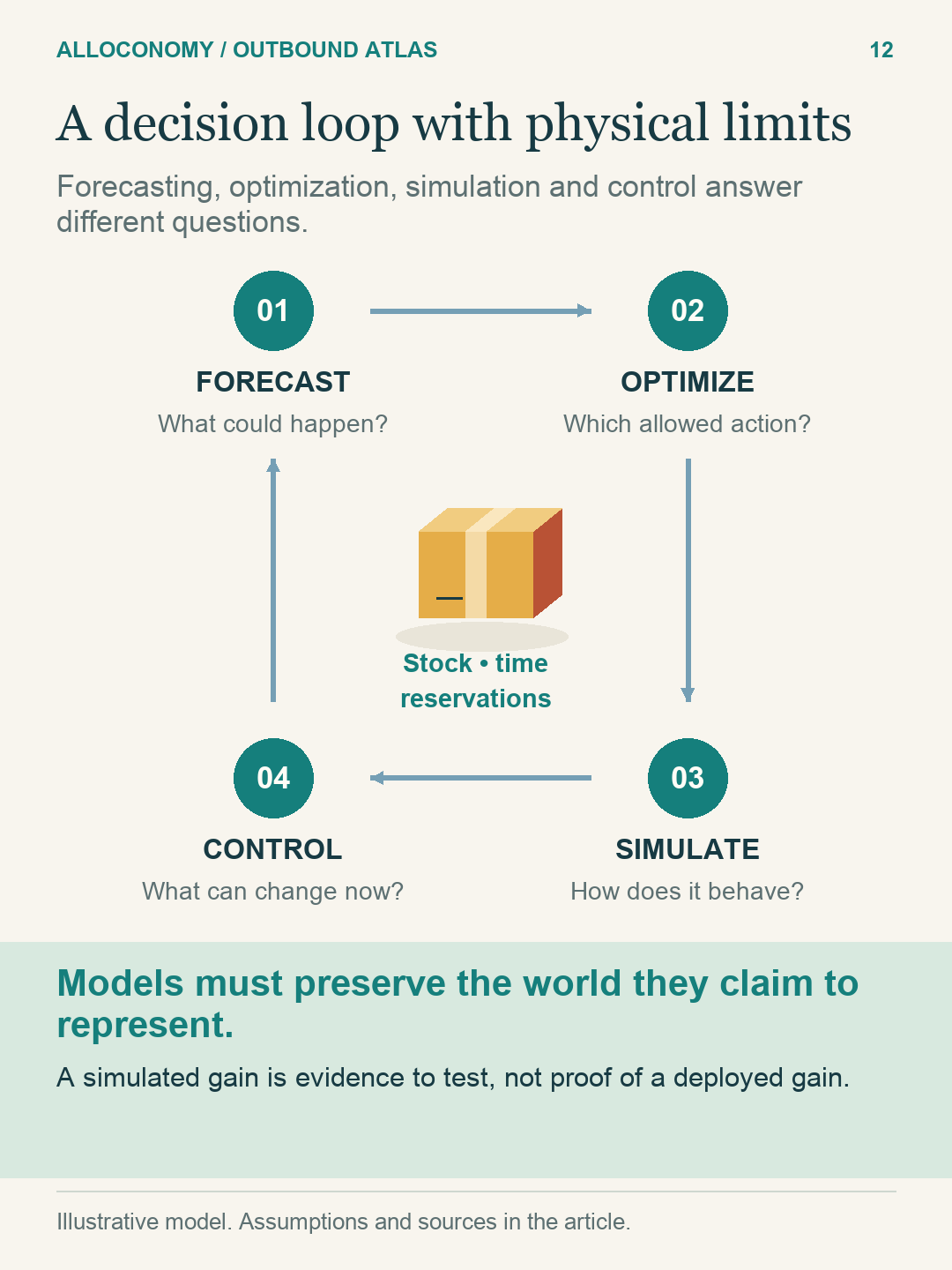
This is why an impressive model needs an unglamorous question: does its world obey the rules of the physical one? Forecasting, optimization, simulation, and control do different jobs. Together they can improve decisions, but a polished interface cannot compensate for inventory that is never consumed.
Four tools, four questions
| Tool | Its question | What it does not establish |
|---|---|---|
| Forecast or scenario generator | What might happen, and with what uncertainty? | What action is best |
| Optimizer | Which allowed action best meets the objective? | Whether the model captures reality |
| Simulator | How would a policy behave as events unfold? | Realized causal savings |
| Controller | What should change given new observations? | Permission to undo irreversible work |
View the full-size diagram →
A machine-learning model can estimate demand, travel time, or picking success. Operations research can select assignments and schedules subject to constraints. A simulator can test the resulting policy across scenarios. A controller can respond to observed exceptions. These techniques are complementary; none replaces correct inventory and capacity state.
A simulated book must remain consumed
Imagine replaying a hundred orders independently against a snapshot containing one local copy of Maya's book. Every order might “find” that same copy. The apparent result is excellent service from nonexistent supply.
A stateful simulation consumes inventory, reserves slots, advances time, and preserves work already in progress. Receipts, arrivals, releases, completions, departures, delays, and deliveries must occur in a feasible sequence. No negative stock, duplicated parcel, delivery before dispatch, or repeated use of the same slot is acceptable.
The model also needs an information boundary. It cannot choose yesterday's truck bookings after seeing tomorrow's demand. Decisions made before uncertainty is revealed must agree across scenarios with the same observed history. Otherwise it is a perfect-foresight benchmark, not an executable policy.
Average performance can hide the difficult days
In a separate invented comparison, Plan A costs $100 on 90% of days and $300 on 10%. Plan B costs $120 on 90% and $140 on 10%. Expected costs are $120 and $122. A wins on the mean; B has a much smaller bad-day cost.
For this two-outcome distribution, the average of the worst 10% of losses is $300 for A and $140 for B. That is the 90% conditional value-at-risk, or CVaR. With other discrete probabilities, calculating the tail can require a fraction of the mass at the boundary. Simply averaging outcomes strictly above a threshold can be wrong.
There is no universal instruction to choose B. The leader must decide which consequences require hard protection and what additional expected cost is justified. A cost-tail measure does not prove that delivery promises are met.
Newer capabilities need old-fashioned validation
Public research describes learned middle-mile scenario generation and potential benefits under uncertainty. A modeled or potential benefit is not the same as achieved cash savings. S8 Shared event standards such as GS1 EPCIS support structured visibility information; data interoperability does not by itself establish that events are complete or true. S10
Validate the baseline against service, backlog, utilization, and cost distributions, including tails. Hold back scenarios for evaluation after tuning. Stress correlated failures: a storm can slow roads and reduce attendance together. Historical flows reflect the old operating policy, so a learned generator may fail when the network design changes substantially.
What the leader should request
Ask for a small worked example, conservation checks, information available at decision time, held-out performance, fallback behavior, and the assumptions that reverse the conclusion. Require human authority for consequential policy and safety decisions. A language model explaining an exception is not evidence that it can safely release operational commands.
Maya benefits when shared events make inventory and exceptions understandable. eComm Inc benefits when models reveal the right decision rather than merely predict familiar data. An investor should separate a research result, a deployed capability, and a measured business outcome.
Try the idea: an optimizer says its answer is optimal. What remains unproved? That the candidate set is complete enough, the state is current, the constraints reflect the physical system, and the objective represents the business decision we actually intended.
Public sources and evidence boundaries
The calculations and operating scenes above are fictional teaching models. These public references support the limited background claims identified in the text. Checked 18 October 2026.
- S8: Navigating uncertainty in Amazon’s middle-mile network (2026-05-06). Research and potential benefits. No claim of realized savings.
- S10: GS1 EPCIS Standard 2.0.1 (version 2.0.1). Public event-data standard. Interoperability does not certify completeness or truth.
Previous: When the Plan Breaks, What Can Still Change? · Next: The Business Models the Network Makes Possible · Return to the opening guide