The Truck That Left Five Minutes Ago
The hundred-and-first parcel can trigger another truck. Follow the fixed costs, loading limits, and timed connections of the middle mile.

The first hundred parcels fit on the truck. The hundred-and-first may need another truck. Meanwhile, a cheaper connection that left five minutes ago is no longer an option for Maya's book.
That is the middle mile: movement between facilities, governed by departures as well as distance. Topology says which connections exist. Routing chooses a path. Scheduling says when that path can be used. Whole vehicles and missed connections make the economics jump rather than glide.
Count whole departures
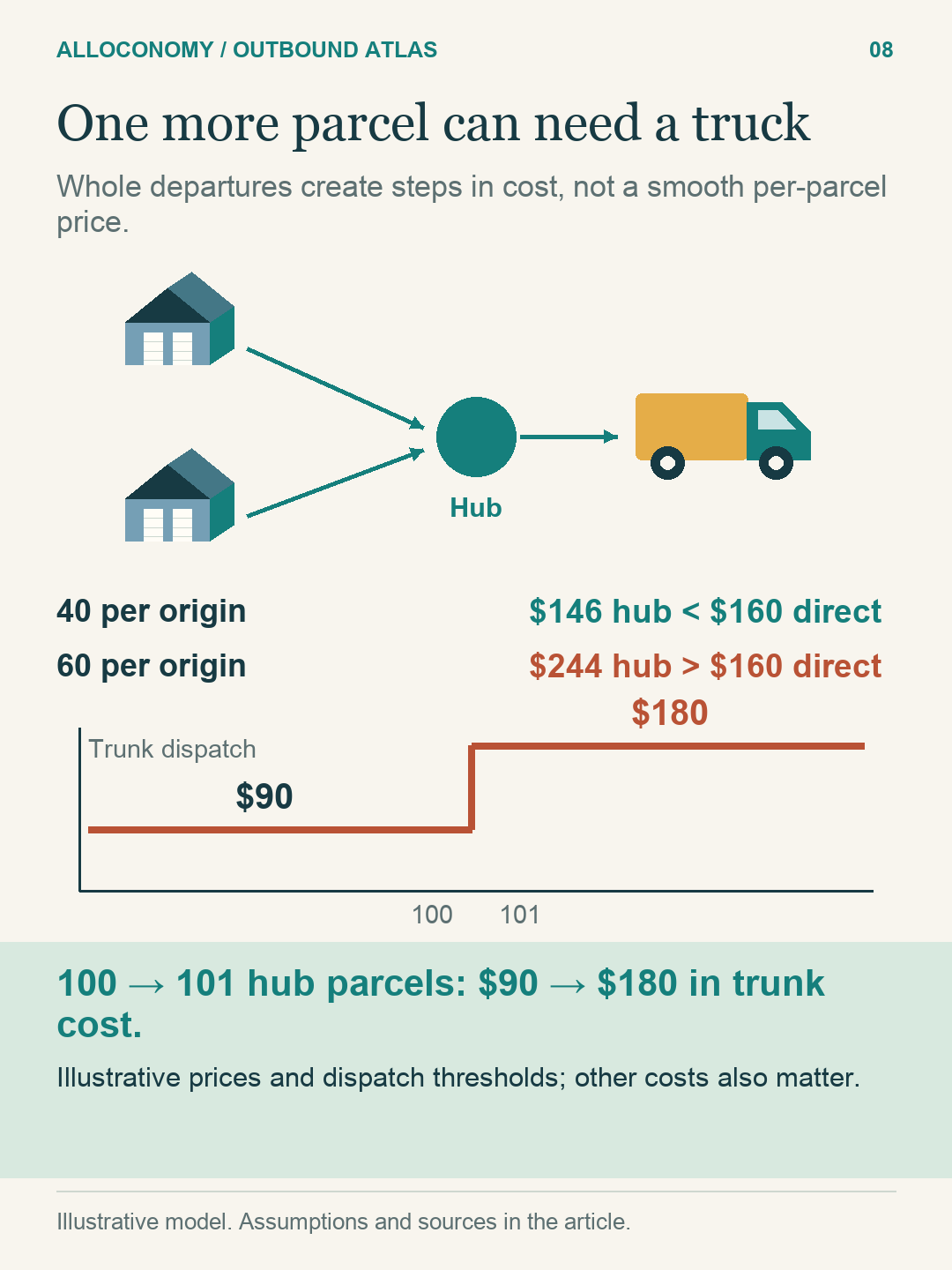
Two fictional fulfillment centers each have forty compatible packages for the same delivery station. Each truck holds 100 packages. A direct truck from either center costs $80. A feeder to a hub costs $20 per center; the hub-to-station truck costs $90. Hub handling costs $0.20 per package.
Assume all these paths meet the cutoff and package count is the binding loading limit; weight, geometry, labor, and other capacities are nonbinding.
| Plan | Calculation | Total |
|---|---|---|
| Both centers direct | 2 × $80 | $160 |
| Both through hub | 2 × $20 + $90 + 80 × $0.20 | $146 |
| One direct, one through hub | $80 + $20 + $90 + 40 × $0.20 | $198 |
An extra touch saves $14 because consolidation uses a different set of whole departures. “Fewer touches” is not a complete economic objective.
View the full-size diagram →
At sixty packages per origin, direct still costs $160. The all-hub plan needs two trunk trucks and costs $40 + $180 + $24 = $244. The preferred route family changes. These are standalone examples, not additions to the later book-order case.
The 101st package is not an average package
At 100 hub packages, the trunk costs $90. At 101, it needs two trucks and costs $180 under these assumptions. A smooth $0.90 allocation per package would predict $90.90, which does not pay for the required departure.
The route-specific jump is not necessarily the increase in the best network cost: eComm Inc may switch to direct trucks or another feasible path. Always compare the available alternatives again.
If a truck has already been irrevocably paid for and has compatible spare space, an extra package may add only handling expense. In next month's plan, the recurring truck commitment might be avoidable. Cost depends on the decision horizon and what is already committed.
A cheap connection that has left is unavailable
In the forty-per-origin case, packages are ready at 07:50. Feeders depart at 08:00, reach the hub at 09:00, and finish handling at 09:30. A 10:00 trunk reaches the station at 11:30; 30 minutes of local preparation makes a noon route just feasible.
If one center becomes ready at 08:05, that feeder is gone. Suppose no later feeder meets a compatible trunk, while both direct trucks can still reach the station in time. The $160 direct plan becomes the cheapest feasible option. Waiting to fill the feeder does not rescue a downstream route that has already left.
A time-expanded diagram represents a location at a particular stage and time. Transport moves it geographically; processing changes its state; waiting uses time and often space. No arrow can run backward through the clock.
Cube, weight, and real loading
A small book and a bulky light package use different resources. Cube means volume; weight is another constraint. Dimensions, stackability, handling restrictions, load order, and equipment can matter even when both scalar totals fit.
Right-sized packaging can release capacity, but average cube reduction does not prove that every load fits or that a truck was removed. The economic bridge must reach an actual avoided departure, productive redeployment, or another measured outcome.
Public research examines middle-mile uncertainty and scenario generation. Such research can inform planning methods without establishing that every proposed saving has been realized. S8
The scale advantage has a schedule
Consolidation is an old idea. Better forecasts and event visibility can coordinate it across more origins and departures. The resulting density can make a shared network attractive to sellers too small to fill their own vehicles. But volume creates an advantage only when compatible freight reaches compatible departures without breaking the service promise.
What to inspect before calling it a transport saving
Maya should learn which preparation errors or package dimensions force exceptions. eComm Inc should pair utilization with punctual dispatch, customer service, empty movements, and total cost. For an investor, denser lanes can support a cost advantage, but a volume increase near a dispatch threshold can temporarily raise cost sharply.
Try the idea: would a fuller truck always improve this network? No. Its departure time, downstream connections, and the extra costs needed to fill it determine whether the additional utilization creates value.
Public sources and evidence boundaries
The calculations and operating scenes above are fictional teaching models. These public references support the limited background claims identified in the text. Checked 18 October 2026.
- S8: Navigating uncertainty in Amazon’s middle-mile network (2026-05-06). Research and potential benefits. No claim of realized savings.
Previous: The Queue After the Robot · Next: The Last Mile Has More Than Miles · Return to the opening guide