When the Plan Breaks, What Can Still Change?
A connection missed by five minutes can deliver forty-five minutes late. Recover the plan while preserving inventory claims and the original promise.

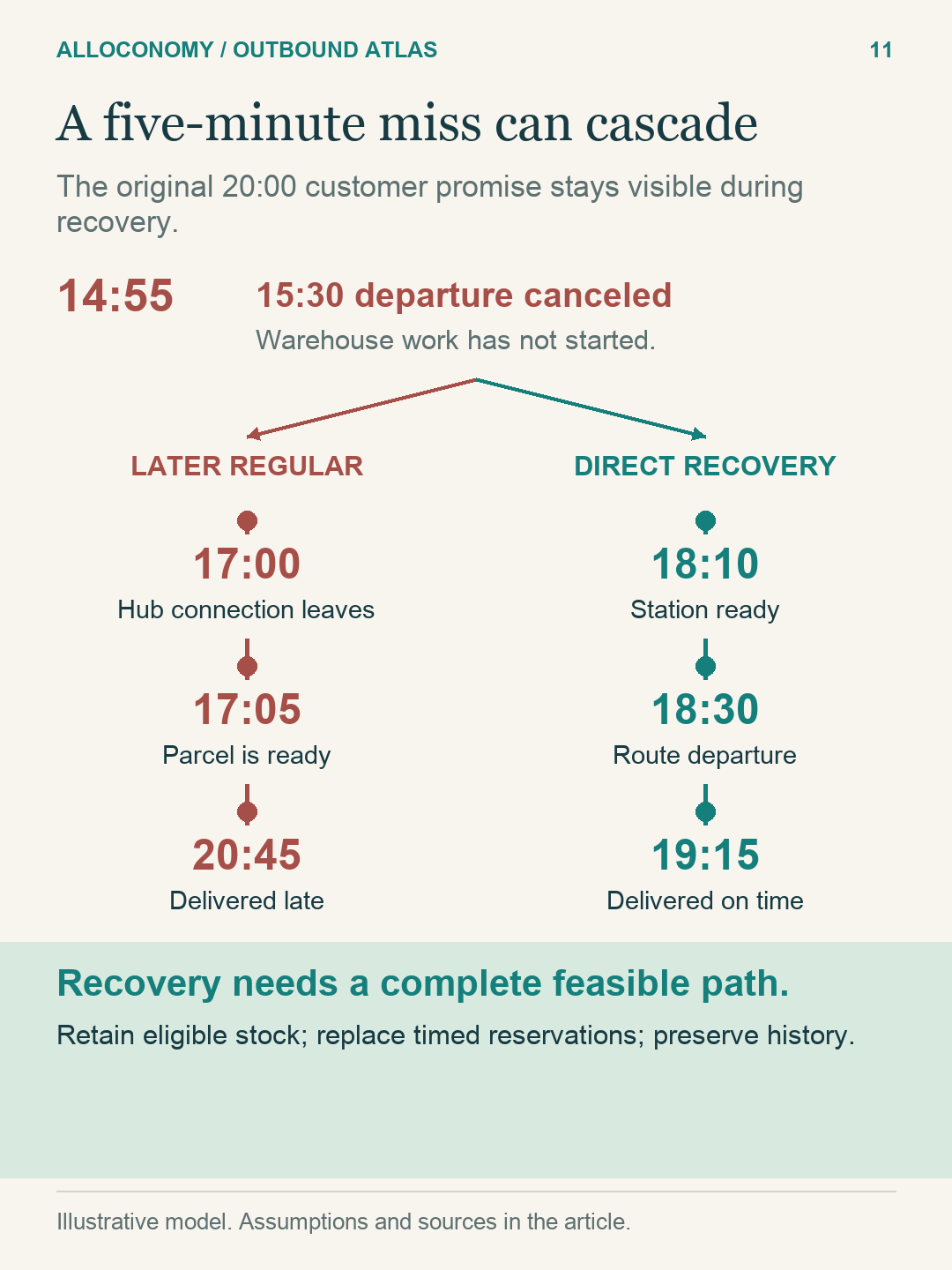
At 14:55, the planned 15:30 departure is canceled. My book and workbook have been assigned, but warehouse work has not started. There is still room to recover—provided the replacement plan fits the clock and the system can change its commitments safely.
The task is to preserve one order, one set of inventory claims, and the promise I accepted. A new route is useful only if it can replace the old one without losing the reservation or creating a second shipment.
Five minutes can become forty-five
Continue the book-and-workbook case from Part 10. The regular B path would be ready at 15:10, depart at 15:30, reach a hub at 16:20, finish hub work at 16:40, and catch a 17:00 connection. It reaches the station at 18:00, completes local preparation by 18:30, and reaches me at 19:15.
The replacement regular departure leaves B at 16:00, reaches the hub at 16:45, and finishes work at 17:05. It misses the connection by five minutes. The next hub departure reaches the station at 19:30; preparation finishes at 20:00 and delivery occurs at 20:45, after the accepted 20:00 deadline.
View the full-size diagram →
The late path is geographically connected. It is temporally infeasible for this promise.
A feasible recovery still needs an economic comparison
A direct B expedite can leave at 15:40, reach the station at 17:40, become route-ready at 18:10, and make the 18:30 route. The combined order now costs $9. A split recovery costs $8: A's book at $2 plus B's workbook expedite at $6.
The 60% chance of a later urgent book order remains. Combined recovery has expected cost $9 + 0.6 × $2 = $10.20. Split recovery has $8 + 0.6 × $8 = $12.80. The combined expedite is better by $2.60 within the stated feasible alternatives. An undiscovered route could change that conclusion.
This comparison uses remaining avoidable cost. Previously consumed work is sunk for the immediate decision, but cancellation fees, rehandling, and switching costs are not. A proposed $0.40 saving that requires $0.60 of rework is a loss.
Replace claims without spending inventory twice
The old plan already holds B's book and workbook. Replanning must recognize this order's own releasable claims while protecting everyone else's. Requiring a second workbook would incorrectly reject a valid replacement; releasing the first claim before securing the new plan could expose it to another order.
A reliable design commits the change against current state versions, or uses an explicit recovery process if several systems cannot update atomically. Retries need an identity so the same command cannot create another shipment. Partial failures need reconciliation and bounded exposure.
These are proposed generic control principles, not a description of private company software. Public planning-and-control work helps establish the broader coordination problem. S2
Every action has its own freeze point
An offered order, a reserved order, a released pick, a packed parcel, and a dispatched truck permit different changes. Once the truck leaves, choosing another source does not retrieve the parcel. A later transport leg might still change.
Frequent replanning is not automatically intelligent. Repeatedly moving work between nearly equal plans creates churn, confusing handoffs and consuming labor. A minimum benefit threshold, dwell time, or operational freeze can make control more stable. The tradeoff should be evaluated, not assumed.
Keep the original promise and the recovery history
The customer record should retain the accepted deadline, the exception, the revised plan, and the actual outcome. An operational plan can change while the customer obligation remains. If the promise cannot be kept, the system needs a truthful exception path and appropriate customer handling.
For Maya, this means understanding who handles disrupted orders and how stock remains attributable. For the network leader, it means testing state conflicts and partial failures, not merely route quality. For an investor, rescue spend and exception frequency reveal costs that a normal-day average can hide.
Try the idea: can an already assigned order be reconsidered? Sometimes. Assignment alone is not the freeze boundary. The answer depends on what physical work has started, what contracts are committed, and which changes remain executable.
Public sources and evidence boundaries
The calculations and operating scenes above are fictional teaching models. These public references support the limited background claims identified in the text. Checked 18 October 2026.
- S2: Maximizing the efficiency of Amazon’s own delivery networks (2022-10-14). Public approach and techniques being tested. Not proof that every discussed component was deployed.
Previous: Why Preserve the Last Nearby Book? · Next: Models That Respect Reality · Return to the opening guide