The Business Models the Network Makes Possible
One inventory pool can support several storefronts. Discover the operating commitments behind multichannel, local, and cross-border fulfillment.

Maya's next growth plan has three storefronts: a marketplace listing, her own website, and a shop abroad. Building a warehouse for each would burden a small book vendor with commitments she may not be ready to make. A shared fulfillment service could change what is possible.
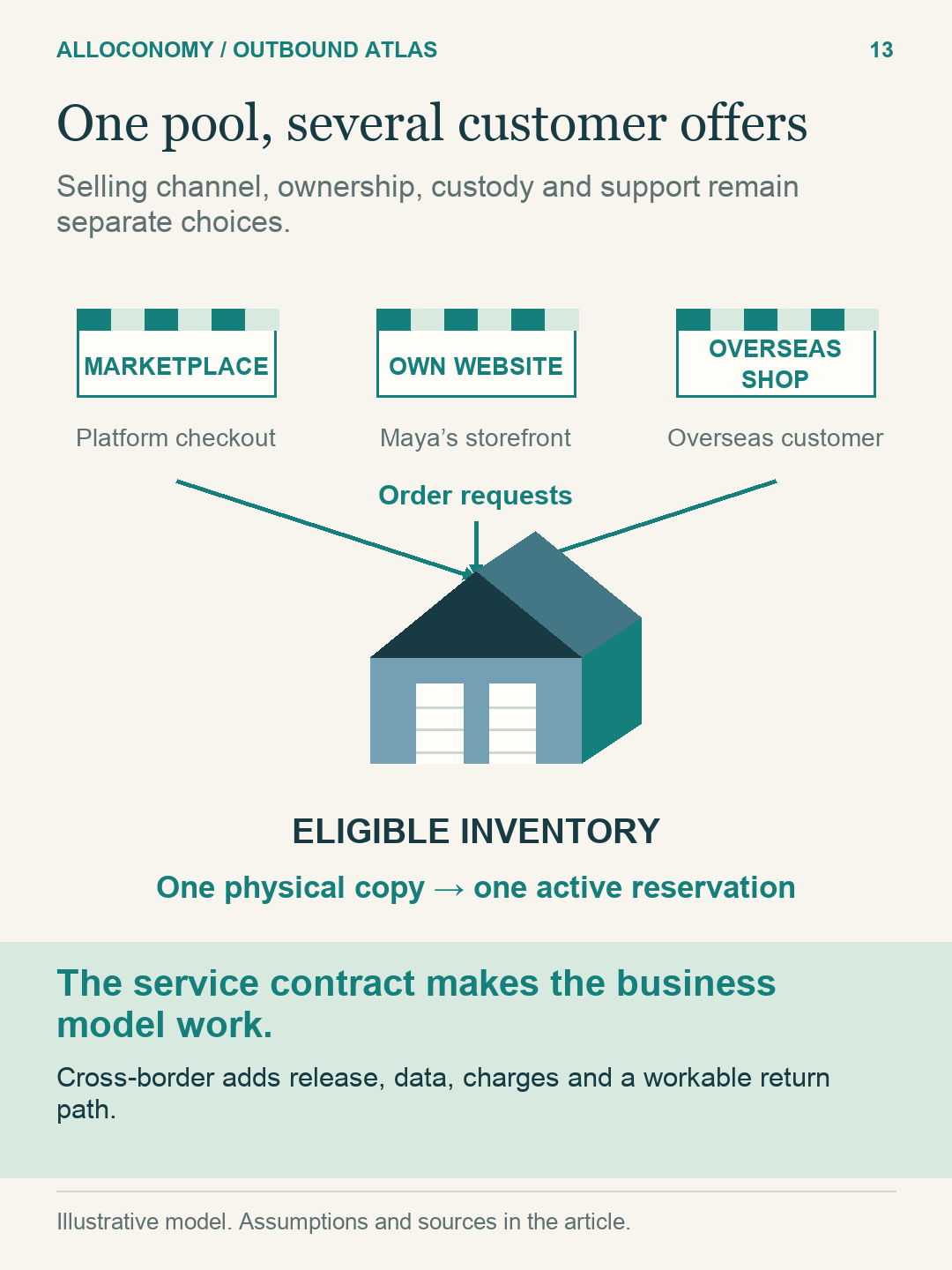
The attraction is easy to see. The difficult work is making several storefronts share the same physical stock without each promising the last book. Fulfillment becomes a business model when the service, inventory, responsibilities, and economics fit together.
Separate the storefront from the fulfillment job
| Model | Who sells to the customer? | Who performs fulfillment? | Main constraint to investigate |
|---|---|---|---|
| Retail resale | eComm Inc's retail business | eComm Inc or its provider | Retail inventory and service economics |
| Marketplace, seller fulfilled | Maya | Maya or her provider | Seller capacity, dispatch, tracking, and support |
| Marketplace, provider fulfilled | Maya | Contracted fulfillment service | Eligibility, fees, stock, service boundaries |
| Direct-to-consumer with shared fulfillment | Maya on her own site | Contracted network | Cross-channel reservations and customer support |
| Ship-from-store or pickup | Named merchant | Store operations | Accurate local stock and protected store workload |
View the full-size diagram →
Selling channel, inventory ownership, physical custody, and customer support are separate choices. The contract joins them. Our fictional table does not assign every responsibility universally; those details need to be read for the particular service.
A public example of multichannel fulfillment describes using one fulfillment network for orders from a seller's own website and other channels. It establishes that this service model exists, not that it is automatically cheaper for Maya. S11
One pool can serve several channels only once
If the marketplace and Maya's website both display the same last book, the shared inventory service needs to reserve it consistently. Otherwise a single pool becomes duplicated availability on two screens.
Integration also needs order identity, cancellation timing, package events, exceptions, refunds, and responsibility for customer support. A service fee may make sense if it avoids Maya's own fixed commitments or provides reach she could not economically build. It may be unattractive for slow, bulky, fragile, or frequently returned products. Compare the actual fee schedule and alternatives; our series supplies no current commercial quote.
The durable concepts are pooling, division of labor, and scale. Newer interfaces and event visibility make them easier to coordinate across digital storefronts. The business model works when the operational contract is dependable.
Cross-border selling has two distinct paths
Maya can ship each eligible order across the border from home-country stock, or move inventory abroad first and then fulfill locally. The first can reduce initial foreign inventory commitment but adds an international path to each customer promise. The second can improve local delivery while increasing stock, replenishment, and compliance exposure abroad.
Public fulfillment programs illustrate both cross-border delivery and placing inventory in overseas networks. Their eligibility and geographic terms are service-specific and can change. S12
Cross-border fulfillment adds product and party data, classification and origin information, customs release, taxes and duties, carrier handoffs, and a workable return path. The World Customs Organization's framework emphasizes advance electronic data and risk management. It is a framework, not a substitute for the rules of a particular country or product. S13
For teaching, write the cost boundary as product cost + preparation + transport + applicable nonrecoverable import charges + local fulfillment + expected returns and support. Declare whose perspective each item uses and avoid counting recoverable taxes as a permanent expense without justification. Exact treatment requires transaction-specific professional review.
Same-day, subscriptions, and long-tail selection
Nearby assortment and timed capacity can support faster delivery. Predictable subscriptions can improve planning, but customers may cancel or change quantities. A long-tail catalog can pool inventory centrally, accepting a different speed proposition. Pickup can consolidate handover but transfers part of the journey to the customer.
These are analytical mechanisms, not claims that every business using the label is profitable. Faster service can attract smaller baskets, which changes order economics. A low price can hide costs recovered through membership fees, seller charges, or another part of the business; that funding must be evidenced rather than assumed.
Mayan needs a different fulfillment proposition
Maya sells books through Stories Inc.; Mayan of Sapiens Inc. supplies printing machines. A machine may need specialist lifting, an appointment, verified site access, and an agreed boundary for installation. A provider serving Mayan is selling a different capability from the ordinary parcel service in our calculations.
This is why “outsourced logistics” is too broad a purchasing specification. Both vendors can buy specialist fulfillment, but they should evaluate the service against different failure modes, resource needs, and customer outcomes. The examples in this series price books and parcels; they do not quote machine-delivery economics.
What changes for Maya
Maya should compare complete customer outcomes and total obligations, including inventory funding, integration, exceptions, and returns. The network leader should protect shared capacity across channels rather than allow each storefront to promise the same resources independently.
An investor should ask which capabilities are difficult to reproduce and whether their value exceeds the assets and operating costs needed to maintain them. The business model is enabled by a dependable system of commitments—not simply by connecting a storefront to a warehouse.
Public sources and evidence boundaries
The calculations and operating scenes above are fictional teaching models. These public references support the limited background claims identified in the text. Checked 18 October 2026.
- S11: Amazon Multichannel Fulfillment (living page). Evidence for service model existence. Fees, eligibility and promises must be checked for actual use.
- S12: Sell worldwide with FBA (living page). Illustrates export fulfillment and overseas inventory placement. No current country list or fee adopted.
- S13: WCO cross-border e-commerce framework (framework and living collection). Advance electronic data and risk management. Not transaction-specific legal or tax guidance.
Previous: Models That Respect Reality · Next: The Journey Back: Returns, Safety, and Resilience · Return to the opening guide