The Queue After the Robot
A faster robot can leave customers waiting. Learn how work mix, bottlenecks, queues, and departure deadlines determine real throughput.

A robot brings Maya's book to the worker faster. The demonstration is impressive. Then the book waits for packing—and misses the same truck it missed yesterday.
To improve fulfillment, faster retrieval must become more complete orders ready before departure. Finding, picking, assembling, packing, and sorting are connected operations. The capacity that matters is the output the whole sequence can sustain at the required quality and service.
Capacity depends on the mix
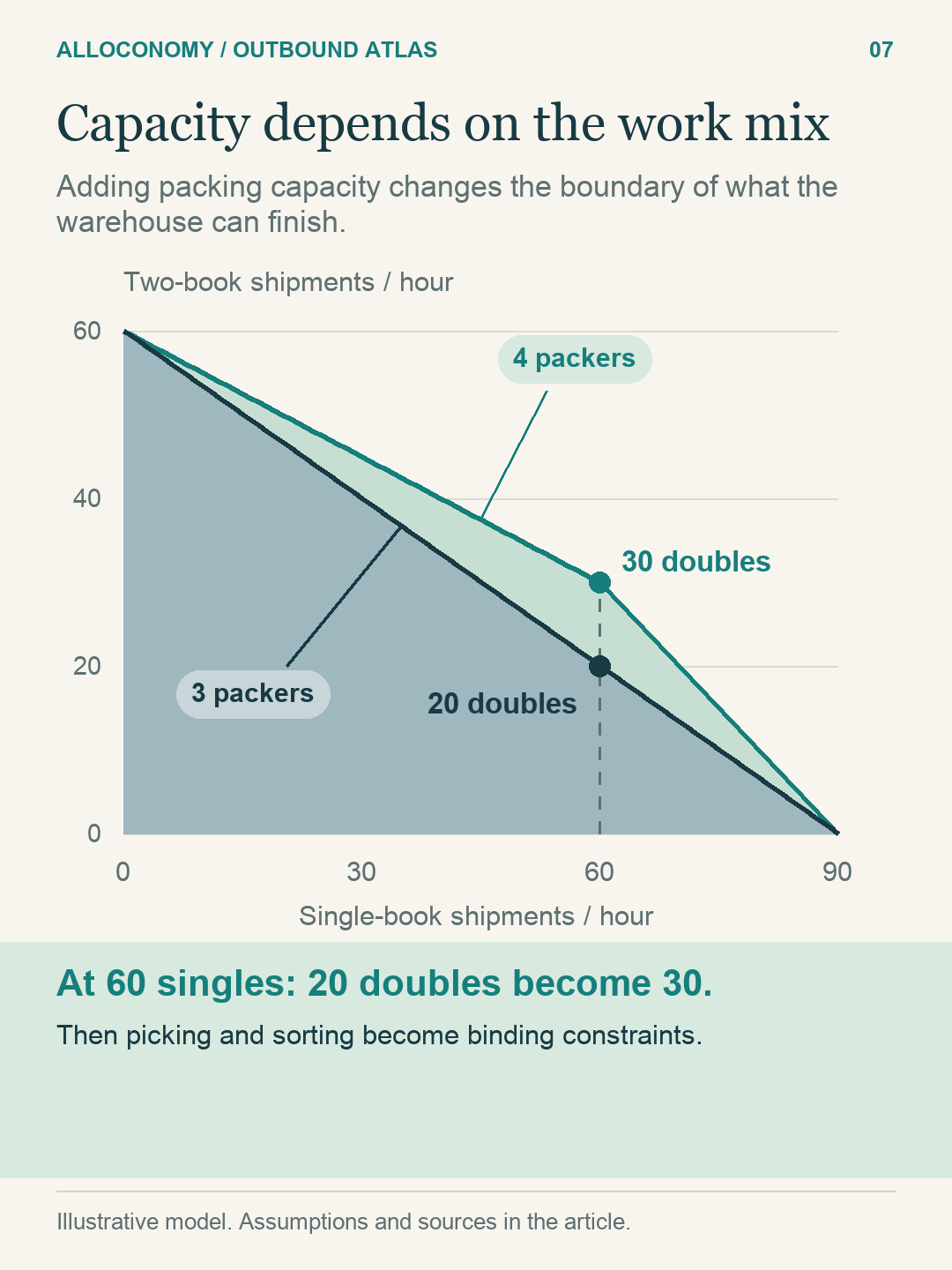
Suppose eComm Inc has two work types: single-book shipments, called s, and two-book shipments, called m, measured per hour. Each shipment becomes one package. Our fictional resource limits are:
- Picking: s + 2m ≤ 120 units/hour.
- Packing: 2s + 3m ≤ 180 productive labor-minutes/hour.
- Sorting: s + m ≤ 90 packages/hour.
At 60 single-book shipments per hour, picking permits 30 doubles, packing permits 20, and sorting permits 30. The complete flow is limited to 60 singles + 20 doubles = 80 packages containing 100 books per hour.
View the full-size diagram →
Add one available trained packer, without reducing another operation, and packing rises to 240 minutes. Now 30 doubles fit, producing 90 packages and 120 books. Another packer alone adds no output at this mix: picking and sorting now bind. If the worker came from picking, recompute that capacity before claiming the gain.
These are steady sustained rates in an operating pipeline. They do not say an empty facility can start and finish that many orders in its first hour.
Faster work can create more waiting
Consider a separate deliberately simple queue: one server, random Poisson arrivals, exponential service times, a stable first-come-first-served system, and unlimited waiting space. Mean time in the system is 1 ÷ (service rate − arrival rate).
At service capacity of 100 jobs/hour and arrivals of 90, that is 0.1 hour, or six minutes. At arrivals of 98, it becomes half an hour. The service itself did not slow; waiting grew as spare capacity vanished. Real facilities have multiple workers, waves, breaks, finite buffers, and priorities, so this formula is an intuition aid rather than a calibrated warehouse forecast.
Little's law provides another check: average work in process equals throughput multiplied by average residence time, with stable, consistent boundaries. At 120 shipments/hour and 15 minutes average residence, average occupancy is 30 shipments. Thirty slots do not necessarily cover the peak. Using picked units with shipment residence time would mix populations.
Robotics changes a constraint
Goods-to-person systems bring inventory to workers; other robots move carts, identify items, or manipulate packages. These tasks have different interfaces and failure modes. Public descriptions of robot capabilities show why “automated warehouse” is too broad a label. S6
A robot that improves retrieval can expose an assembly bottleneck. Suppose two orders each need X and Y. Picking both X units together may reduce travel, but if each partial order occupies a staging slot and only one slot exists, the batch is infeasible. Completing urgent orders and protecting downstream space can matter more than minimizing visits.
The newer capability should be explained alongside the enduring flow constraint it changes. Buying automation without changing its neighboring processes can merely move the queue.
Work backward from departure
A 10:30 truck needs 15 minutes of final loading, and sorting and movement take ten minutes before that. Packed-ready cutoff is 10:05. If picking, assembly, and packing take 35 minutes, latest deterministic release is 09:30. Add uncertainty protection where justified; an average duration is not a guarantee.
Backlog obeys next backlog = current backlog + arrivals − completions. Completions cannot exceed available work or the actual operation's capacity. Preserve sequence: a parcel cannot be sorted before it is packed.
What automation must earn
The enduring concept is bottleneck management. Modern robotics can alter a task's speed, labor requirement, or reliability; the benefit emerges only when the rest of the flow can use that change. This can support later order cutoffs or more orders from the same building. Those are service propositions to demonstrate, not consequences to assume from a faster pick.
The leadership question
Maya benefits when packaging and product information reduce preventable exceptions. eComm Inc should examine queue age, correct completions, quality, safety, and departures alongside local productivity. OSHA identifies material handling, ergonomics, industrial trucks, and robotics among warehouse hazards; speed targets do not resolve those risks. S7
For an investor, the useful automation question is what additional completed service or avoidable cost the system produces after integration, maintenance, and capital expense. Which bottleneck moves next, and what evidence shows that the customer journey improved?
Public sources and evidence boundaries
The calculations and operating scenes above are fictional teaching models. These public references support the limited background claims identified in the text. Checked 18 October 2026.
- S6: Amazon uses robots that sort, lift, and carry packages (living page). Company descriptions of distinct robot tasks. No independent safety or productivity attribution adopted.
- S7: OSHA: Warehousing overview (living page). Hazard categories, not a complete safety assessment or operating certification.
Previous: One Order, Several Plans · Next: The Truck That Left Five Minutes Ago · Return to the opening guide