A Network Is More Than a Map
The closest warehouse can be the slowest source. Learn to read a fulfillment network as capabilities and timed connections.

Maya points to the warehouse closest to my house. Her books are there. Why send my order from a building three times farther away?
Because a nearby building can be the wrong kind of building—or the right kind at the wrong time. It may hold bulk stock without preparing individual orders. Its packing queue may extend beyond the last compatible departure. The first lesson in network design is to ask what a location can do before asking how close it is.
A building has capabilities, not just coordinates
A fulfillment center stores eligible inventory and prepares customer orders. A sort center groups parcels toward destinations. A cross-dock transfers goods with little storage. A delivery station prepares local routes. A bulk storage node can hold replenishment inventory economically while lacking the ability to dispatch a single book to me.
Real facilities may combine roles. Our model should describe the relevant transformations: pallet to cases, units to packages, mixed parcels to destination groups. The label on the building does not prove those transformations are available at a particular time.
Mayan's printing machine demonstrates the boundary. A site may have abundant book-picking capacity but no safe way to handle a heavy machine. Product compatibility is part of capacity.
Three maps must agree
View the full-size diagram →
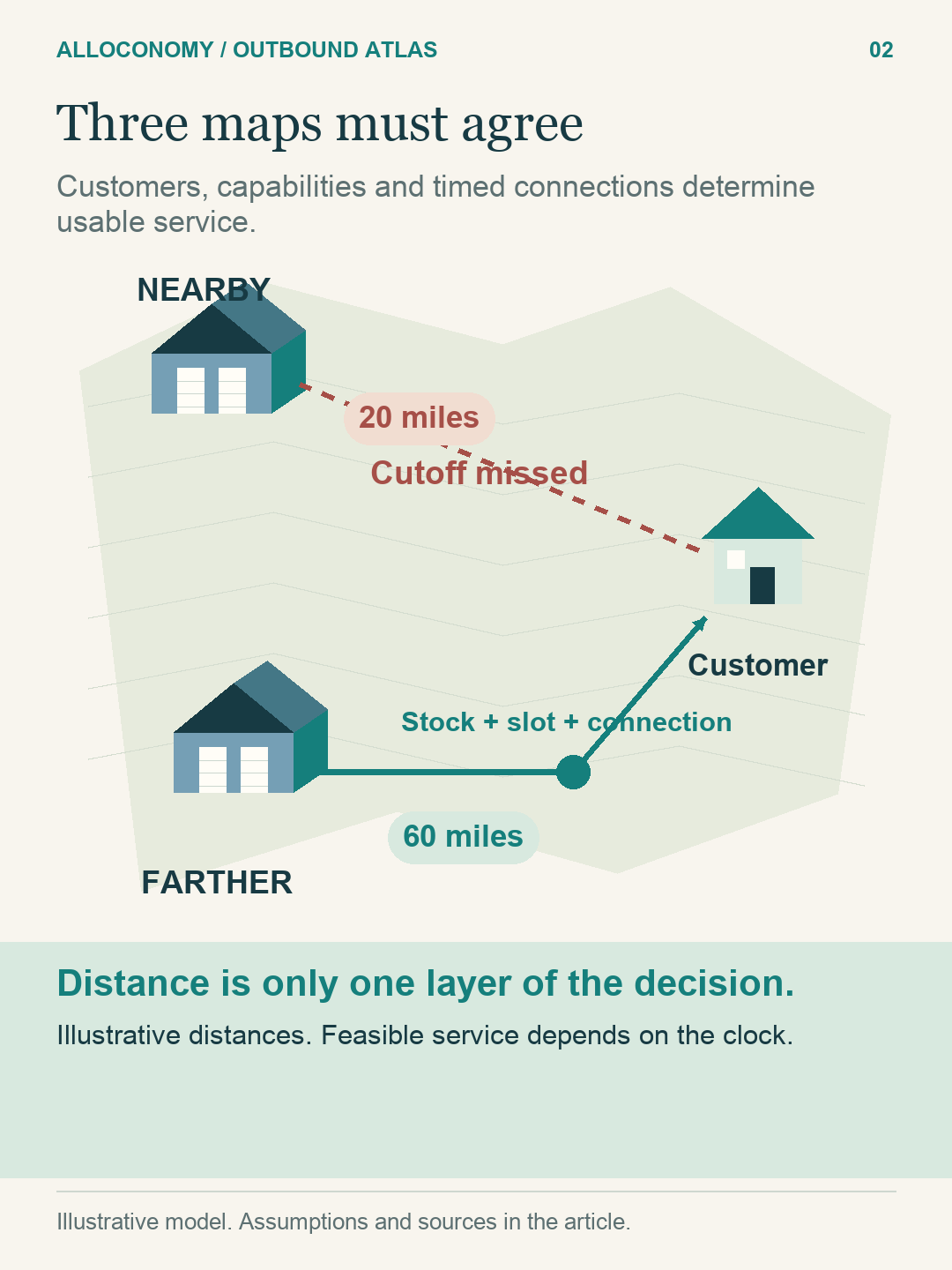
The customer map says which destinations a region serves. The capacity map says which sites and timed resources support that demand. The connection map says how material can actually move. A regional boundary alone creates neither inventory nor a departure.
Consider an invented afternoon. North FC is 20 miles away but cannot finish packing before its last compatible departure. South FC is 60 miles away, has an eligible book ready, and can connect to the evening delivery route. South is farther and faster. This example makes no claim about actual roads or facility locations.
Pooling and proximity pull in different directions
Central stock can share uncertainty across customers. Regional stock can shorten travel and concentrate routine flows. Regionalization can also duplicate slow-moving inventory and reduce the options available to handle an unusual order. A sensible design often needs both local service and explicit exceptions.
Suppose two areas each sometimes want ten copies of Maya's book. If one wants ten exactly when the other wants none, a central pool of ten meets combined demand, provided delivery time permits. If both want ten together, twenty are needed in that high-demand scenario. The same individual demand ranges can create different network needs. Correlation and time determine whether pooling helps.
A mathematical caution matters here. If an exact optimizer has the same objective, complete information, and unchanged costs, removing choices cannot improve its best achievable answer. A restricted regional design can help a real organization by changing coordination, schedules, operating costs, or the quality of approximate decisions. Those changes should be explained rather than calling restriction inherently optimal.
Measure localization with a declared population. If one two-item order has one local item and one remote item, its local-item share is 50%, but its entirely-local-order share is 0%. Neither is the same as shipment share. Keep the region-map version fixed when comparing periods, or disclose the change.
Design for the service you intend to sell
Network design connects capital commitments to a customer proposition. A subscription promising rapid delivery needs enough eligible local assortment and reliable capacity. A national specialty-book service may accept slower delivery to pool a long tail. A machine-delivery business needs handling and appointment capabilities that a book network does not.
Leaders should compare candidate networks across normal days, peaks, and disruption scenarios. Include rent or asset commitments, inventory duplication, transport, labor, service, and transition costs. A topology that looks cheaper at steady state may be expensive to reach or fragile during migration.
Public reporting describes a historical move toward connected regional fulfillment networks at a large retailer. It establishes a dated operating approach and the coordination problem behind it. It does not provide a complete current network map or validate our fictional North and South example. S3
From a network map to a service decision
The enduring idea is specialization: different facilities do different work. Better visibility can make those capabilities easier to coordinate, but an additional dot on the map still needs eligible inventory, labor, and departures. This is how a network becomes a credible rapid-delivery service—or an honest slower service for a broader catalog.
What Maya and the network leader should ask
Maya should ask where her books become eligible for each advertised service, how replenishment reaches those places, and what happens to slow inventory. The network leader should ask which constraint binds by product, location, and interval. A daily capacity total is insufficient if the promised orders all need the same afternoon wave.
For an investor, shorter distance is an operating observation. Its economic value depends on the cost of regional assets, inventory, exceptional movements, and the revenue or retention those capabilities support. The map alone cannot establish a return on capital.
Try the idea: if South's compatible departure disappears, does it remain the better source? No. Recompute the feasible path. A useful network is a set of capabilities and timed options, not a collection of reassuring dots.
Public sources and evidence boundaries
The calculations and operating scenes above are fictional teaching models. These public references support the limited background claims identified in the text. Checked 18 October 2026.
- S3: How Amazon reworked its fulfillment network to meet customer demand (2023-07-24). Dated regionalization account; not a current network map or isolated causal savings estimate.
Previous: From Click to Doorstep: How a Delivery Promise Becomes Real · Next: Before the Order: Which Books Belong Nearby? · Return to the opening guide