Advertising Alloconomy, Part 11: Who Gets the Streaming Ad Dollar?
Identify the authorized seller of a streaming break, then separate buying, insertion, playback, and billing.
At the screen
Maya opens Netflix on an advertising-supported plan and presses Play. In this teaching scene, Northstar has bought a direct CPM campaign from the authorized seller for the eligible Netflix inventory. The opportunity is a timed place before or within a program. Our main money route is this direct purchase; we will then change the buying route to a DSP-mediated sale without changing the basic viewing experience.
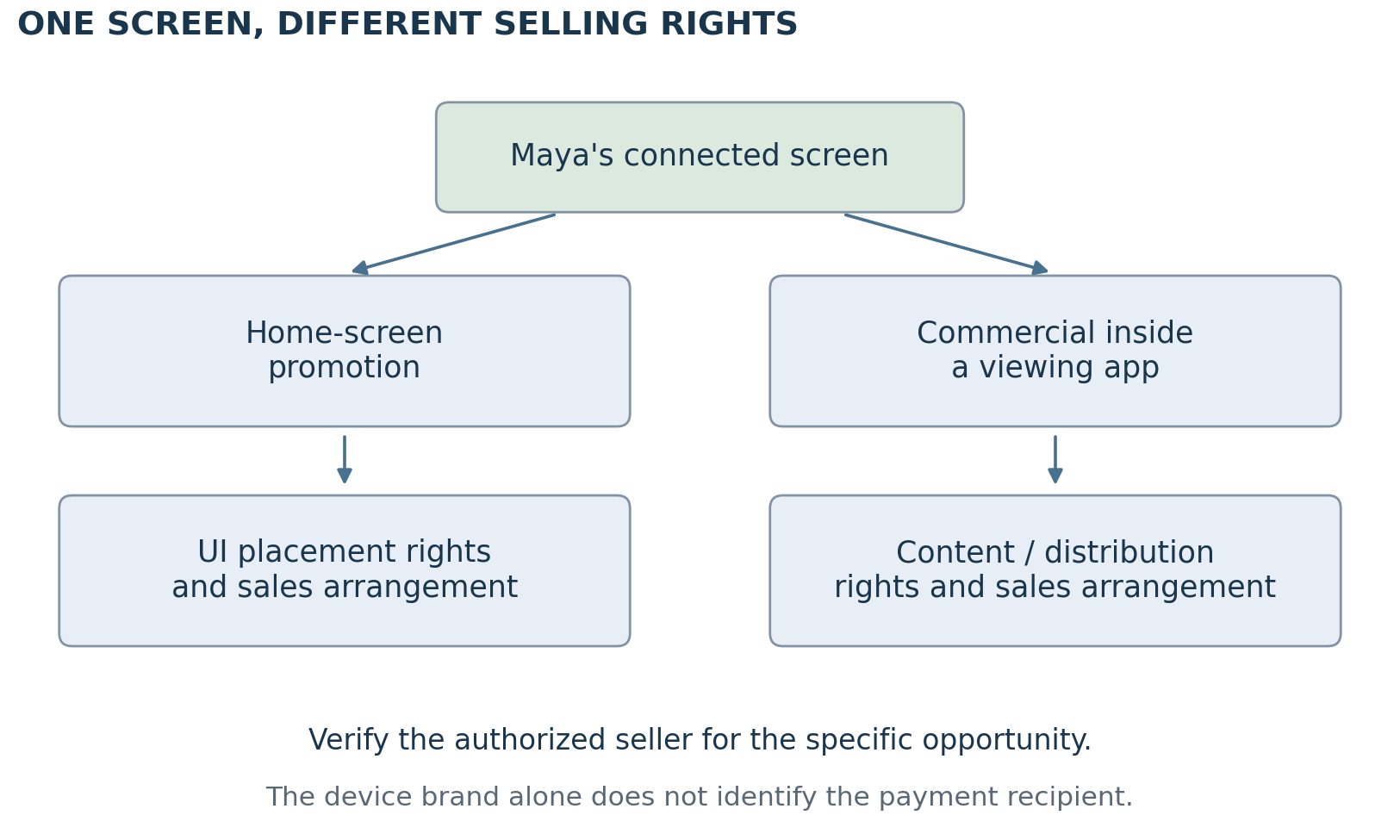
The first ownership question is precise: who has the right to sell this break? A television manufacturer, an app distributor, a content owner, and a streaming service can contribute to one viewing session. The logo on Maya's device does not assign the advertising proceeds among them.
Advertising Alloconomy · Placement map · Part 11
Streaming TV · Commercial break
Northstar buys an eligible commercial opportunity from the party authorized to sell it.
Read from the advertiser toward the audience. Connections show roles in the chosen route, not cash transfers or request timing.
Owning the television, app or programme does not by itself establish who sells the break.
This is a simplified programmatic buying route. A direct reservation is another route; neither route determines whether insertion is client-side or server-side. Ad-pod rules, delivery services and rights contracts vary. The device distributor is not automatically a payee for every in-app commercial.
Simplified teaching map. Company boundaries and contracts vary; one box does not mean one company or one fee. Dollar allocations appear in the separate money-flow diagrams. Those figures are indicative; actual business economics require case-by-case analysis.
Behind the placement
The seller has delivery commitments to satisfy. An ad decision may need to fill a whole pod with several commercials while respecting total duration, compatible creative, frequency, geography, and applicable competitive-separation rules. These are conceptual requirements of a working pod; platforms need not expose identical controls.
| Role and examples | Work that earns its place | What must replace it |
|---|---|---|
| Authorized streaming seller: Netflix, Prime Video, Peacock, Disney | Control eligible viewing inventory and sales rights | Another authorized source of the intended viewing attention |
| DSP when contracted: The Trade Desk, DV360, Amazon DSP | Select and pace purchases across supported sources | Direct buying capability or another buying platform |
| Applicable selling, serving, or insertion services: Magnite, FreeWheel, Google Ad Manager, Publica | Coordinate deals, pods, or ad delivery | Equivalent machinery under the relevant rights arrangement |
| Content owner and distributor | Supply content access and monetization rights | Replacement content and permission to monetize it |
| Measurement and event processing | Reconcile playback with billing and campaign evidence | Trustworthy records accepted by buyer and seller |
Buying the commercial and inserting it are separate jobs. A sales team can reserve delivery; a DSP can purchase an eligible deal. After selection, client-side insertion has the player switch between content and ad resources. Server-side insertion can construct a stream or manifest incorporating selected ads. Dynamic insertion means selection can occur for the particular opportunity; it does not establish an open-auction purchase.
VAST provides structured delivery instructions and tracking information in interoperable systems. The creative file, its metadata, playback signals, and the invoice remain distinct. VAST
Netflix's engineering account makes that separation tangible: playback-related requests, VAST responses, client telemetry, tracking, and event processing feed campaign systems. Rapid operational signals serve different needs from offline impression curation supporting billing and revenue recognition. The account also discusses a Microsoft-era pilot; its historical components should not be combined into an asserted diagram of today's exact system. Netflix event processing
The charge and the dollar
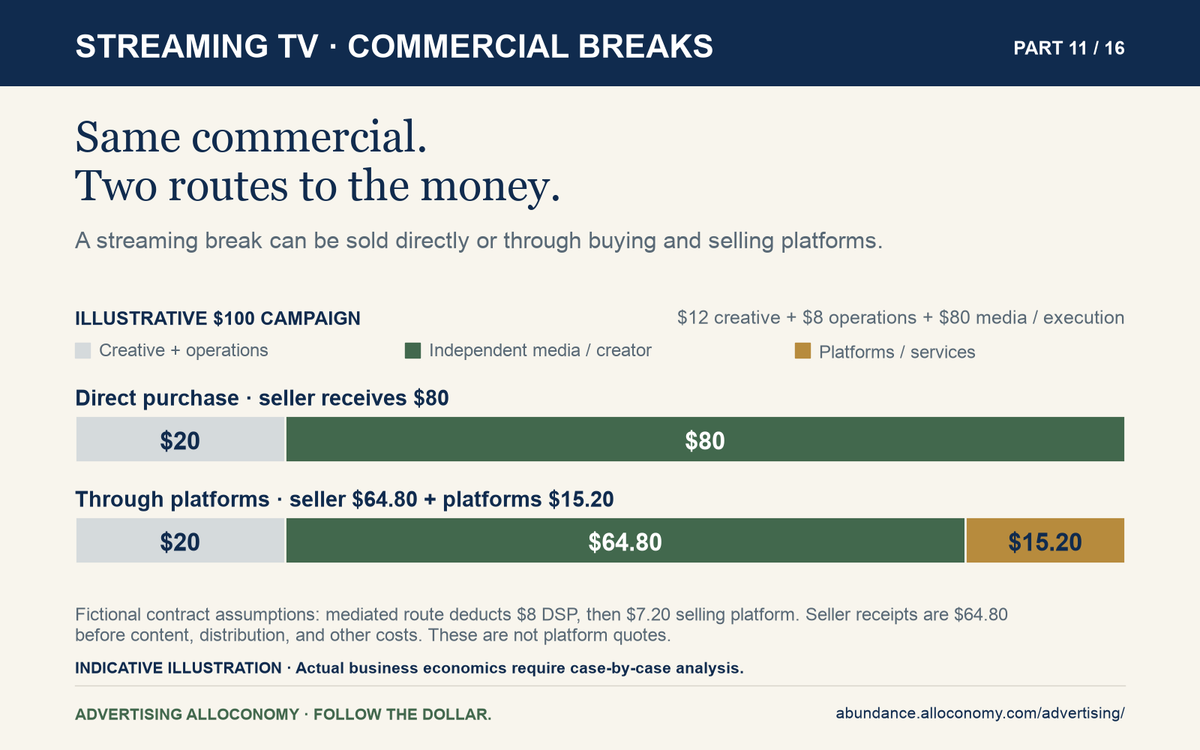
Suppose the direct campaign buys 4,000 accepted impressions at a fictional $20 CPM. Northstar's media allocation is $80. Creative receives $12 and operations $8 under our common teaching boundary.
Follow the dollar
A direct streaming purchase
Teaching campaign: 4,000 accepted impressions at $20 CPM.
Each ribbon ends at a recipient or disclosed bundle. Widths show final allocations, not the order of payments.
Exact amounts and accessible table
| Recipient | USD from original $100 |
|---|---|
| Creative | $12.00 |
| Campaign operations | $8.00 |
| Authorized streaming seller | $80.00 |
| Total | $100.00 |
Total external campaign expense$100.00
The per-ad division of content, distribution, serving, and retained contribution is undisclosed. Each amount is also its percentage of the original $100. These are final allocations, not a payment sequence.
The authorized streaming seller receives $80 before its costs and contractual obligations. Content, distribution, ad-serving, or other payments may follow. Public evidence does not supply one universal per-ad breakdown for Netflix, Prime Video, or the PS5 viewing service, so the gray bundle stops at the seller's gross receipts.
The buyer and seller reconcile accepted delivery under their agreement. Winning an opportunity, stitching a segment, receiving a playback beacon, and accepting a billing record are separate events. A successful server response does not prove someone watched the television. Completion, reach, frequency, surveys, later visits, sales, and experiments each answer different questions; a completed video is not a completed purchase. Netflix event processing
What changes on another route
Change the buying path. A DSP-mediated purchase can reach similar viewing inventory while adding separately contracted recipients. Assume $8 of the $80 execution pool goes to the DSP, leaving $72. A hypothetical selling-platform deduction of 10% of $72 is $7.20, leaving $64.80 for the authorized streaming seller.
Follow the dollar
A streaming purchase through platforms
Teaching assumptions: $8 DSP fee, then 10% of the remaining $72 for the selling platform.
Each ribbon ends at a recipient or disclosed bundle. Widths show final allocations, not the order of payments.
Exact amounts and accessible table
| Recipient | USD from original $100 |
|---|---|
| Creative | $12.00 |
| Campaign operations | $8.00 |
| DSP | $8.00 |
| Selling platform | $7.20 |
| Streaming seller receipts | $64.80 |
| Total | $100.00 |
Total external campaign expense$100.00
These are not quoted platform fees. Seller receipts still contain undisclosed costs and obligations. Each amount is also its percentage of the original $100. These are final allocations, not a payment sequence.
Now $12 + $8 + $8 + $7.20 + $64.80 = $100. Both trading fees are assumptions, not quoted Netflix, Amazon, Sony, DSP, or SSP rates. The buyer's all-in execution eCPM includes them; compare prices on the same basis. ANA's non-CTV sample does not establish these television fees.
Netflix's November 2025 account described Ads Suite in all twelve then-supported advertising countries and named several DSP partners. Its August 2026 US update described further programmatic buying options and pause-ad availability. A Microsoft-exclusive buying diagram is therefore historical; supported formats and deals can still vary by partner and market. Netflix's third season of ads Netflix August 2026 update
Change the service or format. Amazon's Streaming TV offering includes full-screen non-skippable video across supported Amazon and third-party supply. Its sponsored-console route documents CPM charging; DSP access has its own campaign and service arrangements. The earlier Sponsored TV name is included in the broader offering. Fire TV Channels content belongs to this streaming tour, while Fire TV home-screen tiles belong to Part 12. Amazon Streaming TV
Netflix pause ads become eligible when Maya pauses; title sponsorships and QR interactions create further experiences with their own commercial terms. None inherits the main case's $20 CPM merely because it appears in Netflix.
Change the distributor or rights arrangement. On 31 August 2026, Sony announced US Live TV on PS5, with free linear channels and on-demand programming, naming Publica and PubMatic as core advertising-technology partners. This establishes a concrete television experience through a console, not advertising inside every PlayStation game. It does not disclose every impression's vendor sequence or revenue split. The same channel on another distributor may have different sellers, targeting, or inventory rights. Sony's PS5 launch
What this changes for you: streaming commercials
The screen carrying the commercial and the business entitled to sell the break need not be the same.
If you are Maya
Assess the viewing bargain as a whole.
Maya can compare the subscription price, content, and interruptions with the alternatives actually available to her. Repeated commercials are a cost to her experience. The television or device logo alone does not reveal which seller controls a particular break or which company can change its advertising terms.
If you work for the advertiser
Verify the rights and the delivered audience.
Before comparing direct and intermediated prices, establish that each route can sell the intended inventory. Examine qualifying delivery, duplicated household reach where measurable, and outcome evidence. The route leaving the seller more of the illustrative $80 is not automatically the route giving Northstar better incremental reach or contribution.
If you work in a business earning the ad dollar
Make contractual and technical ownership agree.
Streaming, distribution, and platform teams should know who can sell each opportunity and who handles insertion, reconciliation, and settlement. A supplier can justify its fee through useful demand or reliable execution. A higher gross bid is of little use when the rights are wrong or the commercial fails to become billable.
If you are an investor
Follow the rights before projecting the revenue.
Examine inventory control, revenue-sharing and distribution obligations, content costs, and dependencies on major partners. An inventory share is not necessarily the same share of campaign cash. A large device footprint or attractive ad price cannot, by itself, establish what a particular business retains.
Decision to take away: compare two streaming offers only after identifying the authorized seller, the rights included, and the evidence of incremental audience value.
Reconstruct the journey
Netflix's official format gallery separates commercials, pause ads, title sponsorships, and QR-code interactions. Its Emily in Paris example with Shop with Google is a published sponsorship illustration, not a live stream inspected here.
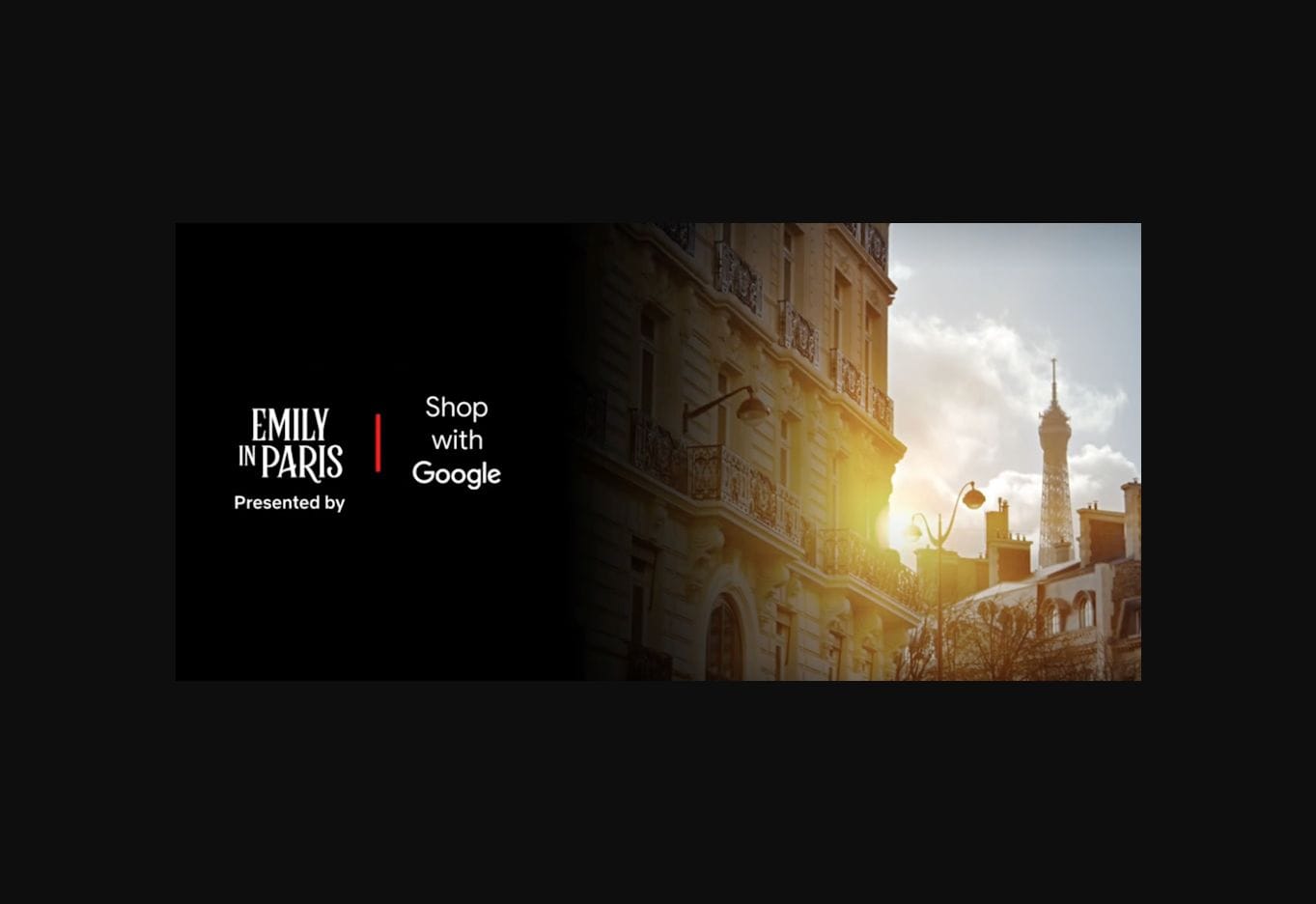
Compare the gallery with Amazon's Streaming TV examples and Sony's PS5 announcement. On an eligible service, identify the viewing app and exact placement before naming its seller. If Maya pauses, distinguish seeing the placement, scanning a code, and resuming the program.
Reconstruct the direct route and then add the hypothetical DSP route. Which parties gained a contractual role, and which playback functions were still needed? Removing redundant selling access might save money; removing an insertion service or a required rights agreement could interrupt delivery entirely. Explain the replacement before treating its invoice as avoidable.
Maya, Northstar Audio, City Ledger, and the assessment companies are fictional. Dollar examples are teaching scenarios unless explicitly labeled as disclosed rules or dated benchmarks. Provider illustrations show placement examples, not independently verified live campaigns. Product availability and terms vary by market; the main lens is the United States. Source links sit beside the claims they support.