Advertising Alloconomy, Part 10: How Rewarded Games Divide the Ad Dollar
A game reward, an ad load, and a billable impression are different events. Follow mediation into developer receipts.
At the screen
Maya runs out of lives in a puzzle game during her commute. The game offers another life if she chooses to watch an advertisement. She accepts; a rewarded creative appears; the game later grants the benefit. The interruption is part of the game's design, and the game developer is the publisher.
For this journey, Northstar buys rewarded impressions through an advertising network. The developer uses mediation to choose among eligible demand sources and an advertising SDK to connect the game's code with the selected ad. Our chosen purchase is CPM, with no separately invoiced mediation fee. The reward describes Maya's experience; it does not establish what Northstar pays for.
Advertising Alloconomy · Placement map · Part 10
Mobile game · Rewarded ad
A network’s demand reaches an optional reward opportunity in the developer’s game.
Read from the advertiser toward the audience. Connections show roles in the chosen route, not cash transfers or request timing.
An extra life is a game outcome, not evidence that Northstar gained a customer.
The developer controls the game and its mediation setup. Bidding and waterfall sources can coexist; this route compresses their selection. A load, a display, a billable event and an earned reward are distinct. The chosen illustration adds no separate mediation fee.
Simplified teaching map. Company boundaries and contracts vary; one box does not mean one company or one fee. Dollar allocations appear in the separate money-flow diagrams. Those figures are indicative; actual business economics require case-by-case analysis.
Behind the placement
The machinery may start before Maya accepts the offer. Developers can load an ad in advance so it is ready when needed. AdMob's integration treats loading, showing, clicking, dismissal, and earning a reward as distinct callbacks. Server-side verification can help validate the reward. A successful load therefore establishes that the app obtained an ad, not that Maya saw it. AdMob rewarded integration
| Role and examples | Work that earns its place | What must replace it |
|---|---|---|
| Demand network: AdMob, AppLovin, Unity Ads | Aggregate demand and price or optimize advertiser purchases | Another source of demand and another advertiser buying route |
| Mediation: AdMob, AppLovin MAX, Unity LevelPlay | Coordinate bidding and waterfall sources | One-source monetization or integrations maintained by the developer |
| Game developer and SDK integration | Create the game, display the creative, and grant the reward correctly | Both the inventory and reliable app behavior |
| Optional attribution or quality provider: AppsFlyer, Adjust, DoubleVerify | Supply independent outcome or delivery evidence | Native reports or another evidence provider |
Mediation is not necessarily a single auction in which the highest fresh bid wins immediately. AdMob describes selecting a mediation group, soliciting bidding sources, and placing the winning real-time bid into an ordered waterfall alongside other sources. A purely bidding configuration may serve the selected bid directly; a hybrid can try a higher-ranked waterfall source first. AdMob bidding
For a separate selection example, suppose the best live bid is $8 eCPM, while a waterfall source is ranked at an estimated $10. Mediation can try that source first and fall back to the $8 bidder if it does not fill. The $10 rank need not be a fresh, binding bid for Maya's impression. Configured ranking estimates and real-time auction prices describe different things.
The selected source supplies creative through its integration. The SDK displays it, records the relevant events, and signals when the reward requirements are met. Granting an extra life proves neither an app install nor a purchase. Maya's game state and Northstar's business results belong to different systems.
The charge and the dollar
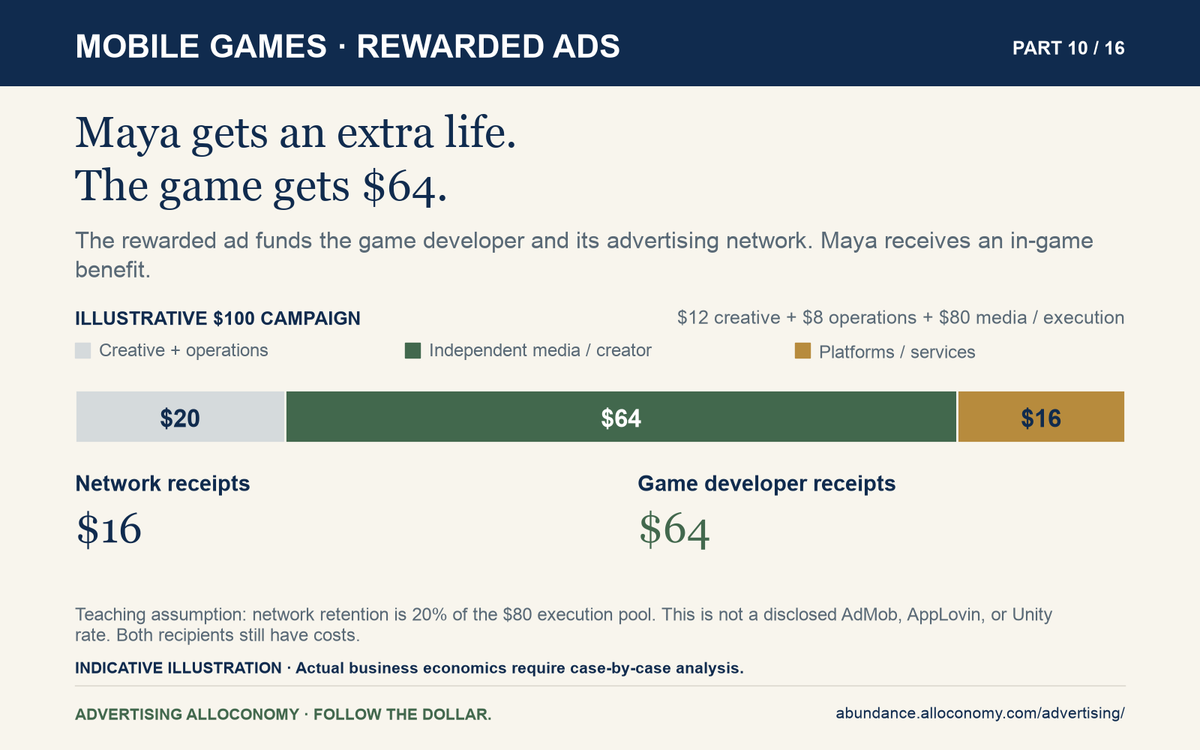
In our campaign, 10,000 qualifying impressions at a fictional $8 CPM use the $80 execution allocation. Assume the network retains 20% of that allocation and pays the developer the remainder. This is a teaching assumption, not a disclosed rate for AdMob, AppLovin, or Unity.
Follow the dollar
A rewarded game impression
Teaching assumption: the network retains 20% of $80 execution.
Each ribbon ends at a recipient or disclosed bundle. Widths show final allocations, not the order of payments.
Exact amounts and accessible table
| Recipient | USD from original $100 |
|---|---|
| Creative | $12.00 |
| Campaign operations | $8.00 |
| Network receipts | $16.00 |
| Game developer receipts | $64.00 |
| Total | $100.00 |
Total external campaign expense$100.00
This is not a disclosed AdMob, AppLovin, or Unity rate. The developer receipt is before costs; the player receives a game reward. Each amount is also its percentage of the original $100. These are final allocations, not a payment sequence.
The complete allocation is $12 creative, $8 operations, $16 network, and $64 developer. The network's 20% of $80 is 16% of the original $100. Its receipt can fund several functions and is before other costs. AdSense's website revenue share does not establish AdMob's share, and a network company's operating margin is not a campaign fee.
| Assumed retention from the $80 execution allocation | Network / original budget | Developer / original budget |
|---|---|---|
| 10% sensitivity | $8 / 8% | $72 / 72% |
| 20% chosen case | $16 / 16% | $64 / 64% |
| 30% sensitivity | $24 / 24% | $56 / 56% |
These are alternative inputs, not an observed fee range. If a distinct mediation or measurement service charges $2, identify which party funds it and recalculate the endpoints. Bundled software can support a paid demand business even when no separate software invoice appears. AdMob's partner-bidding guidance is a reminder to inspect the actual arrangement. Partner bidding
Settlement requires the accepted records under the advertiser and developer agreements. A load, a shown ad, a completed interaction, an earned reward, and a qualifying charge need not be the same event. Maya receives an in-game benefit, not a cash share of this $100. Rewarded API
What changes on another route
Another buyer might optimize for installs, or actually pay for clicks or attributed installs, while the developer evaluates revenue per thousand impressions. In that case, the network manages the difference between the advertiser's charging basis and the publisher's compensation. Neither “rewarded” nor “performance” establishes cost-per-install billing.
Tracking conditions also affect the usable evidence. Apple requires App Tracking Transparency permission for tracking covered by its policy and access to the advertising identifier. Advertising can continue, but the permitted tracking and measurement methods depend on the applicable permissions, app policies, audience, and runtime. Apple privacy and data use
For the developer, higher immediate CPM is only part of the calculation. Too many interruptions can reduce retention, future inventory, or in-app purchases. Additional demand sources may strengthen competition while increasing latency and duplication. The useful comparison is net proceeds together with the health of the game experience.
What this changes for you: rewarded mobile games
Maya's reward makes the exchange visible. It also changes what a completed viewing can mean.
If you are Maya
Put a value on the interruption.
Maya can decide whether another life is worth the time and attention requested. She is receiving a game benefit, not a cash share of the advertising payment. Understanding that exchange lets her set her own limit instead of treating every offered reward as something she must collect.
If you work for the advertiser
Account for the reason the ad was watched.
A viewer may finish to obtain the reward rather than because the headphones interest her. Assess useful reach, subsequent behavior, and incremental contribution; completion alone cannot establish buying intent. Check the actual billing and quality rules before comparing rewarded inventory with a different video environment.
If you work in a business earning the ad dollar
Optimize the whole game experience.
Developers and monetization teams can compare net revenue with retention, voluntary engagement, reward reliability, and operating effort. A network or mediation service should show what additional demand or better execution it contributes. The fictional $64 developer receipt does not establish whether more reward prompts improve lifetime economics.
If you are an investor
Stress-test the source of growth.
Ask whether results depend on better demand, a larger player base, more interruptions, or changes in partner access. Examine retention and payment obligations alongside revenue. The assumed network rate in this tour is not a disclosed fee for any named ad-tech company and cannot be used as its margin forecast.
Decision to take away: evaluate an extra reward prompt using both its advertising proceeds and its effect on the player's willingness to return.
Reconstruct the journey
AdMob's official format reference and rewarded-ad walkthrough show the optional prompt, ad interaction, and reward sequence. Compare them with the Android guide's load, show, and earned-reward events. These are provider demonstrations and implementation documentation, not a production-game session captured for this series.
In a game you already use, find an optional advertisement for a life or hint. Record what happens when you decline, what earns the reward, and whether play resumes correctly. Do not infer the actual SDK or buying path from the format alone.
Now close the imaginary app after an ad loads but before it displays. Reconstruct which records can still exist: a successful load, potentially no shown impression, no reward, and no qualifying delivery under the relevant counting policy. Finally, consider removing an optional attribution provider. Its invoice may disappear, but what evidence about acquired users would the advertiser lose, and what would replace it?
Maya, Northstar Audio, City Ledger, and the assessment companies are fictional. Dollar examples are teaching scenarios unless explicitly labeled as disclosed rules or dated benchmarks. Provider illustrations show placement examples, not independently verified live campaigns. Product availability and terms vary by market; the main lens is the United States. Source links sit beside the claims they support.