Advertising Alloconomy, Part 13: How Music and Podcasts Divide the Ad Dollar
An audio ad can reach a listener with the phone in a pocket. Music receipts and podcast creator shares follow different agreements.
At the screen
Maya walks home listening to Spotify's advertising-supported music experience. Northstar's audio message plays between content while her phone stays in her pocket. A companion image may appear if she opens the app, but an actively viewed screen is not required for this listening opportunity.
Our chosen route is a purchase from Spotify's advertising offering, without a separately priced DSP in the model. Northstar buys eligible delivered audio impressions on a CPM basis. Later we will change both the content and the revenue agreement by moving to an eligible Spotify Partner Program podcast. The same listening device does not make those two money models identical.
Advertising Alloconomy · Placement map · Part 13
Spotify · Music and podcasts
The main route is an advertisement in Spotify’s ad-supported music experience; podcasts add a separate partner relationship.
Read from the advertiser toward the audience. Connections show roles in the chosen route, not cash transfers or request timing.
Separate podcast variant
Music licensing and a podcast creator’s ad share are different economic arrangements.
This music route does not allocate an undisclosed per-ad royalty to a specific artist. Playing the file does not prove conscious attention or a later purchase. The eligible podcast example uses its own qualifying revenue base and agreement; it cannot be copied across to music.
Simplified teaching map. Company boundaries and contracts vary; one box does not mean one company or one fee. Dollar allocations appear in the separate money-flow diagrams. Those figures are indicative; actual business economics require case-by-case analysis.
Behind the placement
The listening session produces an eligible position. Campaign and deal rules guide selection; the delivery system retrieves or prepares the audio, plays it, and records the relevant events. The spoken creative must make sense without a visible button, while a companion can provide an optional response route.
| Role and examples | Work that earns its place | What must replace it |
|---|---|---|
| Audio creative team and campaign operator | Make an audible offer and configure the purchase | Equivalent production and operating capability |
| Spotify buying and delivery offering | Connect campaigns with eligible listening and ad insertion | Another service or distribution route |
| Music or podcast rights holders and creators | Supply content and monetization rights | Replacement content and the relevant permissions |
| DSP or sales representative when separately contracted | Add demand access and execution across publishers | Direct buying capability or another provider |
Delivery is only the first layer of evidence. Playing an entire file does not establish that Maya consciously heard every word. A spoken offer can prompt a purchase later on another device, which makes click-only reporting incomplete. It still does not justify assigning every later purchase to the audio campaign. Delivery reports, permitted matched outcomes, surveys, and experiments can supply different parts of the answer.
The charge and the dollar
Suppose 5,000 accepted audio impressions at a fictional $16 CPM use Northstar's $80 media allocation. Together with $12 creative and $8 operations, that completes the common $100 model.
Follow the dollar
An audio placement in a music session
Teaching campaign: 5,000 accepted impressions at $16 CPM.
Each ribbon ends at a recipient or disclosed bundle. Widths show final allocations, not the order of payments.
Exact amounts and accessible table
| Recipient | USD from original $100 |
|---|---|
| Creative | $12.00 |
| Campaign operations | $8.00 |
| Spotify advertising receipts | $80.00 |
| Total | $100.00 |
Total external campaign expense$100.00
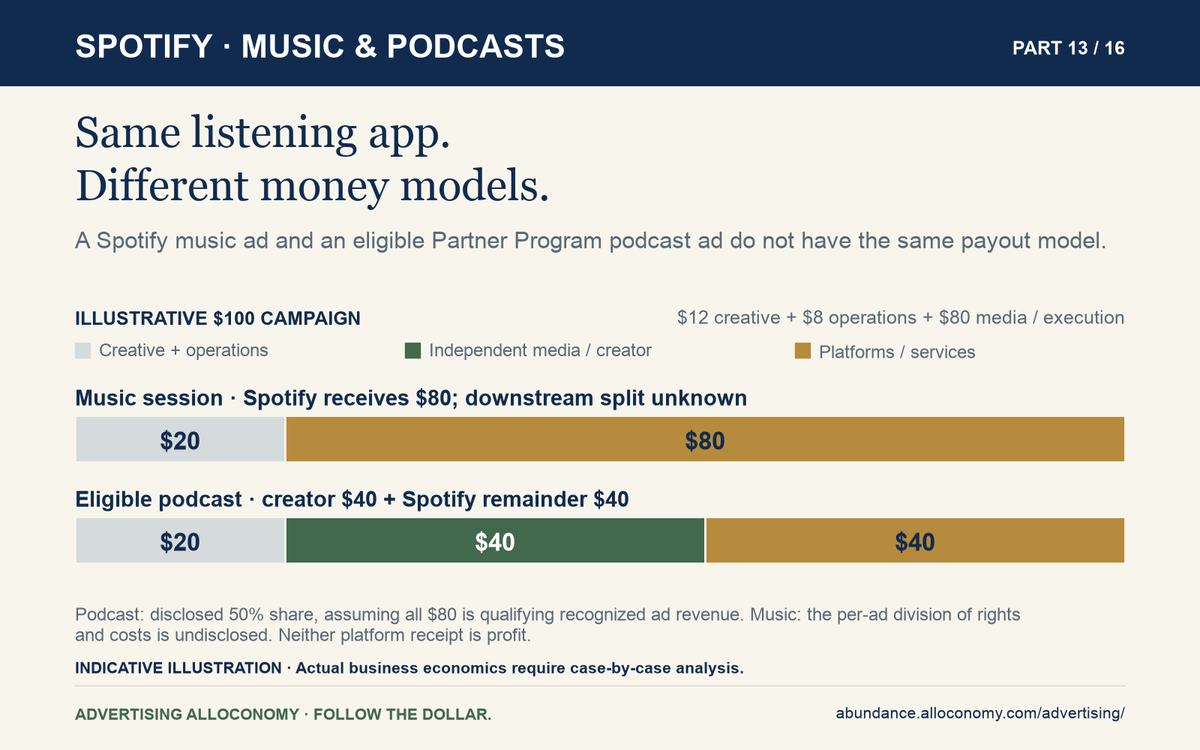
The per-ad division of rights, delivery, sales, and remaining contribution is undisclosed. These receipts are not profit. Each amount is also its percentage of the original $100. These are final allocations, not a payment sequence.
Spotify receives the $80 advertising payment before the relevant rights, delivery, sales, and other costs. Public evidence used here does not allocate those costs per music advertisement. Company-level royalty economics cannot be turned into a flat per-impression deduction or platform cut. Spotify advertising platform
Settlement follows the accepted billing records, which may differ from playback starts, completions, or companion clicks. A listener can hear an ad without opening the companion, open it without responding, or respond without purchasing. The campaign may care about all these events while billing one defined class.
What changes on another route
Change the buying door. Spotify's April 2025 announcement introduced broader access through Spotify Ad Exchange and Ads Manager. Its current programmatic material describes private marketplaces and programmatic guaranteed delivery at a fixed rate through selected DSPs. Owning the listening app does not require a single exclusive buying interface. A separately priced DSP changes the contracted recipients and fee treatment; it does not make the sound itself a different medium. Spotify advertising platform Spotify programmatic options
Change the content and revenue agreement. Now Maya listens to an eligible podcast monetized through the Spotify Partner Program. Spotify publicly describes a creator share of 50% of revenue it recognizes from eligible program ads. For the following figure only, assume the entire $80 media payment is that qualifying recognized-revenue base.
Follow the dollar
An eligible Spotify podcast ad
Disclosed 50% share; assume the full $80 is qualifying recognized ad revenue.
Each ribbon ends at a recipient or disclosed bundle. Widths show final allocations, not the order of payments.
Exact amounts and accessible table
| Recipient | USD from original $100 |
|---|---|
| Creative | $12.00 |
| Campaign operations | $8.00 |
| Eligible podcast creator | $40.00 |
| Spotify remainder | $40.00 |
| Total | $100.00 |
Total external campaign expense$100.00
This applies to the stated Partner Program scenario. It is not a music royalty rate or a universal podcast contract. Each amount is also its percentage of the original $100. These are final allocations, not a payment sequence.
The creator receives $40 and Spotify has $40 before its remaining costs; the same $12 and $8 cover creative and operations. The 50% rule is disclosed, but the equality between our advertiser payment and the qualifying revenue base is an assumption. This is neither the music-service model nor a universal podcast contract. Some supported Partner Program advertisements can reach listeners outside Spotify, so the listening-app logo alone does not identify the seller. Spotify Partner Program
The advertiser's impression invoice and the creator's revenue-share agreement answer different questions. A download, a stream start, completion, a promo-code redemption, and an attributed purchase are different measures. The measurement agreement must specify the denominator; a downloaded episode does not by itself prove an attentive listener heard its advertisement.
Change the sale and creative relationship. A podcast owner can sell a host-read sponsorship directly and integrate the message into content. In that route, the $80 media allocation may go to that seller, which funds its costs and any agreed representation commission. A dynamically inserted commercial can instead be chosen later for a particular delivery opportunity. Host-read versus inserted changes production or selection timing, but does not on its own settle distribution, billing, or seller identity.
A separate representative, network, or DSP needs its actual contractual fee; Spotify's Partner Program percentage cannot supply a missing term in another contract. Reservations can also specify delivery terms that differ from the main CPM example.
What this changes for you: Spotify, music, and podcasts
A similar listening interruption can support very different commercial and creator agreements.
If you are Maya
Separate the message from the relationship you value.
Maya may trust a show or enjoy a playlist without endorsing every advertiser heard there. She can identify the commercial message and evaluate its offer independently. The absence of a visible screen does not make the exchange costless: listening time and interruption still matter to her choice of service.
If you work for the advertiser
Choose evidence suited to listening.
Define whether the purchase aims to build awareness, prompt a response, or generate sales, and use evidence appropriate to that objective. Lack of a click does not establish failure; a reported listen does not establish persuasion. Compare placements after identifying the actual audience, billing rules, and measurement limitations.
If you work in a business earning the ad dollar
Read the agreement behind the share.
A podcast creator or monetization team should distinguish the eligible program revenue base from an advertiser's invoice and from music-rights economics. The illustrative $40 podcast payout cannot be copied into a music contract. Compare expected net earnings after rights, production, selling work, and any contractual deductions.
If you are an investor
Separate the businesses inside the audio label.
Examine music and podcast revenue, obligations, and monetization arrangements using the disclosures available. A shared app interface does not imply identical costs or margins. The $80 music receipt and the podcast's assumed $40/$40 division are starting points for questions, not interchangeable estimates of platform profit.
Decision to take away: compare two audio offers using their actual rights, revenue bases, audience value, and remaining costs before comparing the percentages.
Reconstruct the journey
Spotify's official audio-ad page supplies the LeLune companion-screen illustration below. The advertisement identity, playback controls, and response button connect an audio break with an optional screen action. It is a provider preview, not a live personalized listening session captured in the source research.
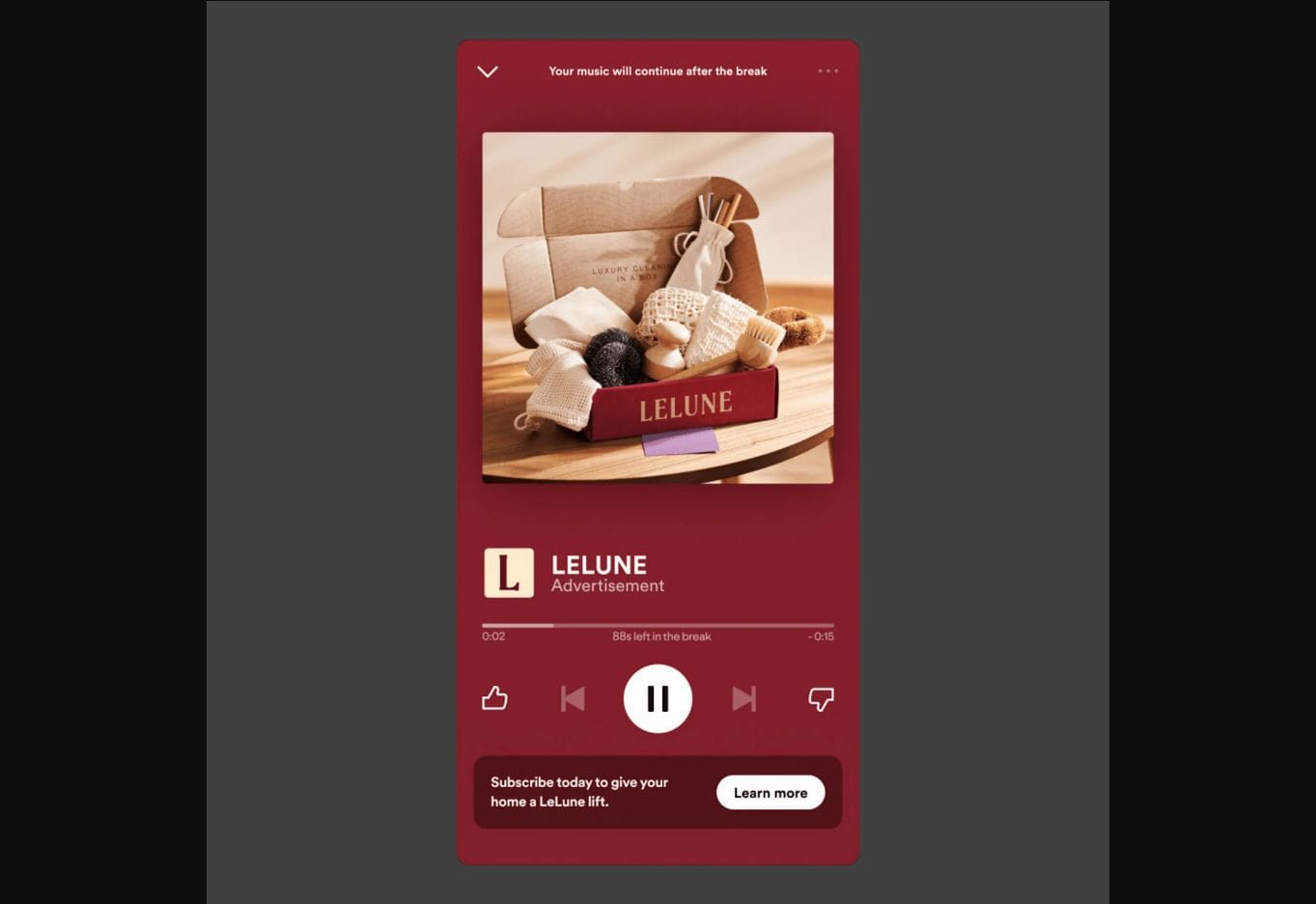
During an eligible listening session, distinguish what can happen with the phone in a pocket from what requires looking at the screen. In a podcast, note clues that a commercial was inserted or spoken by the host, without assuming one universal contract for either form.
Then reconstruct the music purchase and the eligible podcast branch. Why can the series allocate the podcast's assumed qualifying base while leaving the music receipt bundled? Finally, test a proposal to remove an audio network. Can its demand access, specialist execution, and commercial obligations be replaced for less while preserving results? Removing a creator's rights is a different act: it removes the content opportunity on which the advertising depends.
Maya, Northstar Audio, City Ledger, and the assessment companies are fictional. Dollar examples are teaching scenarios unless explicitly labeled as disclosed rules or dated benchmarks. Provider illustrations show placement examples, not independently verified live campaigns. Product availability and terms vary by market; the main lens is the United States. Source links sit beside the claims they support.