Advertising Alloconomy, Part 3: How Reserved Advertising Allocates the Dollar
The same rectangle can fulfill an earlier promise. Follow the contract as carefully as the screen.
At the screen
Maya returns to City Ledger the following week. Northstar's headphone banner occupies the same rectangle, but this time the defining commercial event occurred three weeks earlier: Northstar reserved advertising alongside the newspaper's commuting coverage.
Follow a direct reservation between Northstar and City Ledger, fulfilled by the publisher's ad server without a separately purchased DSP or SSP. The contract specifies the promised delivery and invoice basis; Maya's click is not required. The learning payoff is to separate the moment an ad appears from the earlier moment its commercial terms were agreed.
Before her visit, the publisher forecasts supply, approves creative, and configures the booking. When she arrives, the ad server checks whether the reservation is eligible and needs delivery. The system can fulfill that obligation without holding an open-market auction for this opportunity. Direct display describes the commercial arrangement; serving technology, operating work, and independent measurement may still be involved.
Advertising Alloconomy · Placement map · Part 3
Direct display reservation
The same news-page rectangle fulfils a booking agreed before Maya arrives.
Read from the advertiser toward the audience. Connections show roles in the chosen route, not cash transfers or request timing.
The contract changes the route; the rectangle can look identical.
This chosen direct sale has no separately purchased DSP or SSP step. Forecasting, trafficking, pacing, delivery and reconciliation still require work. Programmatic guaranteed is another implementation of a reservation; using an agency is an operating choice, not a different definition of reserved inventory.
Simplified teaching map. Company boundaries and contracts vary; one box does not mean one company or one fee. Dollar allocations appear in the separate money-flow diagrams. Those figures are indicative; actual business economics require case-by-case analysis.
Behind the placement
| Role and examples | Work that earns its place | What must replace it if removed |
|---|---|---|
| Inventory owner and sales team: City Ledger; real example The Guardian | Package audience access and make a delivery commitment | Another seller, or an automated way to sell this publisher's supply |
| Publisher ad server: Google Ad Manager, FreeWheel, Equativ, Kevel | Pace delivery and coordinate competing commitments | Equivalent forecasting and delivery coordination |
| Buyer operations and creative | Negotiate the package and supply approved assets | Advertiser labor and suitable tools |
| Serving / verification: Campaign Manager 360, Adform, DoubleVerify | Maintain creative records or independently inspect fulfillment when purchased | Native publisher reporting or alternative checks |
Pacing now means delivering the promised amount over the campaign's flight. Delivering everything immediately can be as problematic as falling short. Forecasting errors, unusual traffic, creative rejection, and restrictive targeting may frustrate the plan. A higher open-auction offer does not, by itself, erase an existing obligation.
Northstar can operate its campaign itself, hire an agency, or purchase a platform's managed service. This determines labor, expertise, accountability, and possibly fees. It does not establish whether inventory is reserved or auctioned. Amazon DSP, for example, offers both service models and multiple transaction types. Amazon DSP
The charge and the dollar
Maya's arrival calls for fulfillment. The agreement may commit a number of impressions, a period of presence, sponsorship rights, or a share of eligible opportunities. Delivery records support acceptance, make-goods, extensions, or financial adjustments under that agreement. A reservation's invoice therefore needs the contract as well as event counts.
Follow the dollar
A direct reservation
Teaching scenario: no separately purchased external trading platform.
Each ribbon ends at a recipient or disclosed bundle. Widths show final allocations, not the order of payments.
Exact amounts and accessible table
| Recipient | USD from original $100 |
|---|---|
| Creative | $12.00 |
| Campaign operations | $8.00 |
| Publisher receipts | $80.00 |
| Total | $100.00 |
Total external campaign expense$100.00
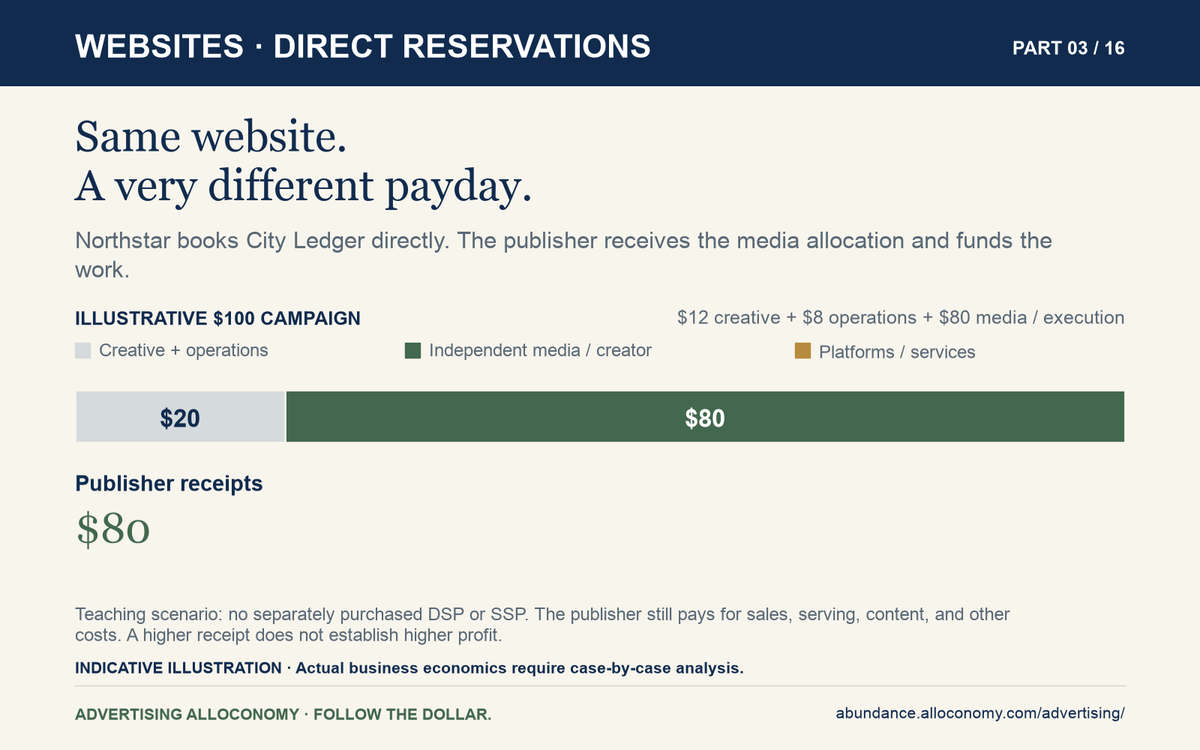
The publisher funds sales, serving, content, and other costs from its receipts. Each amount is also its percentage of the original $100. These are final allocations, not a payment sequence.
Under our chosen direct contract, $12 funds creative, $8 operations, and the publisher receives the entire $80 media allocation. That $80 is a teaching scenario for seller receipts before sales, serving, content, and other costs. The ad server can be essential without appearing as a separately deducted percentage on Northstar's invoice. If Northstar separately purchases an assumed $2 of verification within this same budget, the publisher line becomes $78; the total remains $100.
The visibly shorter payment route has a real operational consequence. Northstar and City Ledger must agree a package and oversee delivery. A saved trading fee is valuable only after considering that coordination work and the risk of an unfulfilled commitment.
What changes on another route
The same rectangle can be sold through five different arrangements:
| Transaction | Price and commitment | What happens when Maya arrives |
|---|---|---|
| Direct reservation—the chosen route | Negotiated delivery obligation | Ad server fulfills an eligible booking |
| Programmatic guaranteed | Negotiated price and reserved volume through connected buying/selling systems | Automated delivery fulfills the agreement |
| Preferred deal | Negotiated fixed price, generally without guaranteed volume | Buyer may accept an eligible opportunity |
| Private auction | Selected buyers compete, usually above a floor | Restricted competition determines an eligible offer |
| Open auction | Broad eligible demand competes | Opportunity is offered without that private buyer restriction |
These distinctions follow Google's documented transaction types; implementation and priority rules vary. “PMP” can mean a private auction or a broader set of private deals, so ask which agreement is intended. Programmatic transaction types
Consider a separate programmatic-guaranteed illustration: one million impressions booked at $12 CPM create a $12,000 media commitment before separately agreed costs. A DSP and seller platform can execute the booking without renegotiating its price in an open auction on every visit. A preferred deal at the same CPM does not promise that the million impressions will be available or purchased; a buyer may pass. Restricted access to a private auction does not guarantee volume either.
Returning to the normalized $100 budget, a hypothetical guaranteed deal could allocate $4 to buying technology and $76 to the seller, alongside $12 creative and $8 operations. This assumes no separate sell-side charge. Recalculate if the contract includes one: the transaction label supplies neither a universal fee nor its denominator.
Amazon managed direct display and DVA change the seller and potentially the operator. Amazon publicly expands DVA as Display, Video, and Audio; a finance role also discusses video, display, audio, and devices within that business context. DVA is a portfolio grouping, with usage that can vary across teams and time. Digital video is a format/channel, direct display concerns how a placement is arranged, and managed service concerns who operates it. Amazon's DVA terminology DVA portfolio context
Move Maya to an eligible Amazon-owned media surface and assume Northstar has contracted a managed display reservation there. Amazon's team prepares the campaign; her arrival triggers eligibility and booked delivery; the creative appears; the agreed events are reported and invoiced. Substitute Amazon for City Ledger as the media seller. An independent publisher payout is not automatic. If separately quoted management replaces our external operator's work, move the allocation instead of charging twice for the same service. A managed DSP auction buying external video follows a different route, despite also belonging to DVA. Amazon pricing Amazon DSP
What this changes for you: reserved advertising
Buying certainty can be valuable. Someone must still carry the cost of delivering the promise.
If you are Maya
Recognize that prominence can be booked.
A banner that appears regularly beside commuting coverage may reflect an earlier reservation rather than a fresh judgment about Maya. Its location does not make it an editorial endorsement. She can evaluate the offer on product evidence instead of treating repeated, prominent placement as independent validation.
If you work for the advertiser
Specify what certainty is worth.
Before committing, write down the audience, placement, timing, delivery obligation, and remedy for shortfall. Compare that package with an auction purchase after including coordination and measurement costs. The direct route's illustrative $80 publisher receipt does not prove a better result if the guaranteed exposure reaches the wrong audience.
If you work in a business earning the ad dollar
Price the work behind the guarantee.
Publisher sales and operations teams should connect commitments to realistic forecasts, serving capacity, and the cost of remedies. An agency can earn its fee by making that coordination work. Removing an external trading platform increases the importance of clear responsibility for pacing, reporting, and disputes.
If you are an investor
Separate contracted demand from profitable delivery.
Reservations may improve visibility into future activity, but examine cancellation terms, delivery obligations, collection, and the costs of maintaining the audience. Ask whether the company earns enough after fulfilling its promises. A contract value is not interchangeable with recognized revenue, cash received, or profit.
Decision to take away: compare a reservation and an auction offer by the uncertainty each removes, the obligations each creates, and the full cost of execution.
Reconstruct the journey
Revisit the official Guardian billboard specification. Imagine a direct reservation, then a guaranteed programmatic booking in precisely that position. The creative's appearance cannot distinguish their contracts. The observed Guardian example identified Preferred Hotels as a sponsor; that is a paid-content extension, not proof of a CPM reservation for surrounding display slots.
For an Amazon counterpart, inspect the official Fire TV Feature Rotator specification. It grounds the placement experience while leaving the actual campaign's sale and service terms to its agreement.
Choose a prominent placement and state what a buyer might have purchased: time, impressions, a share of opportunities, or content production. Then change only the guarantee while holding the price fixed. What becomes uncertain? Finally, replace one platform or service with direct coordination and explain who must now forecast, pace, verify, and resolve underdelivery. Your reconstruction should account for the contract as carefully as the screen.
Maya, Northstar Audio, City Ledger, and the assessment companies are fictional. Dollar examples are teaching scenarios unless explicitly labeled as disclosed rules or dated benchmarks. Provider illustrations show placement examples, not independently verified live campaigns. Product availability and terms vary by market; the main lens is the United States. Source links sit beside the claims they support.