Advertising Alloconomy, Part 8: How Meta Allocates Attention and Ad Spend
A feed predicts a possible purchase. Learn why the objective, billing event, and evidence of persuasion remain separate.
At the screen
Maya opens Instagram and scrolls. A Northstar ad appears between other content, although she has not just asked for headphones. The placement responds to a prediction about relevance rather than a fresh search query.
The chosen route is an Instagram Feed placement bought through Meta's advertising system, with purchases as the campaign objective and impressions as the billing event. Northstar supplies the message and desired outcome. Meta controls the feed opportunity, ad selection, delivery, and native measurement. We assume no separately contracted open-web DSP or SSP in this ordinary owned-feed purchase.
This is the new distinction after Search: an advertiser can ask a platform to find likely buyers without waiting for those people to state an immediate commercial need. The platform's ability to predict an action becomes central to the allocation of attention.
Advertising Alloconomy · Placement map · Part 8
Instagram · Meta feed
Northstar’s campaign competes for a paid position inside the feed Maya is scrolling.
Read from the advertiser toward the audience. Connections show roles in the chosen route, not cash transfers or request timing.
Optimizing for purchases does not make purchases the billing unit.
The selected example optimizes for purchases with impression billing. An adjacent creator does not automatically receive a share of this ad’s invoice. Seeing the same headphones elsewhere does not reveal which personal information was used. Facebook, Snap and TikTok are comparisons, not extra steps in this Instagram route.
Simplified teaching map. Company boundaries and contracts vary; one box does not mean one company or one fee. Dollar allocations appear in the separate money-flow diagrams. Those figures are indicative; actual business economics require case-by-case analysis.
Behind the placement
Northstar or its agency configures the campaign in the supported Meta buying tools before Maya starts scrolling. The chosen objective asks the system to seek opportunities with a useful predicted probability of purchase. It does not specify that purchases must be the invoice unit.
Meta's public account of its auction uses total value, with advertiser bid, estimated action rate, and ad quality contributing. Its developer documentation treats optimization goal and billing event separately. Official indexed documentation supports conversion optimization with impression billing; restricted full-page access means we do not reconstruct a complete proprietary pricing formula. Meta ad auctions; Meta billing events
At the feed opportunity, these campaign choices and platform predictions help determine which eligible advertisement to show. Context, advertiser-supplied audiences, permitted platform activity, and modeled relevance can support selection. The resulting picture does not disclose the targeting method or every model input. It also does not establish that the advertiser received Maya's personal browsing history.
| Participant in this route | Work that creates value | What replacement requires |
|---|---|---|
| Creative and campaign operator | Fit the offer to the feed and specify campaign goals | Another producer/operator or internal capability |
| Meta's feed and allocation system | Supply attention, predict relevance, select and deliver ads | A different media opportunity if this placement is no longer bought |
| Northstar's destination and permitted outcome signals | Complete the action and support learning from results | Another destination, or reduced/different optimization evidence |
| Independent measurement, when purchased | Challenge attribution and estimate incremental value | Other experiments or greater reliance on native reports |
The feed also has competing uses. Each ad consumes time and space Maya could spend with other content. More advertising can increase near-term monetization while affecting satisfaction and retention. Northstar cares about efficient access to likely customers; creators care about distribution and their own monetization arrangements. Meta's allocation system must operate within these overlapping interests.
Consequently, several functions performed by separate open-internet companies sit inside one corporate boundary here: publisher or distributor, auction operator, optimizer, delivery system, and measurer. Integration shortens the buyer's visible chain, while leaving substantial work and economic choices inside it.
The charge and the dollar
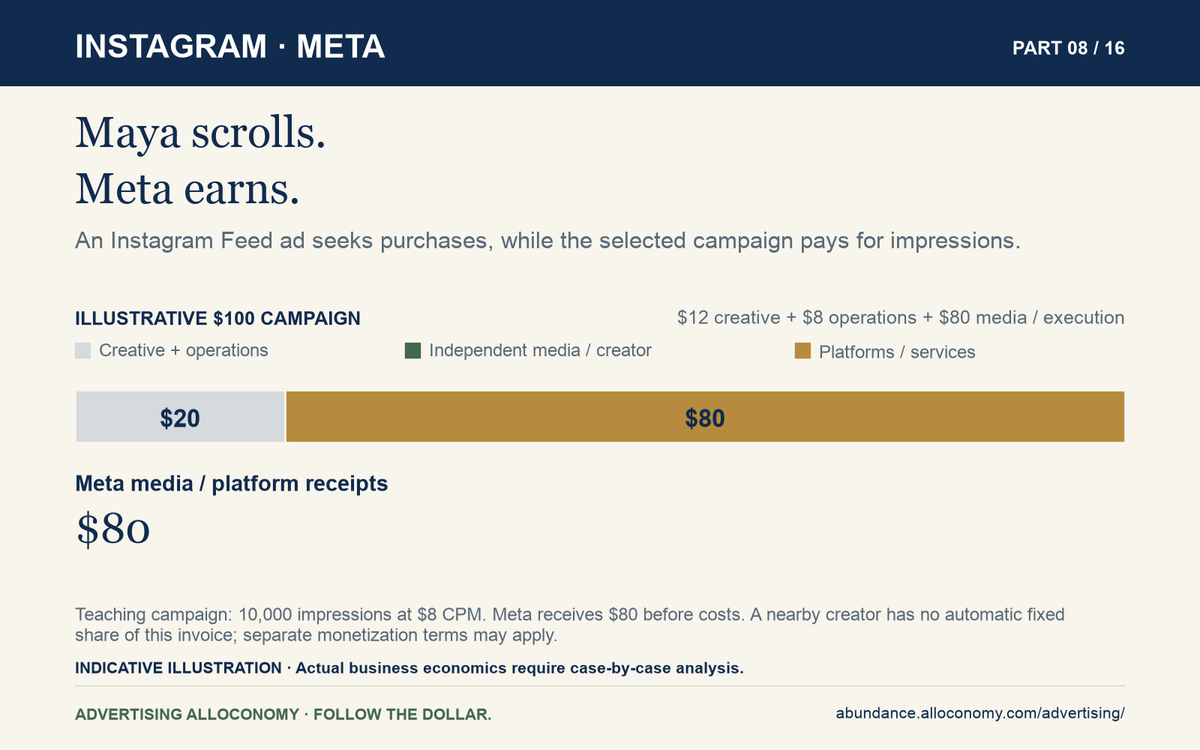
In our impression-billed example, qualifying delivery creates the charge. 10,000 qualifying impressions at an illustrative $8 CPM consume the $80 media pool. Together with $12 creative and $8 operations, the external teaching budget totals $100. Purchases remain the objective. Meta auction; Billing events
Follow the dollar
An Instagram Feed placement
Teaching campaign: 10,000 qualifying impressions at $8 CPM.
Each ribbon ends at a recipient or disclosed bundle. Widths show final allocations, not the order of payments.
Exact amounts and accessible table
| Recipient | USD from original $100 |
|---|---|
| Creative | $12.00 |
| Campaign operations | $8.00 |
| Meta media / platform receipts | $80.00 |
| Total | $100.00 |
Total external campaign expense$100.00
Purchases are the optimization goal. This example bills impressions and assumes no automatic adjacent-creator payout. Each amount is also its percentage of the original $100. These are final allocations, not a payment sequence.
Meta receives $80 for the selected feed advertising, bundling the seller and advertising-service roles. This is a receipt before operating costs and other obligations. A creator whose content appears near the ad does not automatically receive a fixed portion of this invoice; a creator or partnership agreement would introduce its own terms. Meta revenue and costs
Maya may scroll past, save the ad, visit a profile, click to a website, or purchase through an available commerce flow. These are different events with different uses. A later conversion can improve reporting and optimization where instrumentation, permissions, and matching support it, while the media charge remains tied to the chosen billing rule.
To reconcile the campaign, start with qualifying delivery and the advertiser's invoice. Then compare reported conversions with Northstar's own outcome records and, where possible, an incrementality assessment. The estimated action rate used to choose an ad, the billing event used to create cost, and the business metric used to judge success answer three different questions.
Suppose Maya was already likely to buy because she had been comparing Northstar all day. Finding her may improve attributed acquisition efficiency without demonstrating that the advertisement persuaded her. Prediction of a purchase and a change in purchasing behavior are separate capabilities; a strong prediction system is not by itself causal evidence of advertising value.
What changes on another route
Change the owned placement to Facebook Feed under a direct Meta buy and the broad integrated structure is analogous; Facebook is not a second payee added to this Instagram invoice. Reels, partnership ads, and creator-monetization products require their applicable product and rights arrangements. The main feed diagram does not supply a universal creator payout.
Change the inventory boundary to Audience Network and an external publisher enters the chain. Its payout needs its own evidence. The $80 shown as Meta's owned-feed receipt cannot simply become an assumed net retention rate on that outside supply.
Change the platform seller to TikTok or Snap and those platforms offer alternative integrated social purchases. They are useful comparisons for understanding prediction, creative fit, and attention allocation; neither participates in the chosen Instagram payment.
Change the measurement supplier and delivery can continue while decision quality changes. Independent measurement is not necessarily a mandatory per-impression toll, but its absence can weaken the evidence used to decide next month's budget. A supplier can therefore matter economically without sitting in the technical path of every ad.
What this changes for you: Instagram and Meta
Predicting that Maya will buy and causing Maya to buy are different achievements.
If you are Maya
Turn a predicted interest into a conscious choice.
Maya can notice when browsing becomes shopping and decide whether headphones were part of her plan. A relevant-looking ad is a commercial prediction, not proof of a need or of the advertiser knowing her full history. Pausing to compare alternatives gives her own criteria a role alongside the feed's selection.
If you work for the advertiser
Keep the objective, invoice, and outcome separate.
A purchase objective can accompany an impression bill. Confirm each definition, reconcile conversions with business records, and examine lift where feasible. An optimizer finding people already likely to buy can produce attractive reports; the budget decision still needs evidence of additional contribution after the campaign cost.
If you work in a business earning the ad dollar
Choose metrics that expose the tradeoff.
Platform leaders can assess ad revenue alongside user retention and advertiser outcomes. Agencies can demonstrate better creative, testing, and operating decisions. Creators should inspect their own agreements: supplying nearby feed content does not automatically entitle them to a fixed share of this particular ad invoice.
If you are an investor
Ask what is driving monetization.
Examine whether revenue growth reflects audience growth, pricing, more advertising per visit, or improved advertiser results. Those drivers need not have the same durability. The integrated $80 receipt is before costs; the simplified diagram cannot reveal Meta's margin or establish a universal creator payout.
Decision to take away: pair one campaign or platform growth metric with evidence that would reveal whether the broader customer experience is getting worse.
Reconstruct the journey
Official demonstrations: Meta's Instagram Feed image guide shows a Fuze Tea France preview inside a phone frame. Locate the sponsor disclosure, creative, response control, and surrounding feed. This is a provider demonstration, not evidence of an ad served to a signed-in consumer. The Facebook Feed guide offers a related comparison.
Reader replay: Pause at a labeled ad in your own feed. Identify its offered action and suggest a possible objective. Then explain why a shopping destination does not prove purchase billing, and a video does not prove CPV billing. Reconstruct this tour's impression charge and its $80 integrated receipt. To test value, remove the agency or an independent measurer: specify who replaces the operating work or evidence, and which future decision becomes harder if that work is left undone.
Maya, Northstar Audio, City Ledger, and the assessment companies are fictional. Dollar examples are teaching scenarios unless explicitly labeled as disclosed rules or dated benchmarks. Provider illustrations show placement examples, not independently verified live campaigns. Product availability and terms vary by market; the main lens is the United States. Source links sit beside the claims they support.