Advertising Alloconomy, Part 7: How Search Allocates the Advertising Dollar
Search advertising prices access to expressed intent. Follow the auction, click charge, and limits of attributed sales.
At the screen
Maya searches Google for headphones for train travel. This time she supplies an explicit question before seeing an advertisement. Northstar competes for a Google-owned Search placement through Google Ads, using a CPC search campaign. Google supplies the search surface and its advertising system; a selected ad can take Maya to Northstar's own website.
That scope matters. Google Ads is a buying tool, Google Ad Manager is principally publisher ad-serving technology, and Display & Video 360 is a DSP. Their shared corporate parent does not make them interchangeable stops through which every search ad passes. Our main route needs the search advertiser, Google's integrated search offering, and the advertiser's destination—not a compulsory newspaper-style supply chain.
Advertising Alloconomy · Placement map · Part 7
Google · Search
Northstar buys an opportunity to answer Maya’s query in Google’s own search results.
Read from the advertiser toward the audience. Connections show roles in the chosen route, not cash transfers or request timing.
Intent comes from the query; a sale still depends on what follows the click.
This is Google-owned Search, not an independent publisher using Google Ad Manager. The platform combines buying, selection and the search surface. The diagram does not claim to reproduce Google’s proprietary scoring formula or guarantee that the highest bid wins.
Simplified teaching map. Company boundaries and contracts vary; one box does not mean one company or one fee. Dollar allocations appear in the separate money-flow diagrams. Those figures are indicative; actual business economics require case-by-case analysis.
Behind the placement
Northstar prepared eligible keywords or targeting, ad assets, a landing page, bids, and a budget before the query arrived. Maya's search creates the immediate context. The system first determines which ads can participate, then ranks eligible candidates and their possible positions.
Google describes Ad Rank as incorporating the bid, auction-time ad and landing-page quality, thresholds, competition, search context, and the expected impact of assets. “The highest CPC bid wins” leaves out much of that decision. A displayed Quality Score multiplied by bid is also not the complete production formula. About Ad Rank
Northstar can offer more than another advertiser yet fail an eligibility threshold or supply a less useful candidate. A more relevant offer may compete without the largest nominal bid. This connects the platform's immediate revenue to the continuing usefulness of its search experience: the auction must allocate a scarce position while preserving reasons for people to return.
| Participant in this route | Work that creates value | What replacement requires |
|---|---|---|
| Search creative and campaign operator | Translate intent into an offer; manage bids, assets, and goals | Internal capability or another operator and suitable tools |
| Google Search and Google Ads | Supply query-based attention, ranking, serving, and billing | Another media opportunity if this Google placement is no longer bought |
| Northstar's website and conversion records | Complete the offer and capture permitted outcome evidence | Another destination and measurement method |
| Independent analytics or experiments, when used | Evaluate attribution and incremental effect | Alternative analysis or greater reliance on native reporting |
The roles continue after selection. When Maya clicks, the landing page might load quickly and answer her question—or arrive slowly, show unavailable stock, and lose her. A useful ad and a useful destination are connected parts of the commercial experience, although the supplier of the click does not guarantee the sale.
The charge and the dollar
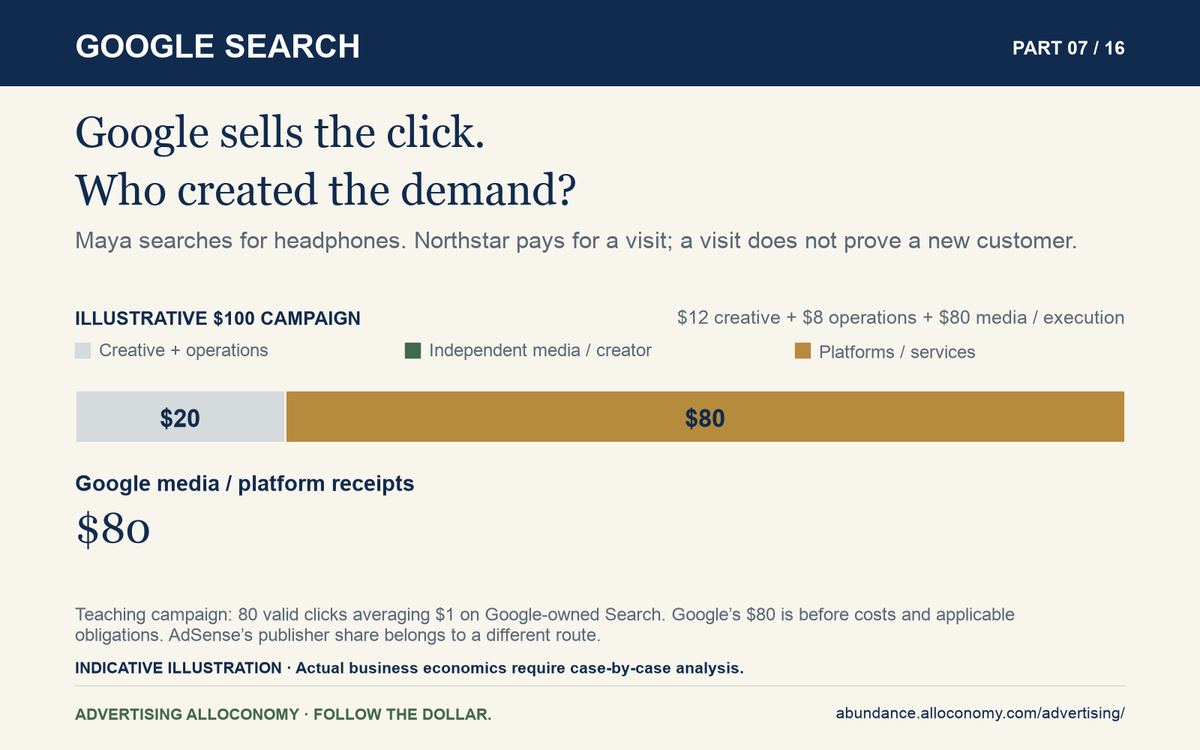
For this CPC campaign, a valid click creates advertising cost. Google explains actual CPC through Ad Rank thresholds and competition; a universal “second bid plus one cent” formula is insufficient. Suppose, for our teaching campaign, 80 valid clicks averaging $1 generate $80 of media charges. The campaign also incurs the common $12 creative and $8 operating expenses. Actual CPC
Follow the dollar
A Google-owned Search placement
Teaching campaign: 80 valid clicks averaging $1.
Each ribbon ends at a recipient or disclosed bundle. Widths show final allocations, not the order of payments.
Exact amounts and accessible table
| Recipient | USD from original $100 |
|---|---|
| Creative | $12.00 |
| Campaign operations | $8.00 |
| Google media / platform receipts | $80.00 |
| Total | $100.00 |
Total external campaign expense$100.00
Distribution obligations and partner arrangements require their own evidence. These are receipts before costs. Each amount is also its percentage of the original $100. These are final allocations, not a payment sequence.
Google receives the $80 for its integrated search-advertising offering, before costs and any applicable distribution obligations. This is not an 80% technology take rate. The AdSense publisher payout discussed elsewhere belongs to a different commercial route; its 68% figure cannot be applied to Google-owned Search.
Follow the records in order: eligible search delivery, valid clicks and adjustments, the advertising invoice, and payment. Then examine Northstar's conversion evidence separately. A strategy optimizing toward conversions does not change a CPC contract into a promise to charge only for acquisitions. Actual acquisition efficiency also depends on the offer, destination, and users who would have bought anyway. Actual CPC; Ad Rank
A later sale can enter reporting through configured conversion instrumentation, available identifiers, consent, and the applicable definitions. Some conversions may be modeled rather than directly observed. These records can help optimize spending, but a sale credited to an ad is not automatically a sale caused by it.
Search sharpens that distinction. Maya has revealed a need at a particular moment, which can make access to her attention valuable. She may also already be close to buying. High intent supports willingness to pay while making the incremental contribution of an advertisement harder to infer from attributed conversions alone.
What changes on another route
Change the inventory owner to a search partner and a partner agreement enters the money chain. Its payout is not estimated by our Google-owned diagram. Change the distribution arrangement and a browser or device agreement may create an upstream payment; that does not make the browser an SSP for Maya's individual search result. Alphabet's company-wide traffic-acquisition costs describe aggregate obligations, not the split of this query's advertising dollar. Alphabet's TAC definitions
Change the campaign scope to an automated cross-channel product and delivery may span search, video, and third-party media. Placement reporting becomes necessary to identify which environment the user actually encountered. A campaign's name is not a publisher address.
Change the search seller to an owned-search offering such as Microsoft Advertising and the advertiser makes an alternative purchase. Microsoft does not thereby become another payee in this Google transaction. Change only Maya's query from a generic problem to “Northstar headphones” and much of the mechanism may remain similar, while the question of how much demand the ad created changes substantially.
What this changes for you: Google Search
A search ad meets an expressed need. The useful question is how much it improves the decision that was already underway.
If you are Maya
Distinguish a commercial answer from an independent one.
Maya can use a sponsored result while recognizing why it is there. Compare the seller, destination, and offer with other results; prominence is not a complete product recommendation. Her query communicates a need, but it does not commit her to the first advertiser offering to satisfy it.
If you work for the advertiser
Test the demand you are paying to reach.
Separate branded searches from broader category needs and examine the landing experience. Use feasible experiments or other credible causal evidence to estimate added contribution. A cheap branded click with strong attributed sales may capture a purchase already likely to occur; a costly generic click may or may not introduce valuable new demand.
If you work in a business earning the ad dollar
Connect optimization to the customer's business.
A bid-management or agency team should show how its decisions improve outcomes or save operating work beyond native tools. A search-platform team must consider relevance and the usefulness of the destination alongside auction yield. Winning more clicks is an incomplete success criterion when those visits fail to help either customer.
If you are an investor
Examine the durability and cost of access to intent.
Investigate why users return, how advertisers obtain returns, and which distribution obligations reduce receipts. Company-wide distribution costs cannot be assigned mechanically to this one query. A valuable search surface still requires an analysis of competition, costs, and the price paid for its expected future earnings.
Decision to take away: ask what would happen to Northstar's sales if a defined group of search ads were absent, and what evidence could credibly answer that question.
Reconstruct the journey
Official demonstration: Google's Search ads page illustrates a modern-furniture query with a labeled ad for a demonstration business. The image is a provider preview, not a captured live auction.
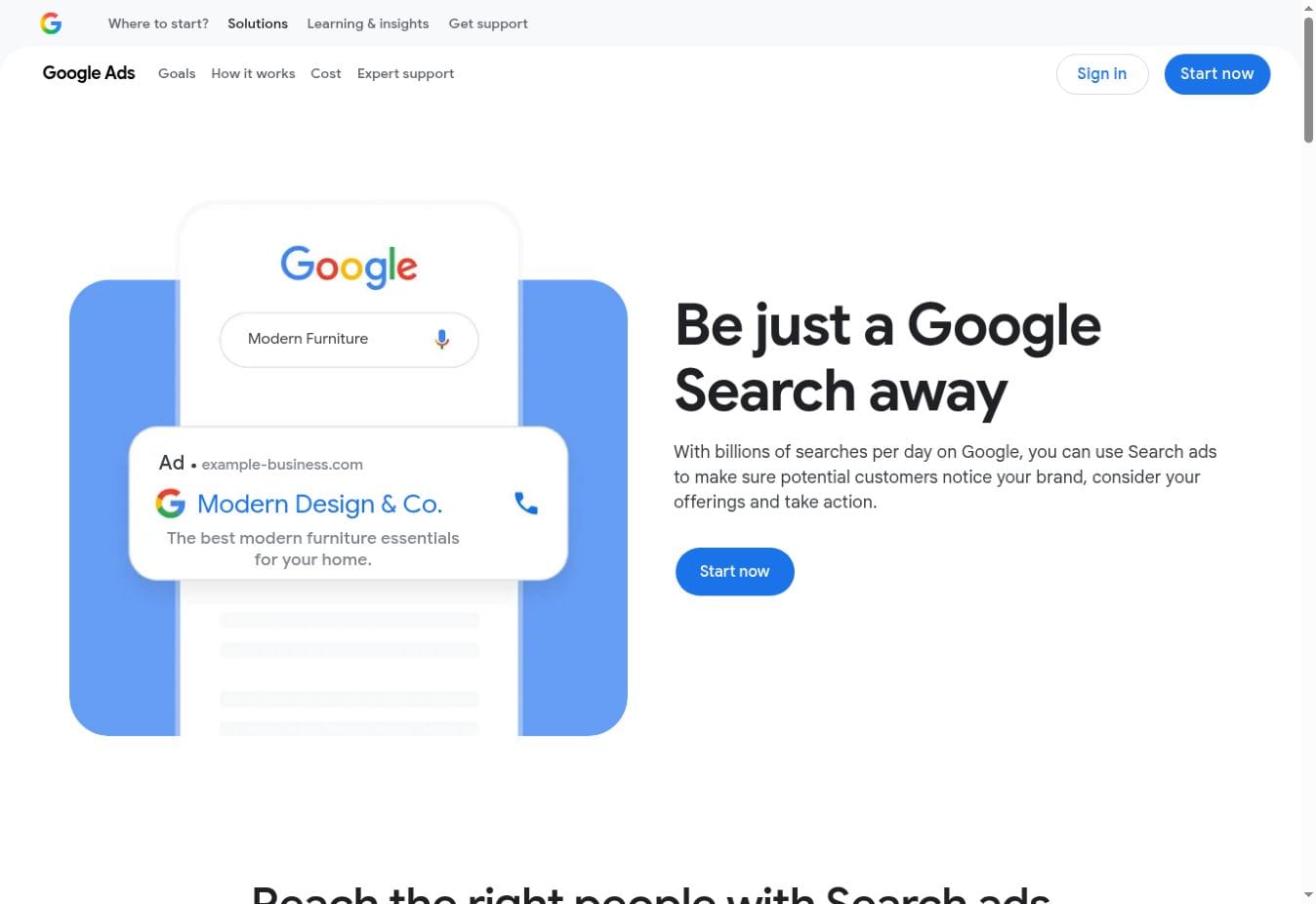
Reader replay: Search for a commercial need. If ads appear, identify the disclosure, advertiser, headline, optional assets, and destination, separating them from organic results. Compare that destination with an Amazon product card: both monetize expressed intent, through different products and ecosystems.
Now reconstruct the query, eligibility decision, click charge, $80 media receipt, and possible sale. Name the additional evidence needed to determine incremental value. Finally, remove a bid-management vendor: who will make its decisions, and what improvement or saved work justified its cost? Removing Google as the seller requires a different attention source, organic discovery, or reduced advertising spend; a higher attributed ROAS elsewhere alone does not prove a better incremental return on the $100.
Maya, Northstar Audio, City Ledger, and the assessment companies are fictional. Dollar examples are teaching scenarios unless explicitly labeled as disclosed rules or dated benchmarks. Provider illustrations show placement examples, not independently verified live campaigns. Product availability and terms vary by market; the main lens is the United States. Source links sit beside the claims they support.