Advertising Alloconomy, Part 4: How Amazon Allocates the Shopping Dollar
A sponsored shopping result buys a visit. Separate the click charge, the product sale, and the sale the ad actually caused.
At the screen
At lunch, Maya opens Amazon and searches for noise-canceling headphones. Among the results, an advertising disclosure marks a Northstar product card. Its image and listing information fit naturally into the shopping page. Clicking it opens the advertised product's detail page.
This tour follows Sponsored Products on Amazon's own shopping surface, with Northstar promoting an eligible listing and Amazon selling the placement through its sponsored-ad system. The chosen charge is CPC. Here the media owner, buying console, selection machinery, delivery, and native reporting sit within one platform; there is no need to insert City Ledger or an independent exchange into this route. Amazon also documents selected external sites and apps, which we will separate from this on-store journey. Sponsored Products
Advertising Alloconomy · Placement map · Part 4
Amazon · Sponsored Products
An eligible sponsored product competes for a place in Amazon’s shopping experience.
Read from the advertiser toward the audience. Connections show roles in the chosen route, not cash transfers or request timing.
The chosen trade buys a shopping visit, not a guaranteed sale.
This map follows the on-Amazon CPC example. Amazon supplies buying tools and the shopping surface; a separate open-web DSP–SSP chain is not required. A valid click can create cost before any purchase. Other placements or product variants need their own route.
Simplified teaching map. Company boundaries and contracts vary; one box does not mean one company or one fee. Dollar allocations appear in the separate money-flow diagrams. Those figures are indicative; actual business economics require case-by-case analysis.
Behind the placement
Northstar chooses an eligible product, targeting, bids, and budget before Maya searches. The shopping action creates an opportunity against which the platform considers relevant campaigns. A keyword match alone does not guarantee an appearance: retail eligibility, relevance, campaign constraints, and bidding matter. Amazon does not expose a complete production scoring and pricing formula for this series to reproduce.
| Role in this route | Work that makes the placement useful | What must replace it if removed |
|---|---|---|
| Northstar catalog and creative work | Supply a clear, eligible product offer | Valid listing content and suitable assets |
| Campaign operator: seller, agency, or software-assisted team | Choose products, targeting, bids, and budgets | Native operations, another tool, or another operator |
| Amazon shopping surface and ad system | Connect shopping intent with eligible paid visibility | A different surface or way to reach demand; this route's Amazon position is lost |
| Amazon transaction and measurement systems | Provide the destination and supported purchase evidence | Other purchase evidence, without this same checkout connection |
Maya sees the sponsored listing. Selection and rendering have succeeded, but the CPC bill has not yet been triggered by her view. She clicks into the detail page. A valid billable click can incur cost whether she buys, compares alternatives, or leaves immediately.
This is the distinctive trade: Northstar pays for a shopping visit. The platform supplies access to commercial intent, while Northstar still needs a competitive offer once Maya reaches the destination. A well-targeted click and a profitable customer are different achievements.
The charge and the dollar
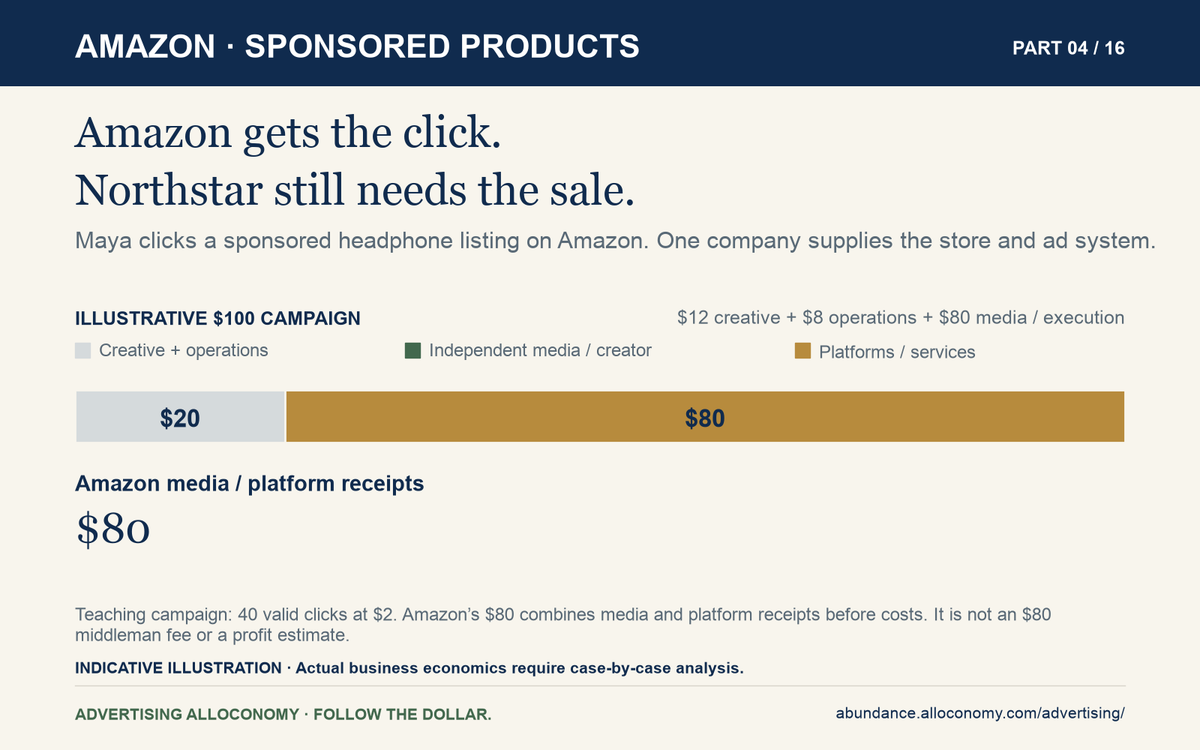
For one consistent fictional campaign, suppose Maya's click costs $2, and Northstar receives 40 valid clicks at $2 each. The advertising bill is $80.
Follow the dollar
An Amazon-owned shopping placement
Teaching campaign: 40 valid clicks at $2 each.
Each ribbon ends at a recipient or disclosed bundle. Widths show final allocations, not the order of payments.
Exact amounts and accessible table
| Recipient | USD from original $100 |
|---|---|
| Creative | $12.00 |
| Campaign operations | $8.00 |
| Amazon media / platform receipts | $80.00 |
| Total | $100.00 |
Total external campaign expense$100.00
The platform combines several functions. Its receipts are neither a DSP fee nor profit. Each amount is also its percentage of the original $100. These are final allocations, not a payment sequence.
With the common $12 creative and $8 operations assumptions, all $100 is accounted for. Amazon's $80 combines media and platform receipts. It is neither an 80% DSP commission nor a disclosed internal division between selling and buying technology. Amazon says sponsored advertising carries no separately charged demand-side fee. An optional outside campaign tool needs its own funded line if purchased. Amazon pricing
Campaign click records support the advertising charge; purchase and attribution records answer later questions. Amazon's annual report separates advertising services from retail and third-party seller services, and describes advertising revenue recognition as ads are delivered based on clicks or impressions. Amazon 2025 annual report
Suppose Maya then buys a $100 product. That purchase does not create another $100 of advertising revenue. Depending on the retail relationship, it may be Amazon's retail sale or a third-party seller's sale alongside Amazon service fees. Merchandise revenue, a seller referral fee, and a fulfillment fee belong to their own transactions. They should not appear as additional cuts of this $80 ad bill.
The nearby checkout offers useful evidence, but it does not settle causality. An attributed purchase may involve a different promoted product or another item from the brand; the relevant definitions and attribution windows belong to the actual advertising product. If Maya already intended to buy Northstar and would have clicked its organic listing, the paid click remains billable while the additional sale caused by advertising may be small. Reconciled clicks answer “What did we buy?”; incrementality asks “What changed because we bought it?”
What changes on another route
Product-feature video changes the creative. Amazon's Sponsored Products video guide shows a moving product presentation within this family. Sponsored Products remains a CPC product; adding motion does not itself create a CPM buy or an extra video intermediary. Identify the promoted listing, destination, and charging rule before classifying the experience.
An external placement changes the media owner. On a participating independent website or app, Sponsored Products can still send Maya to Amazon's product detail page, while an outside publisher supplies her attention. The same $80 then funds a bundled offsite purchase. If publisher receipts are P, Amazon and other serving amounts together are $80 − P; no public universal rate here supplies P. Neither the AdSense share nor an assumed APS UAM route fills that gap. Advertiser click charging and publisher impression payment can also differ, creating performance and settlement risk. Placement coverage Pricing structure
The lesson is precise: a common product name and destination do not guarantee a common supply path. On Amazon's surface the seller is integrated; on outside media a partner relationship has entered, even if the advertiser still uses a simple campaign console.
What this changes for you: Amazon Sponsored Products
The placement buys access to a shopping decision. That makes it valuable, but also makes existing purchase intent easy to mistake for advertising impact.
If you are Maya
Separate paid visibility from product suitability.
Maya can notice the sponsored label and compare price, specifications, reviews, and alternatives beyond the prominent card. The ad may help her discover the right headphones. Its position alone cannot establish that they fit her needs better than a less visible option.
If you work for the advertiser
Connect the click bill to the product margin.
The fictional $2 click is an expense even if the visit ends without a sale. Check the listing, stock, conversion performance, returns, and contribution after marketplace and fulfillment costs. Where feasible, test how many purchases the ads add rather than assuming all credited product sales disappear without advertising.
If you work in a business earning the ad dollar
Show how your work improves the shopping outcome.
A retail-ad platform or agency team should connect better matching, product content, and campaign operations to useful discovery and advertiser economics. Merely increasing bids can increase spend without fixing an unavailable product or weak listing. For the marketplace, preserving shopper usefulness is part of sustaining the advertising opportunity.
If you are an investor
Identify which transaction earns which revenue.
Distinguish advertising receipts from merchandise sales and other seller charges. Investigate whether sellers can earn attractive returns and whether the shopping experience supports continued demand. The illustration's $80 media receipt supplies neither Amazon's product-level profit margin nor the economics of every retail-media business.
Decision to take away: evaluate one advertised product using the full acquisition cost and incremental contribution, not only the sales credited to its sponsored card.
Reconstruct the journey
Use Amazon's Sponsored Products page as the official reference. For a reader replay, search a category such as wireless headphones on Amazon.com or Amazon.in. Compare disclosed advertising cards with neighboring organic results: image, listing information, and detail-page destination may look similar. Availability varies by marketplace and session. This exercise asks you to inspect your own session; it does not assert that a particular live campaign was observed.
Trace one card from shopping query to eligible campaign, displayed listing, click, destination, and possible purchase. Label which event creates the CPC charge. Now replace the product image with video and explain what stays the same. Finally, remove an optional campaign tool, then remove Amazon as seller. The first change transfers operating work; the second removes access to this particular paid position. Name a feasible alternative for each, and explain what evidence you would need before claiming that the paid visit caused an additional sale.
Maya, Northstar Audio, City Ledger, and the assessment companies are fictional. Dollar examples are teaching scenarios unless explicitly labeled as disclosed rules or dated benchmarks. Provider illustrations show placement examples, not independently verified live campaigns. Product availability and terms vary by market; the main lens is the United States. Source links sit beside the claims they support.