Advertising Alloconomy, Part 5: Who Earns the Brand-Discovery Dollar?
A brand-led placement can sell clicks, viewable impressions, or reserved presence. Its appearance does not reveal the contract.
At the screen
Maya searches Amazon again. This time Northstar introduces a range of headphones through a brand-led placement. She can explore a Brand Store or an eligible product destination instead of necessarily following one promoted listing.
Our main route is Sponsored Brands on Amazon-owned shopping inventory, bought by Northstar with a page-visit goal and CPC charging. Amazon supplies the placement and advertising system. We will then change the buying objective to see how the same family can support viewable-impression charging or a reservation without acquiring a new chain of intermediaries. Sponsored Brands
Older material calls this family Headline Search Ads. Amazon's 2018 rebranding also changed Amazon Advertising Platform, or AAP, to Amazon DSP. Translate those historical names before treating them as additional modern products. Amazon's 2018 rebranding
Advertising Alloconomy · Placement map · Part 5
Amazon · Sponsored Brands
Northstar buys an entrance to its brand within Amazon’s shopping experience.
Read from the advertiser toward the audience. Connections show roles in the chosen route, not cash transfers or request timing.
The paid entrance and the destination are different parts of the experience.
The chosen scene uses CPC. A Brand Store visit is not automatically another billable ad impression. Other Sponsored Brands offers can use different billing arrangements; the creative format alone does not establish the charge.
Simplified teaching map. Company boundaries and contracts vary; one box does not mean one company or one fee. Dollar allocations appear in the separate money-flow diagrams. Those figures are indicative; actual business economics require case-by-case analysis.
Behind the placement
Northstar prepares a brand creative and destination. Its operator selects the eligible objective, targeting, bids, and budget. When Maya searches, Amazon's system determines whether and where that campaign can serve under the selected offer. In our CPC scene she clicks through to Northstar's destination; that qualifying click is the event purchased.
| Role in this route | Work that creates value | What must replace it if removed |
|---|---|---|
| Brand creative and Store work | Present a coherent product range and destination | Equivalent assets and a useful landing experience |
| Campaign operator | Choose goals, queries, bids, and commitments | Advertiser labor, automation, or another operator |
| Amazon placement and allocation system | Supply prominent eligible discovery and enforce the purchase terms | Another route to attention; an unrelated SSP cannot supply this same owned position |
| Native reporting and optional outside analysis | Report delivery and investigate attributed outcomes | Narrower native evidence or another measurement approach |
The Brand Store is a destination. A visit there is not automatically another billable ad impression, and the Store's existence does not reveal what generated its traffic. Several campaigns and other sources can lead to the same destination. Follow the purchase of access separately from what Maya does after arrival.
The charge and the dollar
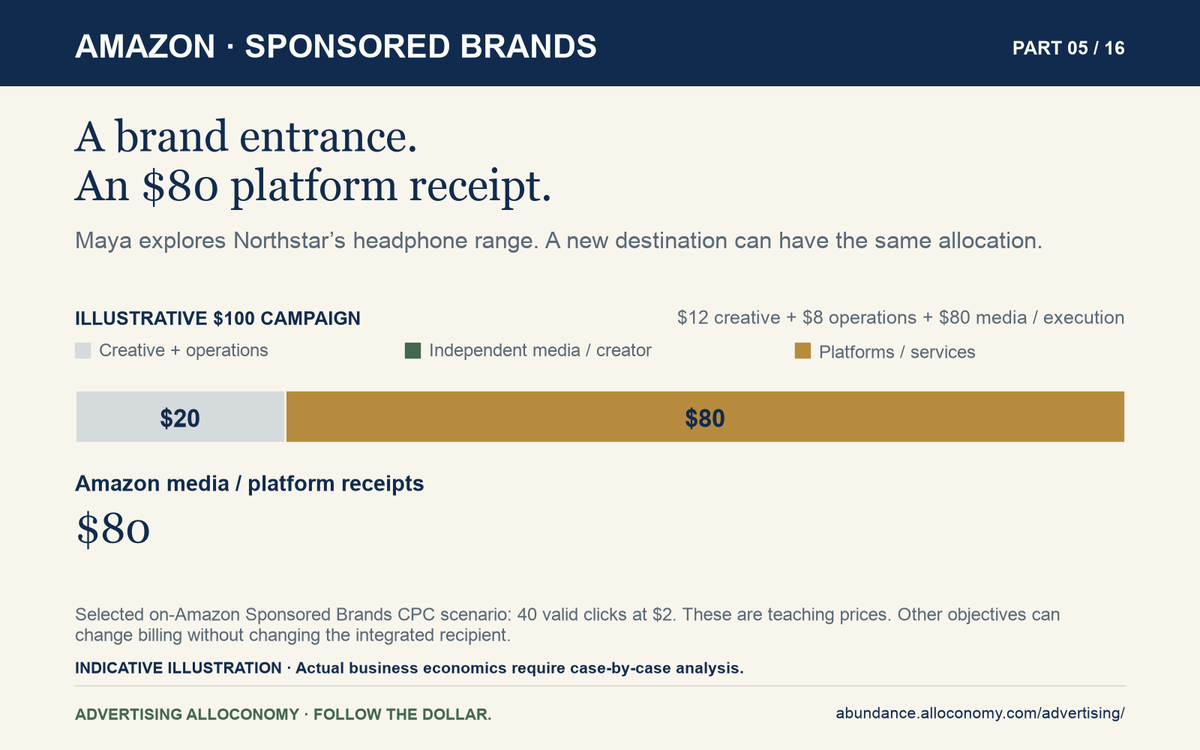
Suppose Northstar's CPC campaign produces 40 valid clicks at a fictional $2 each: $80 of advertising charges. The $100 allocation is the same as the on-store Sponsored Products case—$12 creative, $8 operations, and $80 Amazon media/platform receipts.
Follow the dollar
An Amazon-owned brand placement
Teaching campaign: the same $80 media pool under the selected CPC route.
Each ribbon ends at a recipient or disclosed bundle. Widths show final allocations, not the order of payments.
Exact amounts and accessible table
| Recipient | USD from original $100 |
|---|---|
| Creative | $12.00 |
| Campaign operations | $8.00 |
| Amazon media / platform receipts | $80.00 |
| Total | $100.00 |
Total external campaign expense$100.00
A different goal can change the charging rule while preserving these integrated recipients. Each amount is also its percentage of the original $100. These are final allocations, not a payment sequence.
What has changed is the experience being promoted, not the number of economic recipients. The $80 does not reveal Amazon's internal cost split. Separately purchased partner software would require its own funded allocation.
The campaign configuration, valid-event records, delivery report, and invoice connect the visible experience to the charge. Purchase reporting then asks what happened after exposure or a visit under the applicable attribution rules. Imagine Maya searched for Northstar by name: the brand may value prominent presentation and protection from competing offers, yet many attributed purchases might have occurred without the ad. A generic category query can instead introduce a brand Maya had not considered. Prior awareness, organic position, competition, and destination all affect the causal interpretation.
What changes on another route
Current documentation lists CPC for page-visit goals, vCPM for brand impression share, and fixed upfront pricing for reserve share of voice. Sponsored Brands should therefore not be taught as universally CPC. Sponsored Brands
| Branch | Invoice illustration | What changes from the main route |
|---|---|---|
| CPC—the chosen route | 40 valid clicks × $2 = $80 | A click creates the charge |
| vCPM | 20,000 qualifying viewable impressions × $4 per thousand = $80 | Viewability qualification replaces the click as the counted basis |
| Reserved branded share of voice | $80 of each normalized $100 assigned to the actual reservation price | Upfront commitment replaces the example click/view tariff |
These are separate arithmetic comparisons, not Amazon quotes or minimum commitments. They preserve the same budget boundary while changing the purchased event or obligation. In the vCPM scene Maya can qualify as a paid view without clicking. In the reserved scene Northstar secured eligible top-of-search presence for branded terms before her query arrived.
Amazon's October 2025 announcement describes reserved branded share of voice as fully self-service and priced upfront. The offer promises presence for relevant branded queries most of the time, subject to its eligibility and commitments; it should not be translated into unconditional ownership of every query. This is a concrete example of self-service buying that does not require a new impression-by-impression auction price. Reserved branded share of voice
If Maya looks but never clicks, our CPC example has no click charge from her encounter. The vCPM alternative can charge for a qualifying view, while the reserved alternative follows its agreement. The seller and brand-led appearance can remain the same across all three.
What this changes for you: Amazon Sponsored Brands
A brand entrance can create discovery, redirect existing demand, or do both. Those outcomes justify different decisions.
If you are Maya
Notice who curated the entrance.
A branded collection or storefront leads Maya into a selection arranged around that advertiser. It can be useful for exploring a range, but it is not a neutral comparison of all headphone makers. She can leave that entrance and compare alternatives before deciding.
If you work for the advertiser
Match the purchase to the objective.
Specify whether you want discovery, visits, or reserved presence, then confirm the applicable charging rule and destination. Compare broad discovery with branded searches separately. A high return among people already seeking Northstar does not establish that the placement introduced the brand or created those purchases.
If you work in a business earning the ad dollar
Earn the creative and operating allocation.
An agency or creative team can test whether the brand promise, product selection, and landing experience help customers decide. Report the outcome that the work is meant to improve. Attractive assets and more storefront visits are intermediate achievements; they still need a connection to the advertiser's objective.
If you are an investor
Ask whether growth adds demand or raises its price.
Investigate whether the product expands useful brand discovery, monetizes existing shopping intent more heavily, or changes the mix of ad formats. These possibilities can have different implications for advertiser retention and margins. A separate product label does not establish a separately disclosed profit stream.
Decision to take away: state what the brand placement should change, and choose evidence that can distinguish that change from demand Northstar already had.
Reconstruct the journey
Amazon's Sponsored Brands page provides official demonstrations of desktop top-of-search, mobile search, and a mobile home-page placement. The Accent Athletics illustration combines brand imagery with several products; it is a provider demonstration, not a verified active campaign.
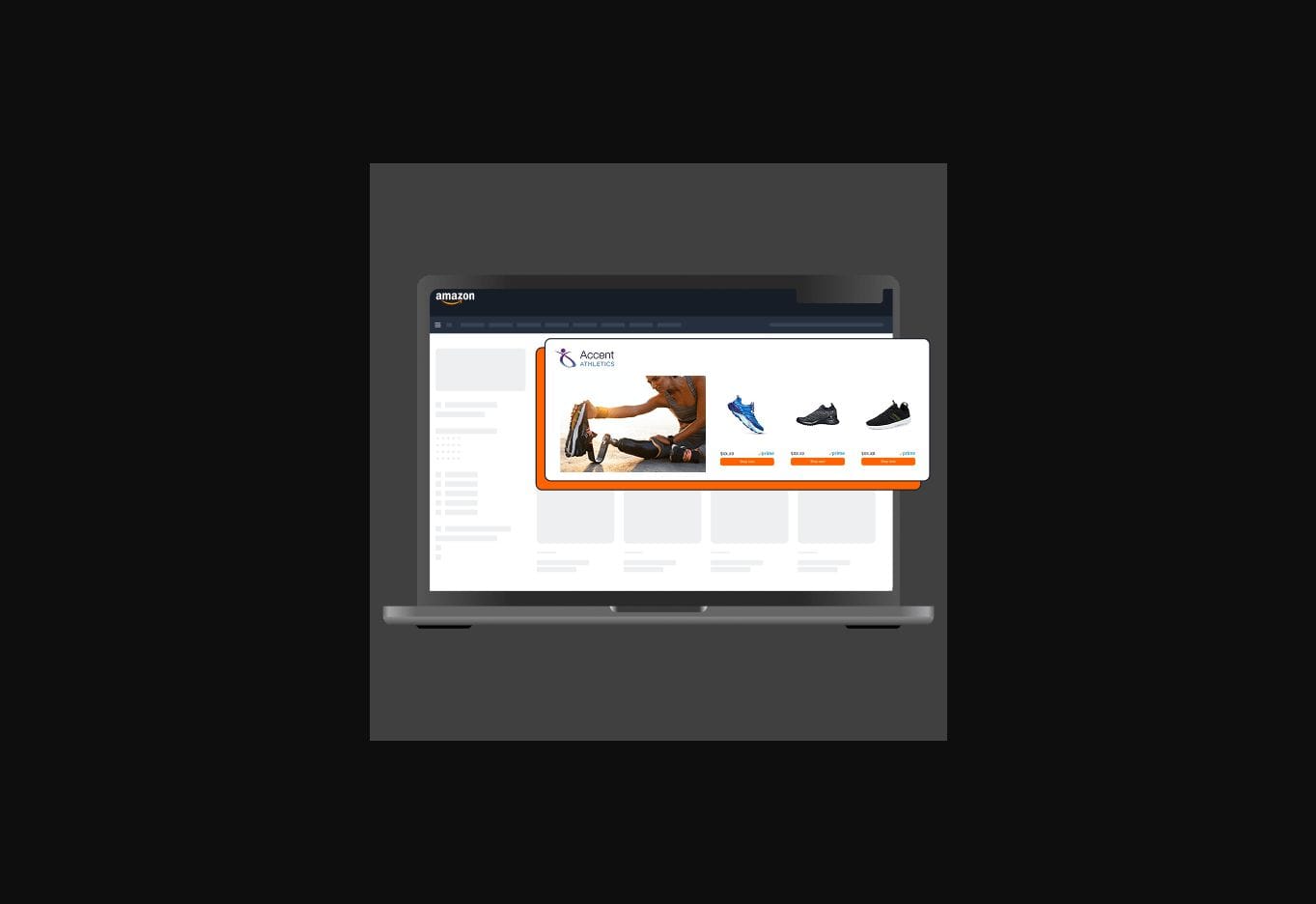
For a reader replay, find a brand-led collection on an Amazon shopping results page and distinguish it from an individual Sponsored Product. Record the advertiser, product group, and destination choices. Reconstruct all three possible charging stories, then identify the campaign record needed to determine which one actually applies. A screenshot alone cannot choose among them.
Finally, suppose Northstar brings creative work in-house or replaces campaign software with native operations. Explain who performs the displaced work. Then evaluate the harder alternative: stop buying the prominent position and rely on other routes to demand. What incremental contribution would justify the expense? A strong answer accounts for existing branded demand as carefully as the visibility purchased.
Maya, Northstar Audio, City Ledger, and the assessment companies are fictional. Dollar examples are teaching scenarios unless explicitly labeled as disclosed rules or dated benchmarks. Provider illustrations show placement examples, not independently verified live campaigns. Product availability and terms vary by market; the main lens is the United States. Source links sit beside the claims they support.