Advertising Alloconomy, Part 9: How YouTube Shares the Video Dollar
A skip button cannot tell you what the advertiser owes. Trace video charges and the different bases for creator payouts.
At the screen
Maya opens a headphone review on YouTube. A Northstar commercial starts before the review, with a skip control after the applicable interval. A creator supplied the video Maya came to watch; the platform supplies the viewing environment and advertising system.
Our chosen route is an eligible YouTube watch-page ad around a participating creator's public video, bought under a supported CPV setup. Northstar buys advertising through Google's supported arrangements, YouTube selects and delivers it, and the eligible creator receives the applicable partner payout. We do not add a fictional independent publisher SSP to every YouTube playback.
This looks like one video interrupting another. Commercially, it joins two contracts: the advertiser's rules for paying for an ad, and the creator's rules for sharing defined advertising revenue. Their denominators will matter as much as their percentages.
Advertising Alloconomy · Placement map · Part 9
YouTube · Watch Page
A video ad reaches Maya alongside eligible creator content on YouTube.
Read from the advertiser toward the audience. Connections show roles in the chosen route, not cash transfers or request timing.
Content and revenue relationship
The creator supplies content; the partner agreement determines a separate revenue share.
The chosen campaign is CPV; selection alone does not establish a charge. The eligible creator’s percentage applies to its qualifying revenue base, not automatically the advertiser’s entire campaign budget. Video standards are supporting functions, not extra compulsory payees.
Simplified teaching map. Company boundaries and contracts vary; one box does not mean one company or one fee. Dollar allocations appear in the separate money-flow diagrams. Those figures are indicative; actual business economics require case-by-case analysis.
Behind the placement
Northstar prepared the video and campaign configuration in advance. When Maya presses Play, the platform evaluates eligible demand and applies the chosen format and delivery constraints. Selecting an advertisement does not by itself establish whether Maya will watch long enough to create a CPV charge.
| Participant in this route | Work that creates value | What replacement requires |
|---|---|---|
| Video producer and campaign operator | Create a compatible commercial and choose buying controls | Production and operating capability inside the advertiser or elsewhere |
| Google/YouTube buying and delivery system | Connect demand to viewing, select ads, and deliver them | Another platform or supported distribution/buying route |
| Eligible creator or rights holder | Supply the video, audience, and rights to monetize it | Replacement content and the necessary permissions |
| MCN or rights administrator, when involved | Manage rights, contracts, or partner settlement | Direct handling by the creator or another intermediary |
The delivery vocabulary helps locate the encounter. In-stream advertising accompanies video content playback. Pre-roll, mid-roll, and post-roll identify position relative to that content; an ad pod groups commercials within a break. An out-stream or other video placement may instead sit in a page experience without preceding a video Maya deliberately chose. Placement definitions evolve, so the mere presence of a video player does not establish premium in-stream inventory.
Across interoperable video systems, VAST standardizes an ad description and related metadata supplied to a player. It is neither the auction nor the buying platform nor a billing rule. Open Measurement supports standardized access for verification providers in supported environments. Neither standard establishes that Maya paid attention. They are useful infrastructure concepts, not extra compulsory payees in this chosen YouTube route. VAST; Open Measurement
The charge and the dollar
For Google's documented CPV configuration, a qualifying charge occurs when Maya watches 30 seconds, completes the ad if it is shorter, or interacts first. Imagine a 45-second Northstar ad that she skips after eight seconds without interacting. That viewing does not meet the stated CPV threshold. Other viewers in the campaign may qualify: an illustrative 2,000 qualifying views at $0.04 produce $80 in media charges. Video ad formats
Follow the dollar
An eligible YouTube watch-page ad
Disclosed 55% creator rule; assumed $80 equals the defined net-revenue base.
Each ribbon ends at a recipient or disclosed bundle. Widths show final allocations, not the order of payments.
Exact amounts and accessible table
| Recipient | USD from original $100 |
|---|---|
| Creative | $12.00 |
| Campaign operations | $8.00 |
| Eligible creator | $44.00 |
| YouTube remainder | $36.00 |
| Total | $100.00 |
Total external campaign expense$100.00
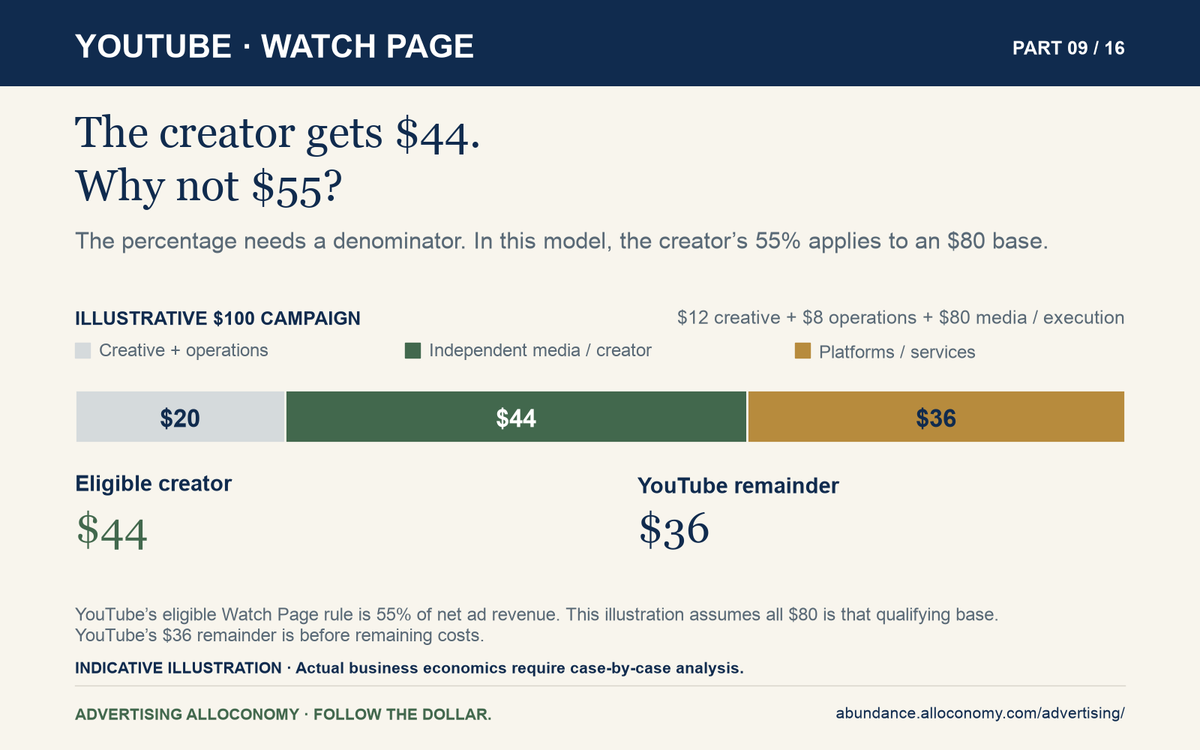
The equality of the advertiser payment and the qualifying net base is an assumption. The remainder precedes remaining costs. Each amount is also its percentage of the original $100. These are final allocations, not a payment sequence.
The common teaching budget pays $12 for creative and $8 for operations. To allocate its remaining $80, we need a different denominator: YouTube's Watch Page Monetization Module pays eligible partners 55% of defined net ad revenues. For this figure alone, assume the entire $80 advertiser payment equals that qualifying net-revenue base. The creator receives $44; YouTube's remainder is $36 before its remaining costs. The endpoints reconcile to $100. Partner earnings
The 55% rule is disclosed. Equality between our $80 invoice and the defined net base is an explicit teaching assumption. An outside buying fee, contractual deductions, a rights claim, or an MCN can change the reconstruction. The advertiser's CPM or a single person's viewing event is therefore insufficient to infer the exact creator payout.
Settlement brings the two contracts back into view. On the buying side, reconcile qualifying events, charges, adjustments, and the invoice. On the creator side, consult the applicable partner agreement and finalized earnings. The advertiser's qualifying view is a charge event; it is not a promise that every viewer, click, or ad produces an identical creator payment. The platform's 45% remainder of the assumed watch-page net base is not a disclosed profit margin.
What changes on another route
First change only the buying setup, leaving the skippable format recognizable. Google's guidance says that target CPM, target CPA, or Maximize conversions configurations for this format charge on impressions. Maya's eight-second viewing may then incur cost despite failing the CPV threshold. Non-skippable and bumper formats have their own documented CPM-oriented setups. A skip is neither a universal refund nor a complete verdict on whether the communication achieved anything. Video ad formats
Next change the placement and revenue-sharing system to Shorts Feed. Eligible creators receive 45% of their allocated Creator Pool revenue. If $80 were already allocated to one creator from that pool, the payout would be $36. That is a different $80: it is not a trace of our advertiser's original media invoice, because pool formation and allocation precede the creator percentage. Do not insert the Shorts calculation into the watch-page allocation or compare 45% and 55% as though they share a base. Reservations and other video products likewise require their applicable commercial and partner terms. Revenue-share modules
Finally change the inventory owner to an eligible video partner's app. A similar creative can then accompany a different publisher and supply relationship. The buying campaign's label does not establish which owner supplied a particular placement. An in-feed discovery ad also represents a different user moment from an ad interrupting chosen content: an advertisement promoting a video and an advertisement played around a video are distinct experiences.
What this changes for you: YouTube
The viewer's experience, the advertiser's bill, and the creator's payout follow different rules.
If you are Maya
Separate the commercial from the creator's judgment.
A Northstar ad before a headphone review does not, by itself, establish that the reviewer endorses Northstar. Maya can evaluate the review and the ad separately. Her skip also does not reveal a universal refund or a precise creator payout: those depend on the buying setup and applicable sharing terms.
If you work for the advertiser
Judge paid viewing against the intended result.
Confirm what qualifies for a charge, then test creative and audience choices against useful outcomes. A low cost per qualifying view does not establish persuasion or profitable sales. Compare formats using their actual charge rules and evidence of effect, rather than assuming every view represents an equivalent purchase of attention.
If you work in a business earning the ad dollar
Negotiate and forecast using the right base.
Creators and their representatives should model the eligible revenue base, rights, deductions, and costs under their actual agreement. In this illustration, 55% of $80 is $44. A percentage without its base is insufficient for choosing a partner, forecasting income, or comparing Watch Page with another monetization arrangement.
If you are an investor
Follow the obligations after the media receipt.
Examine creator and rights-holder payments, delivery costs, and the audience and advertiser relationships supporting the business. The illustrative $36 remainder is not profit. A higher platform remainder could improve economics, damage creator incentives, or reflect a changed mix; the allocation alone cannot tell you which.
Decision to take away: before comparing two creator or video-ad offers, write each percentage's denominator and each party's remaining costs beside it.
Reconstruct the journey
Official format reference: Google's video-ad format guide compares in-stream, in-feed, bumper, Shorts, and other placements. Use it to connect a visible experience to a format before asking about the buying and revenue contracts.
Reader replay: In an eligible ad-supported YouTube session, record where an ad appears, its skip control, and its offered destination. Premium access, region, account state, and availability can change the experience; this series does not claim a live YouTube commercial captured in a live consumer session. Explain why a visible skip button cannot settle the billing question. Then reconstruct the $80 advertiser base and the separately defined creator base. If a rights administrator were removed, who would handle rights and settlement? Removing the underlying creator's content or permissions is a more fundamental change: it removes this viewing opportunity itself.
Maya, Northstar Audio, City Ledger, and the assessment companies are fictional. Dollar examples are teaching scenarios unless explicitly labeled as disclosed rules or dated benchmarks. Provider illustrations show placement examples, not independently verified live campaigns. Product availability and terms vary by market; the main lens is the United States. Source links sit beside the claims they support.