Advertising Alloconomy, Part 15: The Infrastructure Behind Every Allocation
Requests, permissions, delivery events, and financial records must agree before an advertising system can be trusted.
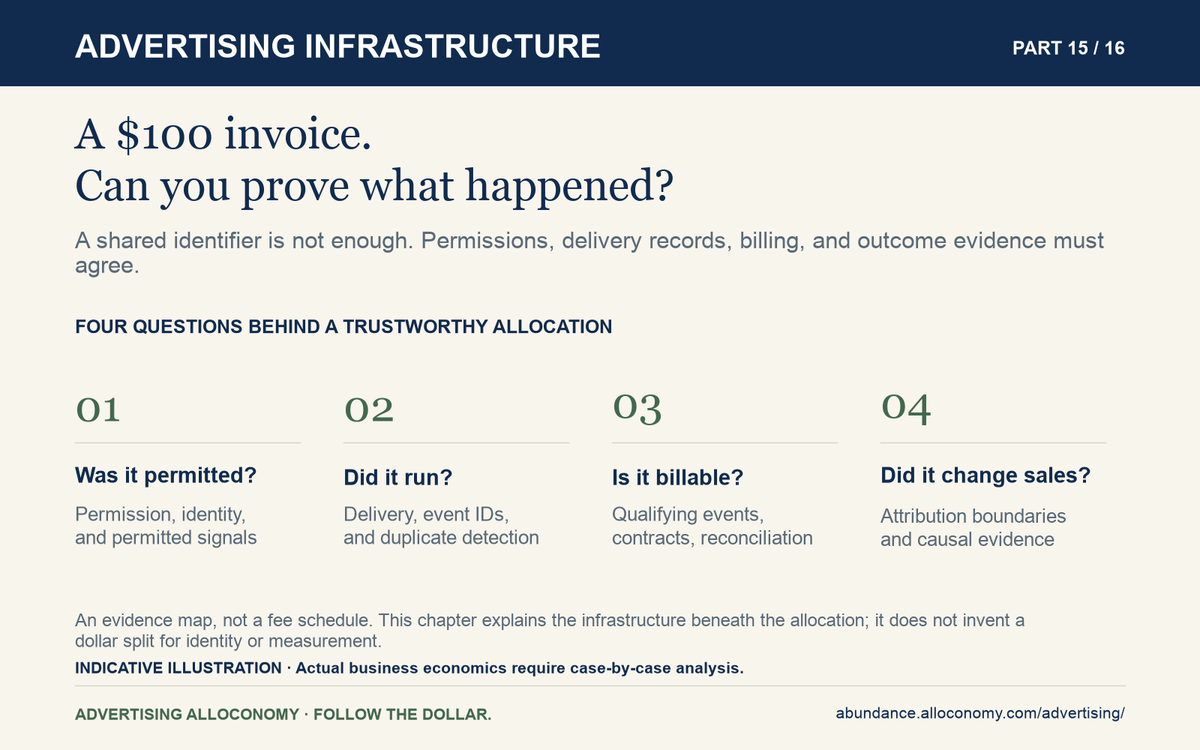
The tours work only if their systems agree on requests, permissions, events, and obligations. Infrastructure is part of the advertising product: it determines which opportunities can be evaluated, which ads reach a person, and which records can support a bill.
Identity changes the information available
First-party and third-party describe relationships and context. They do not automatically establish permission or data quality. A signed-in platform may know more about Maya within its service than an independent publisher does. Cookies, app advertising identifiers, matching, pseudonymization, aggregation, and modeling solve different problems.
In the newspaper tour, a permitted identifier may connect a request with prior information. Without it, contextual selection or another permitted approach can remain available, while cross-site frequency control and attribution become less complete. A hashed email is not automatically anonymous and does not confer permission for every use.
Browser behavior needs dates. WebKit documents blocking third-party cookies by default. Google's October 2025 Privacy Sandbox update retained Chrome's cookie-choice approach and announced retirement of several previously proposed advertising technologies, including Topics and Protected Audience. An older account in which every Chrome ad inevitably moves to those APIs is therefore unsuitable as a universal current model. WebKit tracking prevention Google Privacy Sandbox update
Apple's ATT rules create another branch for covered app tracking. Clean rooms and server-side integrations do not remove applicable data-use obligations. Implementation must follow current product policies and relevant local requirements; the architectural lesson is that identity and permission are inputs to the route, not a passport shared by every participant. Apple privacy and data use
Place each acronym beside its job
| Term | Job in the journey |
|---|---|
| Ad tag / SDK | Connects a page or app to requests, display, and events |
| OpenRTB | Structures bid requests and responses between participating systems |
| Floor | Defines a selling threshold under the applicable rules |
| Bid shading | Adjusts a buyer's offer to avoid overpaying where the auction permits that strategy |
| Deal ID | Identifies agreed access or terms; does not certify quality |
| VAST | Describes video creative resources and tracking metadata |
| SSAI / CSAI | Inserts advertising on the server side / client side |
| OM SDK / OMID | Provides supported interfaces for independent measurement access |
| Pacing | Spreads delivery or spend toward the campaign's time-bound objective |
| Frequency cap | Limits counted exposures within a defined identity and time scope |
| CMP | Coordinates applicable consent choices and signals |
| CDN | Delivers creative and content assets efficiently |
The protocol and measurement descriptions follow OpenRTB, VAST, and Open Measurement. The table locates the work; implementation specifications supply the fields, edge cases, and supported versions.
Reliability can create or destroy value silently
Engineering teams manage latency, timeouts, creative compatibility, event loss, duplicates, invalid traffic, pacing, and reconciliation. A bidder with excellent predictions earns no opportunity from an offer that arrives too late. Duplicate purchases can train an optimizer toward an outcome that did not occur. A rendering failure can separate auction success from a qualifying charge.
Campaign configuration, online decisioning, creative delivery, event collection, measurement, billing, and settlement need compatible identifiers and explicit event definitions. They need not share one database or one processing speed. Netflix's account of real-time metrics and curated billing events illustrates why fast operational reporting and financially correct event processing can require different treatment. Netflix event processing
AI fits into these jobs. Models can estimate response probability, choose creative, adjust bids, identify suspicious activity, and help operators. The economic task remains allocation under uncertainty. A model trained against distorted conversion records or an unsuitable objective can improve its reported accuracy while worsening advertiser value.
What this changes for you: advertising infrastructure
Infrastructure earns its budget when it improves a real transaction or prevents a consequential mistake.
If you are Maya
Treat privacy controls as specific choices.
Maya can review the available permissions and ad settings instead of assuming a sign-in grants every participant the same access. Declining optional tracking does not necessarily remove all advertising. Repetition or relevance alone cannot establish exactly what data was used; claims about her privacy need more evidence than the creative she sees.
If you work for the advertiser
Check the records before optimizing the campaign.
Ask whether purchases are duplicated, events are missing, and billing definitions match the collected evidence. Give finance and engineering a shared reconciliation problem. An optimizer trained on incorrect conversions can confidently direct money toward the wrong outcome; repairing the evidence may be more valuable than another bidding adjustment.
If you work in a business earning the ad dollar
Translate engineering improvements into customer value.
Connect faster decisions, valid permissions, reliable rendering, and correct settlement to realized opportunities and fewer disputes. Measure the failures that matter rather than celebrating request volume alone. A new employee can use one broken transaction to explain why a reliability project deserves priority over a more visible feature.
If you are an investor
Investigate replacement difficulty and operating burden.
Ask whether a supplier's integrations and reliability create useful customer dependence or merely expensive maintenance. Examine service costs, major platform dependencies, and the durability of permitted data access. Calling a product infrastructure or AI does not establish pricing power; its value must survive changes in the surrounding system.
Decision to take away: trace one failure from the technical event to the person, invoice, or budget decision it affects, then estimate what fixing it would improve.
Maya, Northstar Audio, City Ledger, and the assessment companies are fictional. Dollar examples are teaching scenarios unless explicitly labeled as disclosed rules or dated benchmarks. Provider illustrations show placement examples, not independently verified live campaigns. Product availability and terms vary by market; the main lens is the United States. Source links sit beside the claims they support.