Advertising Alloconomy, Part 16: Which Intermediaries Earn Their Allocation?
Evaluate access, cost, evidence, and bargaining power, then reconstruct an unfamiliar streaming business from one transaction.
Return to City Ledger's rectangle. Several SSPs, wrappers, and resale relationships may describe the same underlying opportunity to buyers. Maya still sees one slot. Extra paths can add access to demand or useful service; they can also duplicate computation, raise costs, delay decisions, and obscure the opportunity's description.
Jounce's 2025 outlook advances a strategic interpretation: competition increasingly concerns control of supply, advertiser demand, and the signals buyers receive. Treat that thesis as an interpretation of specialist research, then test it against a particular transaction. Jounce, State of the Open Internet 2025.
Authorization, identity, and declared payment paths
| Tool | Question answered | Limit |
|---|---|---|
| ads.txt / app-ads.txt | Did the property authorize this seller account? | Authorization does not establish attention quality or fair economics |
| sellers.json | Who is associated with the seller account? | Self-declared information still requires validation |
| SupplyChain / schain | Which selling/payment participants are represented in this request? | It does not list every technical service or prove completeness |
These functions follow IAB Tech Lab documentation. A DIRECT label concerns the relevant account relationship; it does not promise premium content, zero fees, or effectiveness. Two routes to the same publisher can differ in rights, costs, signal quality, and duplication. ads.txt sellers.json and SupplyChain
An additional intermediary can supply exclusive access, outsourced yield management, a useful placement, or another genuine publisher service. The IAB's sustainability guidance recognizes value-adding resellers while also identifying opportunities to reduce unnecessary routes. The replacement question is therefore specific: who will do this job, with what access and performance, at what full cost? IAB supply efficiency guidance
Curation moves a decision, and potentially bargaining power
A curator can package selected inventory and signals into a deal that the advertiser activates through its buying tool. The curator may contribute judgment and a buyer relationship while other companies provide execution and auction infrastructure.
Jounce's 2025 outlook argues that this can weaken the bargaining position of a DSP that simply executes an allocation decided elsewhere. Test that hypothesis by asking whether the curator has durable buyer relationships, distinctive selection, measurable results, and transparent economics. A deal ID alone demonstrates none of those advantages. Jounce, State of the Open Internet 2025, pp. 26–31.
Decide whether the destination is worth reaching
Supply quality contains several questions. Invalid traffic concerns whether activity is valid under counting rules. Brand safety concerns excluded content categories. Brand suitability adds the advertiser's particular context and preferences. Attention and effectiveness concern whether acceptable exposure was noticed and changed anything. Human visitors and brand-safe text can coexist with cluttered placements that accomplish little. Ad Manager counting and filtering Jounce supply-chain terminology.
Jounce's supply-chain terminology uses six categories: High Risk, Made For Advertising, Cheap Reach, Rebroadcasting, Premium, and Bellwether. It separates poor experiences from inefficient routes to otherwise valuable supply. Bellwether includes Jounce's manual oversight of selected sellers; this does not establish that every other premium seller has inferior inventory. Jounce supply-chain terminology.
Ask whether the publisher has an audience reason to exist, whether placements and refresh create meaningful exposure, whether declared signals match the experience, and what rights or service each intermediary contributes. Jounce's classifications are specialist research judgments, not causal findings about every impression. Its commercial work in classification and advice makes the distinction between observed mechanics, proprietary judgments, and recommendations especially useful.
Good supply-path optimization connects worthwhile attention to the buyer through justified services. Shortening the path helps when it removes unnecessary cost without losing greater value. Direct access to an ineffective placement does not become a good investment merely because fewer companies appear on the invoice.
Locate the scarce resource and the paying customer
Start with what the business controls: an audience habit, shopping intent, content rights, a distribution interface, advertiser relationships, bidding technology, data, or trusted measurement. Then ask who pays for access to that resource and how readily the customer could reproduce the result elsewhere.
An interface does not secure attention indefinitely. Data access does not establish an exclusive right to use it. Processing billions of requests does not necessarily confer control of advertiser budgets. A supplier can be operationally necessary yet economically replaceable if its work moves elsewhere with little loss. These are analytical questions about a business model, not investment recommendations.
Translate leadership language into an answerable question
| Phrase in a meeting | Follow-up that locates the economics |
|---|---|
| Yield improved | Per impression, session, or viewer-hour; net of which costs? |
| Take rate increased | Revenue divided by which spend base; did pricing, mix, or accounting change? |
| We grew supply | More people and attention, more ad load, or more requests for existing opportunities? |
| Demand is strong | More advertisers, higher bids, larger budgets, or stronger commitments? |
| ROAS improved | More incremental sales, or a change in attribution or targeting? |
| Fill rate increased | Against which request denominator; with what price and user experience? |
| We have premium CTV | Which content, rights holder, app, seller, placement, and measurement? |
| We reduced supply paths | Which costs fell; did differentiated access or demand disappear? |
| Our AI improved outcomes | Which target, against what control, at whose cost? |
A useful new employee connects these questions to the team's actual decisions. A publisher can increase short-term revenue by raising ad density while damaging retention. A buying team can reduce CPM while losing effective exposure. An optimizer can find people who would have purchased anyway. These are possible incentive conflicts; the response is to choose counter-metrics that expose them.
Evaluate publisher revenue with retention and attention quality; campaign efficiency with incremental contribution; automation with event integrity and reconciliation. Identify who can change each rule and who bears the cost when the local metric improves but the broader objective worsens.
Write a one-transaction company brief
Choose a real product and answer six questions in one page: who pays; which event or service creates revenue; which amounts are owed onward; what access or capability is differentiated; what would make customers switch; and which reported metric could rise while the business deteriorates?
Then draw its decision, delivery, money, and evidence maps. Where a field remains unknown, specify the document or observation needed to resolve it. A precise unknown is a better analytical result than an invented margin or an inferred seller based on the device logo.
The final case: an unfamiliar commercial
Maya watches a documentary in the fictional HarborStream app on an Orbit television stick. A Northstar commercial appears midway through the program. Everything in this case, including the contracts and prices, is invented for assessment; no terms are attributed to an actual platform.
The facts available to the analyst
HarborStream holds the advertising rights for this program. Its distribution contract assigns Orbit 30% of eligible advertising opportunities; HarborStream controls the remaining opportunities. The commercial under review occupies a HarborStream-controlled opportunity, sold through its authorized exchange to Northstar's DSP.
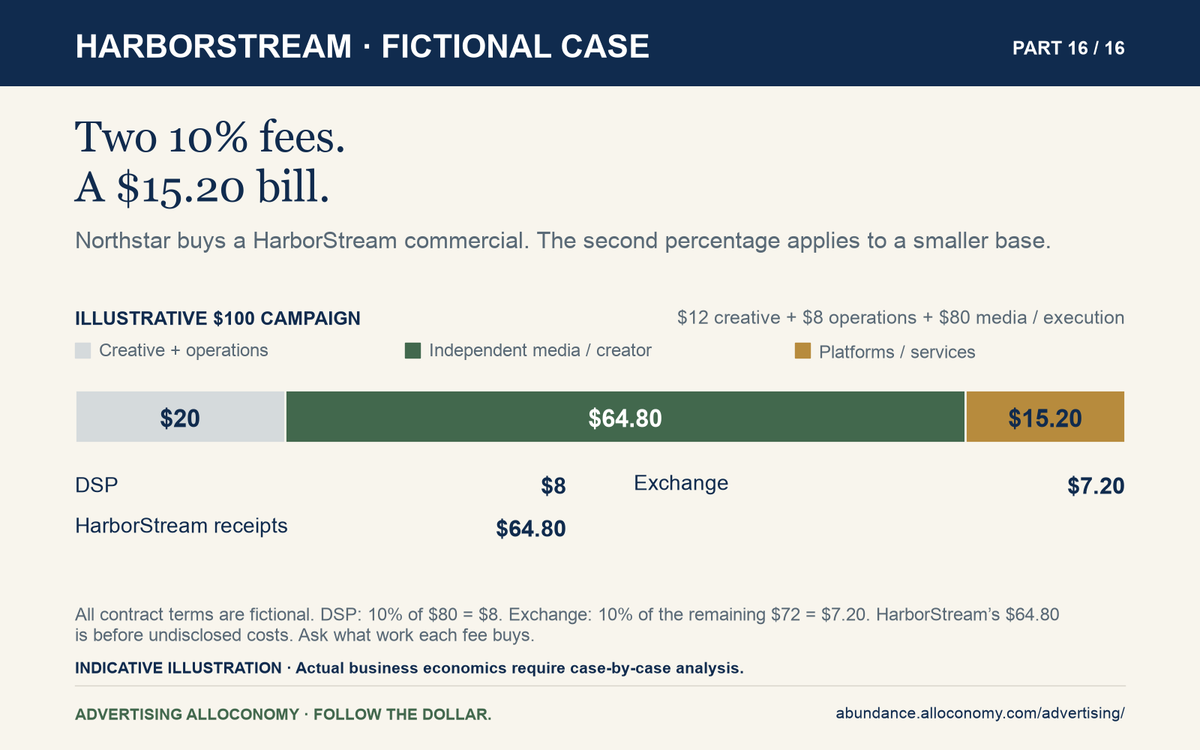
Northstar's external campaign expense is $100: $12 creative, $8 campaign operations, and $80 execution. The DSP deducts 10% of that execution amount. The exchange deducts 10% of the amount it receives. The remainder reaches HarborStream. Its content and distribution costs are not disclosed. The $8 operations charge covers a separate campaign-management service, so it does not duplicate the DSP fee.
The buyer is invoiced $20 gross execution CPM for 4,000 qualifying impressions. Its system recorded 10,000 bid requests, including duplicate descriptions and unsuccessful opportunities. The campaign optimizes toward purchases and reports $200 in attributed sales. A separate, competently designed lift study estimates $60 of incremental sales, with uncertainty that must accompany a spending decision. Contribution margin before advertising is assumed to be 40%.
Reconstruct before reading the answer
Identify the buyer, visible surface, authorized seller, transaction route, and billable event. Reconcile the $100. Determine whether Orbit receives $30 from this campaign, whether the exchange takes 10% of the original budget, and whether HarborStream's receipts are profit. Explain what the request count and attributed sales establish. Finally, propose a feasible way to replace the exchange and identify the evidence needed to judge that change.
Reveal the worked answer
The route. Northstar is the buyer. The surface is an in-program break in HarborStream's app, accessed through an Orbit device. HarborStream is the rights holder and authorized seller for this opportunity. Its exchange connects that supply to Northstar's DSP. The device supplies distribution, but its logo does not make it the seller of this particular break. Creative delivery and playback evidence connect the selected commercial to the qualifying impression; purchase optimization does not change the stated impression invoice.
The charge. The 4,000 qualifying impressions at $20 per thousand produce the stipulated $80 gross execution charge. The 10,000 requests are not 10,000 delivered ads: they include duplication and unsuccessful opportunities. Actual system records would need to connect selection, delivery, qualification, and billing without counting those stages as interchangeable events.
Follow the dollar
The HarborStream campaign allocation
Fictional assessment · USD · $100 total external campaign expense.
Each ribbon ends at a recipient or disclosed bundle. Widths show final allocations, not the order of payments.
Exact amounts and accessible table
| Recipient | USD from original $100 |
|---|---|
| Creative supplier | $12.00 |
| Campaign operator | $8.00 |
| DSP | $8.00 |
| Exchange | $7.20 |
| HarborStream receipts | $64.80 |
| Total | $100.00 |
Total external campaign expense$100.00
All contract terms are invented for this assessment. The DSP fee is 10% of $80; the exchange fee is 10% of the remaining $72. HarborStream’s receipts precede undisclosed content and distribution costs.
| Final allocation | Calculation | Dollars from the original $100 |
|---|---|---|
| Creative supplier | Stipulated external expense | $12.00 |
| Campaign operator | Stipulated separate service | $8.00 |
| DSP | 10% of $80 | $8.00 |
| Exchange | 10% of the remaining $72 | $7.20 |
| HarborStream receipts | $72 minus $7.20 | $64.80 |
| Total | All endpoints | $100.00 |
The unsupported inferences. Orbit's 30% agreement concerns eligible opportunities, not 30% of this campaign's cash. This commercial is in HarborStream's retained inventory; no separate payment to Orbit is specified in the campaign allocation. There may be relevant distribution obligations elsewhere, but the case does not quantify them. The exchange's local 10% is 7.2% of the original campaign budget. HarborStream's $64.80 funds undisclosed costs and obligations before any profit. Neither its margin nor a further rights-holder split can be calculated from these facts.
The advertiser result. Attributed ROAS is 2.5× if the report divides $200 by the $80 execution charge; it is 2× against the full $100 expense. Both require an explicit denominator. Using the lift estimate, incremental contribution before advertising is $60 × 40% = $24; after the full campaign expense it is negative $76. That is a point estimate under the stated assumptions. The uncertainty in lift and any omitted economic effects must be considered before using it to forecast a larger campaign.
A feasible replacement. Northstar and HarborStream could investigate an authorized direct programmatic integration or a different exchange with access to these rights. Someone must still provide eligibility and auction/deal execution, demand access, technical integration, event reconciliation, settlement, and support. Compare net receipts and advertiser results after replacement costs, latency, measurement quality, and any lost demand are included. The diagram's $7.20 is an identified charge, not automatically $7.20 of recoverable waste. Sign-off on removal requires a viable substitute and evidence that the whole transaction improves.
The strongest answer identifies what the records establish and stops where the evidence stops. That is the skill needed to read a new product announcement, inspect a revenue model, or challenge an appealing but unsupported claim in a leadership meeting.
A product map to keep
| Product or label | Economic role and route | Relevant parts |
|---|---|---|
| Sponsored Products | Product promotion; central CPC shopping route plus supported external placements | 4 |
| Sponsored Brands / legacy Headline Search | Brand discovery on Amazon; CPC, vCPM, or eligible reservation | 5 |
| Display / formerly Sponsored Display | Contextual or audience display, including supported external destinations | 6 |
| Amazon DSP / legacy AAP | Buyer technology spanning owned and external media, auctions and deals | 2, 3, 6, 11, 13 |
| DVA | Display, Video, and Audio portfolio grouping; no single universal transaction | 3, 6, 9, 11, 13 |
| Managed display / direct display | Service arrangement and/or commercial reservation; inspect the actual offer | 3, 6 |
| Streaming TV / earlier Sponsored TV | Streaming-content advertising with sponsored-console and DSP routes | 11 |
| Fire TV Sponsored Tiles | Device-interface content/app promotion; CPC in the selected setup, with CPM under other supported objectives | 12 |
| APS UAM / TAM | Publisher-side demand coordination and associated commercial arrangements | 2, 6 |
| Amazon Marketing Cloud | Measurement and audience collaboration, rather than a sellable slot | Part 14 |
Eligibility, availability, and terms remain product- and market-specific. The primary sources appear in the tours. This map does not imply that each product can buy every Amazon surface: Sponsored Brands is not a generic Fire TV banner, and Sponsored Products is not every sponsored tile.
Compare functions before corporate names
| Company or platform family | Roles illustrated in this series | First analytical question |
|---|---|---|
| Amazon | Retailer, media owner, buying platform, publisher services, measurement | Which role earns this dollar? |
| Search/video owner, buyer tools, publisher ad serving, app monetization | Is the inventory owned or third-party? | |
| Meta | Consumer distribution, native auction, optimization, measurement | What is optimized and what is billed? |
| Netflix | Content/viewing service, ad technology, direct and programmatic inventory | Which rights, countries, and buying routes apply? |
| Roku | Distribution interface, media, supply technology, buyer/data products | Is the ad on Home, in owned content, or in another app? |
| The Trade Desk | Buyer platform serving advertiser and agency relationships | What spend is handled and what becomes revenue? |
| Independent SSP/exchange | Supply access, auctions, publisher monetization | What differentiated access, demand, or service is supplied? |
| Verification/data provider | Measurement, quality assessment, audience or identity inputs | What can it observe and what can it establish? |
The platform rows summarize the cited product documentation; the final two describe functional archetypes whose contracts vary. The Trade Desk's annual report explains its platform, customer relationships, and revenue model. The Trade Desk 2025 annual report
What this changes for you: choosing who earns a place
The final case turns the map into a reusable way to evaluate a supplier, a product proposal, or a business.
If you are Maya
Judge the bargain you actually receive.
Maya's concern is useful content, tolerable interruption, appropriate data choices, and a good purchase decision. A route with fewer intermediaries does not automatically improve those things. She can recognize commercial incentives without assuming that every fee harms her or that every supposedly free experience offers the same tradeoff.
If you work for the advertiser
Make the replacement proposal complete.
Before removing the fictional exchange's $7.20 charge, specify who supplies its access, execution, reconciliation, and support. Compare the alternative's full cost and outcomes. If measurement suggests the campaign itself adds too little contribution, renegotiating one fee may be insufficient; changing the campaign or reducing spend also belongs in the decision.
If you work in a business earning the ad dollar
Turn the removal test into a product priority.
Ask what the customer would have to rebuild or lose if your service disappeared. Use that answer to choose work that improves access, quality, operating effort, or evidence. A leader can challenge a growth target that rewards more transactions while customer economics deteriorate; an employee can make that tradeoff visible with a concrete case.
If you are an investor
Build the thesis around a defensible economic role.
Identify the customer, revenue trigger, onward obligations, differentiated capability, and reason customers might switch. Then test whether expected earnings and cash generation justify the investment price under plausible alternatives. The one-transaction brief exposes assumptions; it cannot turn the fictional HarborStream example into a valuation of a real company.
Decision to take away: finish the sentence, ‘I would change this allocation if the evidence showed…’ A useful conclusion specifies a choice and the fact that could reverse it.
Maya, Northstar Audio, City Ledger, and the assessment companies are fictional. Dollar examples are teaching scenarios unless explicitly labeled as disclosed rules or dated benchmarks. Provider illustrations show placement examples, not independently verified live campaigns. Product availability and terms vary by market; the main lens is the United States. Source links sit beside the claims they support.