Advertising Alloconomy, Part 2: How the Open Web Divides the Dollar
One page load reveals competing requests, buying decisions, delivery, and the difference between a bid and a bill.
At the screen
It is 8:10 a.m. Maya opens a City Ledger article about commuter trains. The headline arrives first. Beside it, the page reserves an empty rectangle. Maya begins reading while a market assembles around that space.
Our chosen route is an open-web display purchase: Northstar Audio buys through a demand-side platform, an SSP/exchange offers City Ledger's inventory, and the publisher's ad-serving system coordinates the final selection. Northstar pays for qualifying impressions under a CPM arrangement. The new idea is that one visible placement can depend on several separately operated businesses—and several competing routes to the same opportunity.
The preparation happened before Maya arrived. City Ledger configured its ad unit, partners, delivery rules, and privacy choices. Northstar supplied a headphone creative, targeting instructions, bids, and a budget. Her visit activates those arrangements; it does not create a campaign from scratch.
Advertising Alloconomy · Placement map · Part 2
Open-web display
Northstar buys access to a City Ledger page through separate buying and selling systems.
Read from the advertiser toward the audience. Connections show roles in the chosen route, not cash transfers or request timing.
- SSP / exchange: offers supply
- Publisher ad server: selects and serves
Several auction paths can compete for the same placement.
This shows one selected commercial route. Requests usually travel from the publisher toward buyers, and responses return. A header-bidding wrapper may contact several partners; a win inside an SSP is not necessarily the publisher’s final selection. SSP and exchange roles can be bundled. The publisher ad server is a function, not automatically another separately charged company.
Simplified teaching map. Company boundaries and contracts vary; one box does not mean one company or one fee. Dollar allocations appear in the separate money-flow diagrams. Those figures are indicative; actual business economics require case-by-case analysis.
Behind the placement
The page's ad code, or a server acting for it, requests an ad. A header-bidding wrapper may solicit several supply partners while a primary ad server considers their offers alongside other eligible demand. Calls can run in the browser or between servers. An SSP and an exchange may be functions within one business, so the route need not contain a separate company for every label. Prebid introduction Open Bidding
| Role and examples | Work that makes this placement possible | What must replace it if removed |
|---|---|---|
| Publisher: City Ledger | Create the reading experience and control its placement | Another audience relationship and media owner |
| Ad server / wrapper: Google Ad Manager, FreeWheel, Prebid | Coordinate commitments, competing offers, and delivery records | Equivalent publisher orchestration |
| SSP/exchange: Magnite, PubMatic, Index Exchange, OpenX | Connect seller inventory to demand and enforce transaction rules | Direct demand connections and selling machinery |
| DSP: The Trade Desk, DV360, Amazon DSP, Yahoo DSP | Evaluate opportunities across sellers and pace campaign spending | Another buying system, direct integrations, or a narrower purchase |
| Data / verification: LiveRamp, DoubleVerify, IAS | Add permitted signals or independently inspect delivery when purchased | Alternative evidence, native tools, or reduced coverage |
The request describes an opportunity: site, placement, supported formats, device context, price floor, deal identifiers, and available privacy-constrained signals. It need not identify Maya by name or reveal her shopping history. Northstar's DSP asks whether an eligible campaign should bid. Wrong context, an exhausted budget, frequency limits, incompatible creative, or an unattractive price can all produce a pass. OpenRTB 2.6
Suppose two supply routes return fictional publisher-net offers of $4.80 and $5.10 CPM. A reserved campaign may also qualify. An offer that wins within one SSP can still lose when the publisher compares it with another source; a timeout can remove it altogether. Gross bids are not enough for this comparison: $6 through one path may leave the publisher less than $5.80 through another. Google's documented auction model also considers the probability of generating a billable impression when estimating publisher value. Exact priorities and optimization rules depend on the ad-serving system. Google's auction model Ad selection
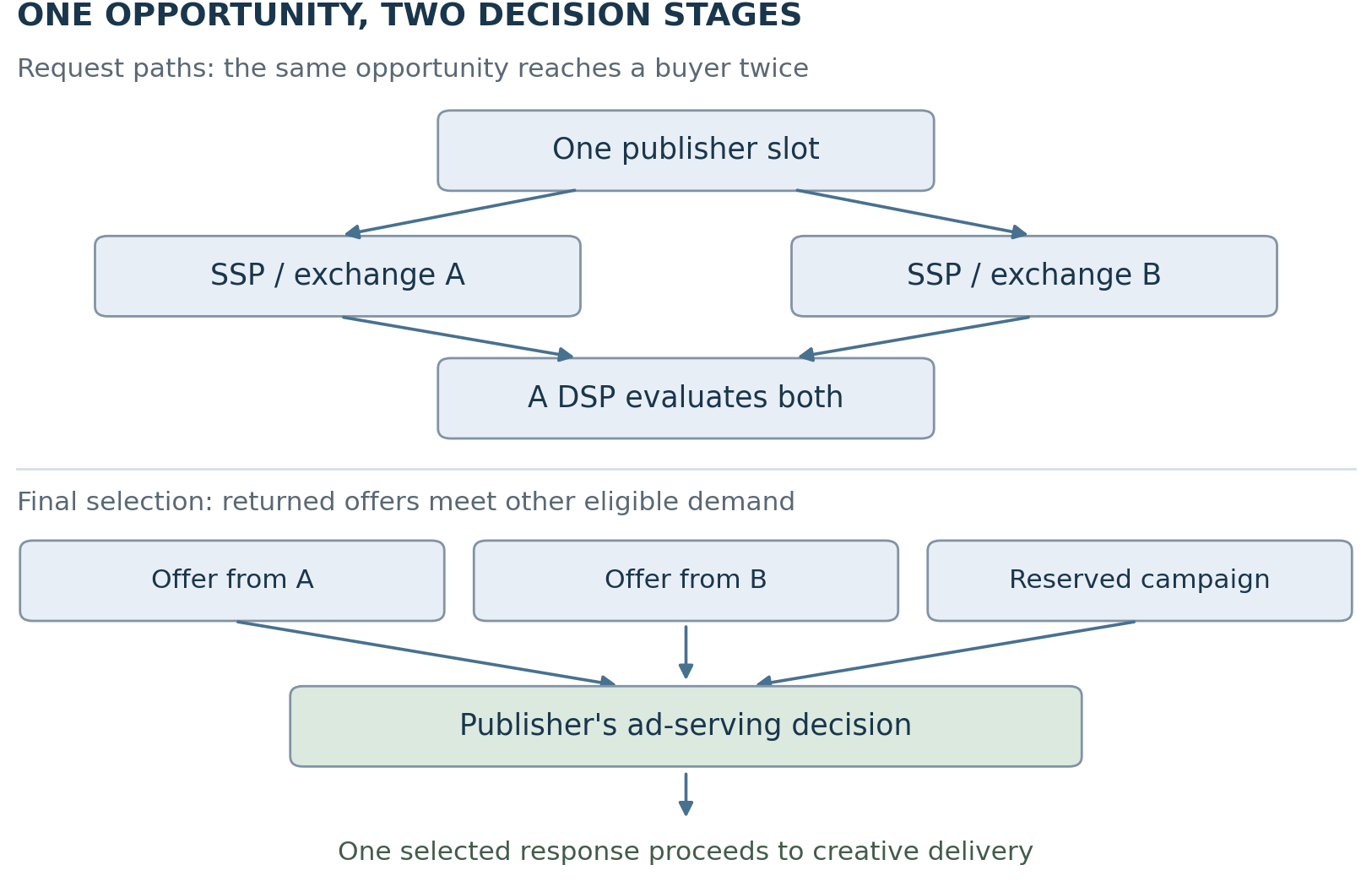
City Ledger selects Northstar's offer. The ad response contains the creative or instructions for fetching it. Delivery infrastructure retrieves the image, and the headphones appear. An impression signal can be recorded; a qualifying viewability event may follow. Maya might instead scroll away before qualifying visibility or a click. Selection, rendering, and viewability remain distinct events.
The charge and the dollar
Maya sees the headphones and keeps reading. She never clicks. A qualifying CPM impression can nevertheless create advertising cost: Northstar purchased an opportunity to communicate. After delivery, buyer and seller reconcile counted events, invalid traffic, discrepancies, and fees. Cash normally settles through aggregate commercial invoices, while a recorded event can precede the amount finally accepted for billing. Ad Manager impression counting Ad Manager revenue reconciliation
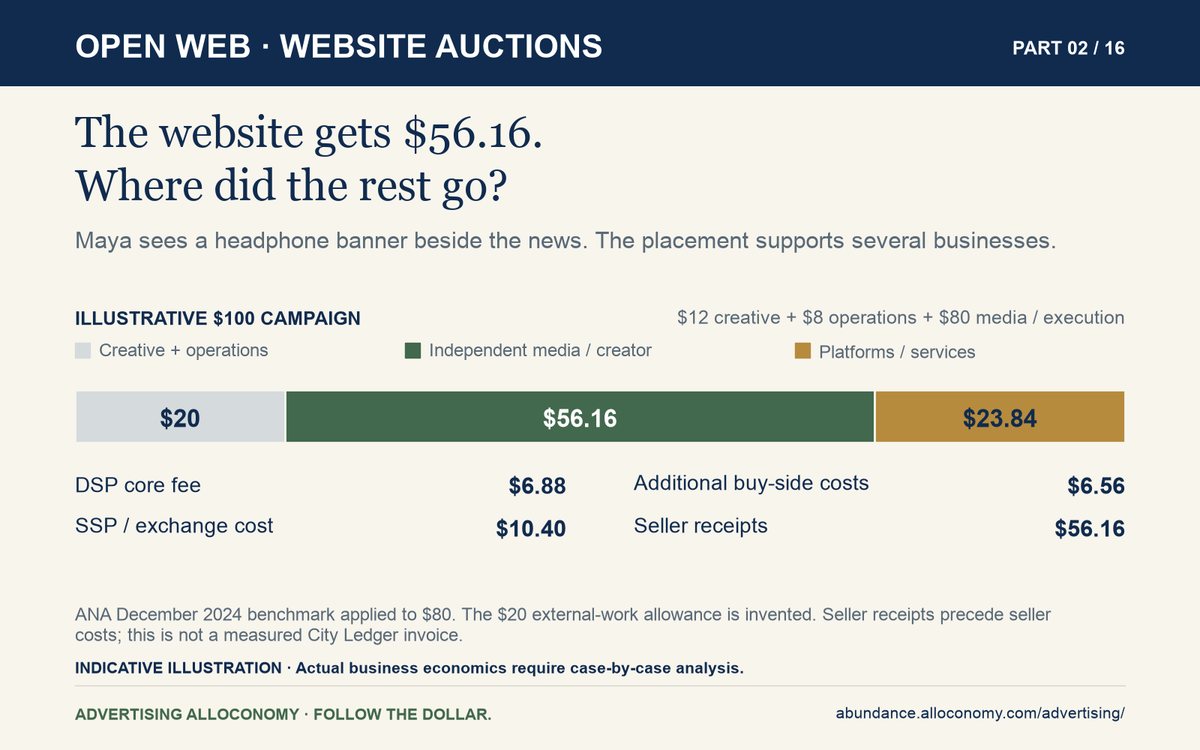
To put scale around this route, apply the December 2024 ANA benchmark to our shared $80 execution pool. This is a benchmark reconstruction, separate from the fictional bids above—not a measured City Ledger invoice.
Follow the dollar
The open-web allocation
Dated ANA December 2024 benchmark applied to an assumed $80 execution pool.
Each ribbon ends at a recipient or disclosed bundle. Widths show final allocations, not the order of payments.
Exact amounts and accessible table
| Recipient | USD from original $100 |
|---|---|
| Creative | $12.00 |
| Campaign operations | $8.00 |
| DSP core fee | $6.88 |
| Additional buy-side costs | $6.56 |
| SSP / exchange cost | $10.40 |
| Seller receipts | $56.16 |
| Total | $100.00 |
Total external campaign expense$100.00
The benchmark excludes agency and CTV. Creative and operations are teaching assumptions; seller receipts precede seller costs. Each amount is also its percentage of the original $100. These are final allocations, not a payment sequence.
The endpoints are $12 creative, $8 operations, $6.88 DSP core fee, $6.56 additional buy-side costs, $10.40 SSP cost, and $56.16 seller receipts: exactly $100. In the original sample, the corresponding execution percentages were 8.6%, 8.2%, 13.0%, and 70.2% of spend entering the DSP. The SSP percentage is derived from the reported totals. The sample excluded agency and CTV, and included both open and private programmatic routes. It supplies a dated scale reference, not an open-auction-only tariff. ANA benchmark
This picture allocates the advertiser's budget among economic endpoints; it does not claim each recipient receives a separate payment directly from Northstar. Nor does the additional-cost bucket disclose separate rates for data, verification, and serving. Those require transaction records. An exchange function already supplied by the SSP should not acquire an invented second fee, and publisher-paid technology may be funded later from seller receipts. City Ledger's $56.16 is before its operating costs.
What changes on another route
Google Ads buying AdSense for Content provides a different, disclosed share structure. Google's approximate mechanics applied to the same $80 yield $12 buying-side retention, $13.60 AdSense share, and $54.40 publisher receipts. The 20% selling-side rate applies to the $68 remaining after the buying-side amount. The external $12 creative and $8 operations remain outside the media route. This allocation replaces the ANA reconstruction; the two must never be added. An applicable platform-partner share needs its own stated line. AdSense share Google's 2023 explanation
A different privacy choice changes the available information. If Maya rejects optional tracking, contextual or other permitted targeting may remain possible. Cross-site frequency control and later attribution can become weaker without the placement disappearing.
A different source of demand can change the winner. The publisher might deliver a reservation or a house promotion. A filled rectangle is therefore not proof that an outside advertiser won an auction.
What this changes for you: the open web
A long route deserves inspection. Counting its boxes will not tell you which ones earn their place.
If you are Maya
Judge the advertisement separately from the article.
The headphone banner occupies space on City Ledger; it does not establish that the newsroom recommends Northstar. Maya can keep that distinction while deciding whether the offer interests her. Seeing an ad after declining optional tracking also does not, by itself, prove that her choice was ignored: contextual advertising is another possible route.
If you work for the advertiser
Compare routes to equivalent opportunities.
Ask the buying team to reconcile fees and seller receipts, identify repeated paths to the same supply, and compare quality and outcomes after costs. The illustrative $56.16 seller receipt is a prompt for investigation, not a target every campaign should hit. Removing a route helps only if useful demand, delivery, or evidence survives.
If you work in a business earning the ad dollar
Prove what your connection adds.
An SSP or exchange team should be able to show which demand, reliable transactions, or operating work a publisher would lose without it. A publisher should compare net proceeds alongside page speed and reader retention. More requests or a higher gross bid can look impressive while producing a worse reading experience or less settled revenue.
If you are an investor
Test whether access is distinctive.
Investigate whether buyers need this intermediary to reach valuable supply or can reach equivalent opportunities through another route. Examine customer concentration, fees retained, servicing costs, and cash collection. High transaction volume alone cannot establish bargaining power or durable earnings when several businesses handle the same underlying opportunities.
Decision to take away: choose one supply route and identify the evidence that would justify keeping it, changing it, or removing it.
Reconstruct the journey
The Guardian's billboard specification is an official placement demonstration offering the same horizontal position through direct display and programmatic buying. In the observed public-page example, a Guardian page displayed a podcast house banner. That establishes a visible promotion, not whether an external auction participated.
Visit an ad-supported newspaper and find an advertising label, a filled slot, and any empty reserved space. Record the page, device, time, and consent state. Reconstruct opportunity, selection, delivery, charge, and settlement, marking what you observed and what remains unknown. An empty slot alone does not prove an absence of demand.
Finally, remove one supply partner from your drawing. Was it a duplicated resale route, or the only connection to distinct advertiser demand? Explain what replaces its work and compare publisher-net proceeds, reliability, and access. Fewer boxes improve the outcome only if the remaining route does the necessary work better.
Maya, Northstar Audio, City Ledger, and the assessment companies are fictional. Dollar examples are teaching scenarios unless explicitly labeled as disclosed rules or dated benchmarks. Provider illustrations show placement examples, not independently verified live campaigns. Product availability and terms vary by market; the main lens is the United States. Source links sit beside the claims they support.