Activity-Based Costing: Follow the Work
Two orders can bring in the same money and create very different work. Ten simple ideas help us see why, from Prime and streaming to delivery and software.
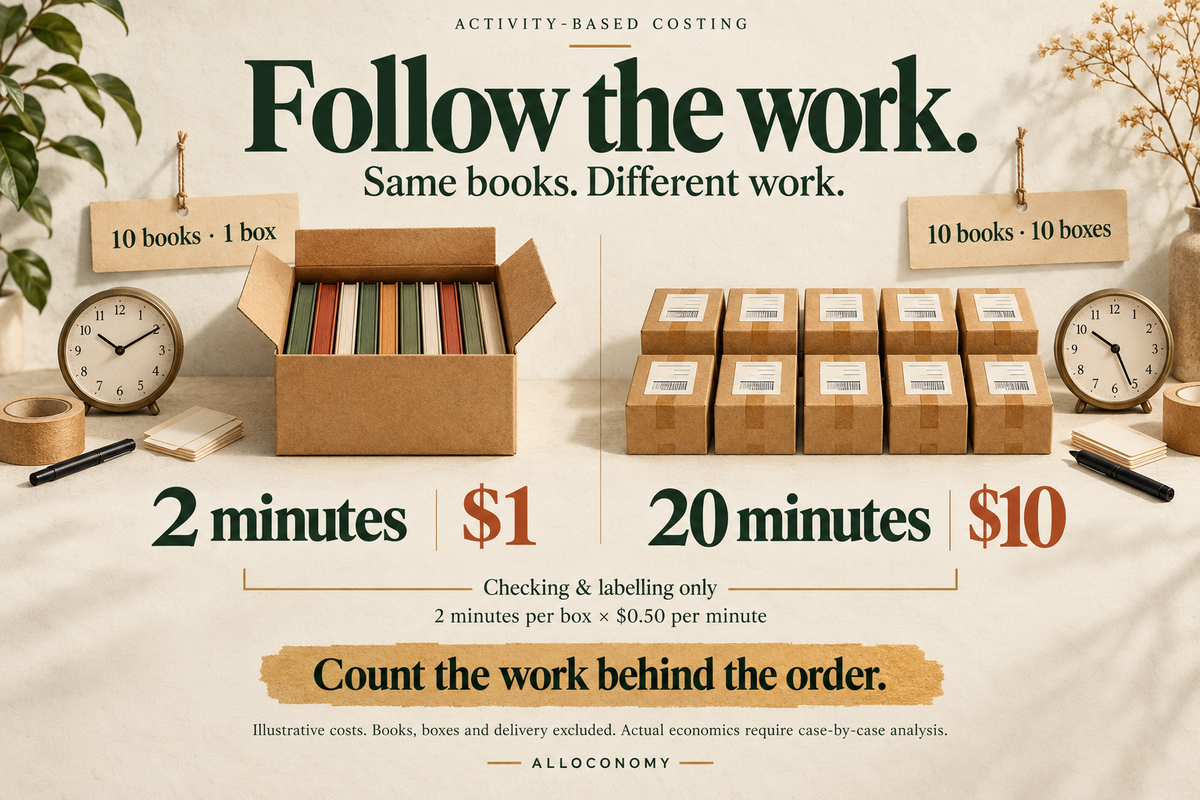
Two orders. Different work.
Maya and Mayan are packing books for a school fair. One teacher buys ten books in one box. Ten other teachers each buy one book in a separate box.
Both groups buy ten books. But the second group needs ten boxes, ten labels and ten separate handovers. Counting only the books misses much of the work.
That is the starting point of activity-based costing, or ABC. An activity is a piece of work: packing a box, answering a question or checking a booking. A cost is the money used to provide something. ABC connects the two.
Instead of dividing every shared bill equally, we ask which activities used the resources. Resources are the things needed to do the work: people's time, space, equipment and supplies. A mental model is simply a useful way to think about a problem.

Follow one small example
Imagine that checking and labelling each box takes two minutes. The first group needs 2 minutes. The second needs 20 minutes. Suppose this packing time costs the business 50 cents a minute.
The packing work is then assigned $1 for the first group and $10 for the second. These are invented teaching numbers, covering this activity only. The books, boxes and delivery would be counted separately.
The question becomes practical: could the second group collect its books together? Would people pay for separate delivery? Could a clearer label form make packing faster? ABC helps us see which promise creates which work.
The ten-idea cheat sheet
| Idea | In plain words | A useful question |
|---|---|---|
| 1. Costs follow work | What we promise customers creates jobs to do. | What work happens next? |
| 2. Work happens at different levels | Some work happens per item, some per batch, some for the whole service. | What makes this job happen again? |
| 3. Averages can hide differences | Equal sales do not mean equal work. | Who uses more of the shared help? |
| 4. Count what causes the work | Use a measure that fits the activity. | Should we count orders, minutes or space? |
| 5. Ready time and used time differ | A team can be ready even when no customer needs it. | How much available time did we use? |
| 6. Extra steps add up | Similar orders can need different steps. | What makes this job take longer? |
| 7. Follow the whole customer journey | Selling is only the start of serving someone. | What help comes before and after the sale? |
| 8. Ask what would actually change | Moving a cost in a report does not remove a bill. | Which money comes in or goes out differently? |
| 9. Give saved time a job | Faster work creates useful room in the day. | What will we do with that time? |
| 10. Keep the model useful | Measure the differences that help a decision. | Would more detail change what we do? |
The same questions fit very different businesses
Amazon Prime brings several benefits into one membership, including delivery, Prime Video and Amazon Music benefits. One member may watch often; another may order many parcels. One membership count cannot describe all those activities. Amazon's overview.
YouTube and Netflix both deliver video, but we must name the business we are studying. A creator making a YouTube video does different work from YouTube running the platform. A Netflix example starts with Netflix's own service activities.
Walmart Fulfillment Services stores and ships sellers' products. DoorDash connects customers, merchants and delivery work. A hotel booking site checks listings and helps with bookings. A software subscription business keeps an app running and helps people use it. Each gives us a different place to practise following work.
Why this matters
A business owner can use this map to improve a service or understand a price. An employee can spot repeated work. A customer can see why an extra promise may need extra effort. An investor can ask how work might grow as sales grow.
Start with the ten ideas, then read one essay at a time. Each introduces a simple example before applying the idea to a business. All numbered examples are invented; they do not reveal the named companies' internal costs.
Try it
You sell twelve cookies. Is one box of twelve the same work as twelve gift-wrapped boxes of one? Name two activities that change. Answer: wrapping and labelling repeat more often, even though the cookie count stays the same.
Where the idea comes from
The series adapts the ten-model structure from our earlier research into short, original teaching examples. ACCA's ABC explanation supports following activities and choosing measures. Kaplan and Anderson explain available and used capacity. These ten labels are our reading map, not an official list.