A Cost on Paper Is Not Always Money You Can Save
Dropping an activity does not cancel every bill assigned to it. A school-fair table and a software service show how to ask the right savings question.
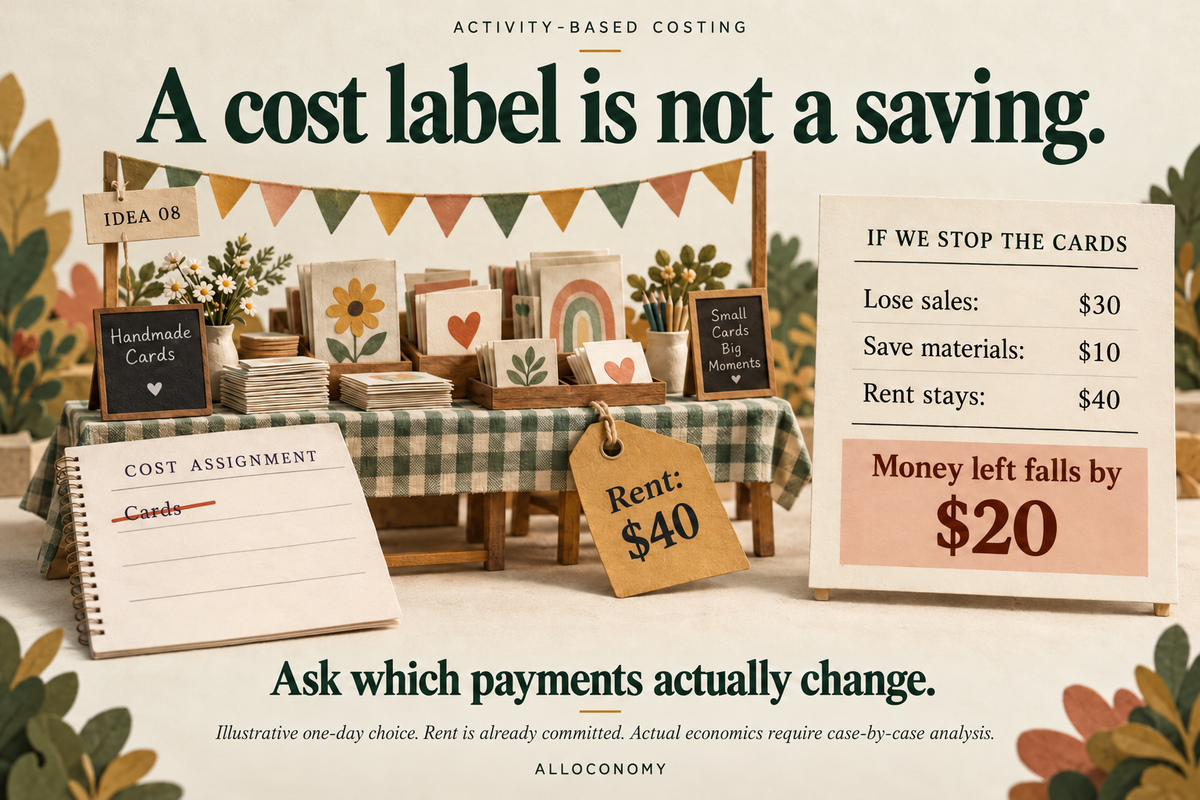
The table is already rented
Maya rents a school-fair table for $40 for the day. She sells handmade cards and bookmarks. She assigns half the table cost, $20, to each activity in her notebook.
Cards bring in $30 and use $10 of paper and envelopes. After assigning $20 of rent, the card activity appears to leave nothing.
“Should I stop selling cards?” she asks.
Mayan asks a different question: “Will stopping the cards change what you pay for the table today?” The answer is no. The $40 table booking is already committed for the day.

Compare the two choices
If Maya sells the cards, she receives $30 and spends $10 on their materials. She has $20 more to help pay the table bill.
If she stops the cards, she loses the $30 of sales and saves $10 of materials. The rent stays the same. She has $20 less money left.
The assigned rent was useful for thinking about the whole stall. It was not a promise that $20 of rent would disappear if the cards did.
The decision rule is simple: compare the money and work that would actually change, over the period you care about.
Apply it to a SaaS feature
Imagine a software business assigns part of its monthly support-team cost to a feature. Removing that feature may reduce support requests. But if the team's pay stays the same next month, the assignment does not become an immediate payroll saving.
The released time may still be useful. The team could help other customers sooner. We examine that next. The first step is to describe the benefit accurately: less work or more available time, rather than an invented fall in a bill.
If a separate supplier charge really ends when the feature ends, that is a different line in the decision. Follow the actual agreement and payment.
Apply it to video services
Imagine a streaming service deciding whether to remove a title. A cost assigned to that title in a report does not, by itself, say what payment would stop. The decision needs information about the relevant commitments, future receipts and work.
We do not need to learn complicated contracts to understand the basic model. Ask two plain questions: “What would we stop paying?” and “What would we stop receiving?” A cost allocation alone answers neither.
Try it
A stall pays a fixed $50 daily rent. Selling badges brings in $25 and uses $8 of materials. If it stops badges while keeping the same stall, what changes? Answer: it loses $25, saves $8 and has $17 less left toward rent and other bills.
Carry this idea: deleting a row in a cost report does not delete the bill behind it.
Source
ACCA: Relevant costs explains comparing future cash flows that change because of a decision. All figures above are illustrative.