The Trouble with Splitting Every Bill Equally
Two customers pay the same amount, but one needs four times as much help. A small software example shows what an average can hide.
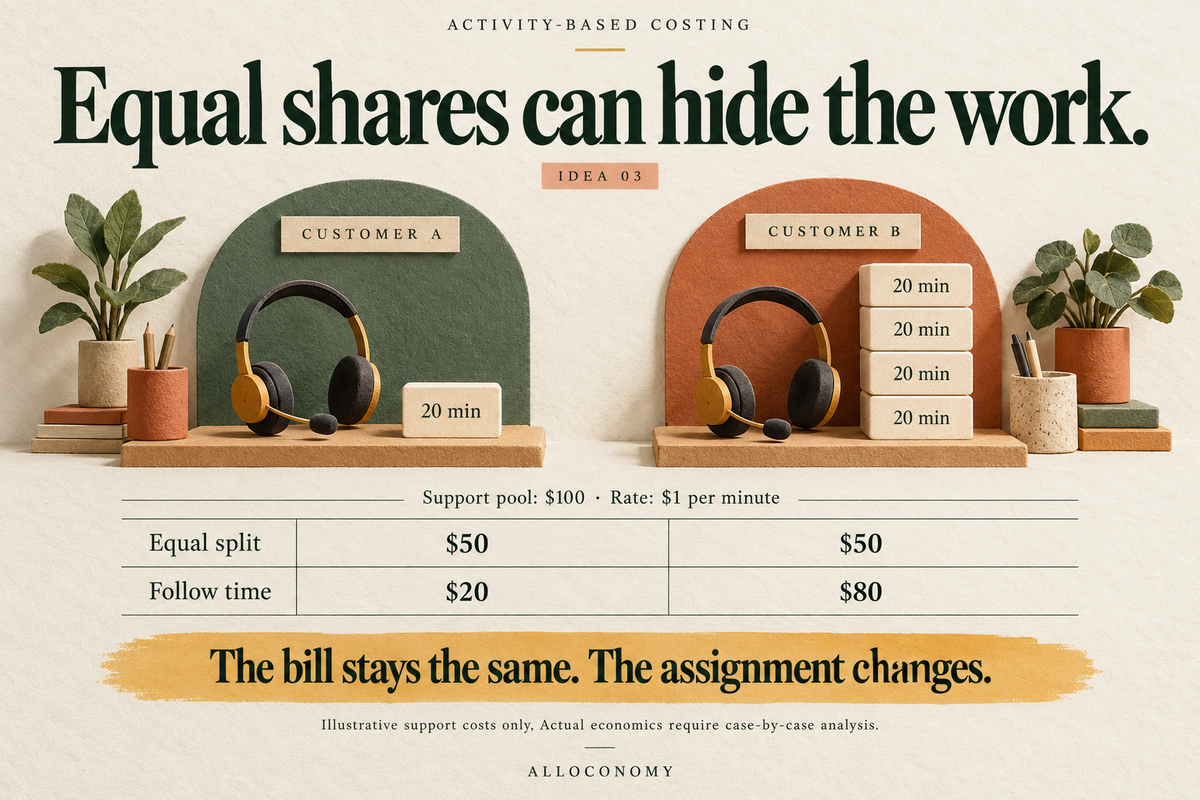
A fair-looking split can hide the work
Maya and Mayan share an art room. Maya uses it for one hour; Mayan uses it for four. If they split the room bill equally, the maths is easy. But equal shares do not describe equal use.
A business can make the same mistake with support costs. “Two customers, so half each” sounds tidy. It can hide a large difference in the help each customer needs.
An average is a total divided by a count. An average can be correct for the group while giving a poor picture of its individual members.

Two software customers
A software-as-a-service business, or SaaS business, lets customers use an app over the internet, often for a subscription. Think of an online tool for keeping a shop's appointments.
In our invented example, two customers each pay $100 a month. Customer A needs 20 minutes of support. Customer B needs 80 minutes. Suppose these 100 minutes use the whole $100 support pool for the period. A pool is simply a group of related costs.
An equal split assigns $50 to each customer. Following support time gives a rate of $100 ÷ 100 minutes = $1 per minute. A is assigned $20; B is assigned $80.
| Support cost only | Customer A | Customer B | Total |
|---|---|---|---|
| Equal split | $50 | $50 | $100 |
| Follow support minutes | $20 | $80 | $100 |
No bill changed. We changed our picture of who used the support. These are support costs only, so the remaining money is not the company's final profit.
What should the business do?
It could examine why B needs more help. Perhaps setup instructions are confusing. Perhaps B bought a more demanding service. Perhaps a useful training session would reduce repeated questions.
ABC makes those conversations more specific. It does not say that a customer needing help is a bad customer. The business may earn enough from the relationship to make the help worthwhile.
Apply it to Prime and delivery
Imagine two Prime members paying the same membership fee. One mainly uses video and music. The other mainly uses parcel delivery. Membership count alone will not describe their use of each service. The first step is to separate the activities, then find measures that fit them.
Likewise, two delivery orders can have the same sale value while needing different support. An easy-to-find address and a mistaken address do not necessarily create the same work. We would investigate the actual tasks rather than treating the sale amount as a complete explanation.
Try it
Two hotel bookings earn the same fee. One needs no help; the other needs three long support calls. Would dividing support costs equally reveal that difference? Answer: no. Calls or support minutes might explain it better, depending on how similar the calls are.
Carry this idea: a correct total does not guarantee a useful split.
Source
ACCA's ABC explanation contrasts broad allocations with activity measures. Salesforce's SaaS definition provides the software-service context. All amounts and customer patterns here are invented.