Ready to Help Is Different from Busy Helping
A support team costs money while it waits as well as while it helps. A 100-minute example makes available capacity and unused capacity easy to see.
The quiet hour still exists
Mayan opens a help desk for an afternoon. Some people come with questions. At other times, he waits, ready to help.
The waiting time is not imaginary. He made the time available even though nobody used it. A business that pays a help team faces the same difference.
Capacity means how much work a resource can do. For a help team, we can often express it as minutes available for helping. For a warehouse, it might be space available for storing goods.

Buy 100 minutes, use 60
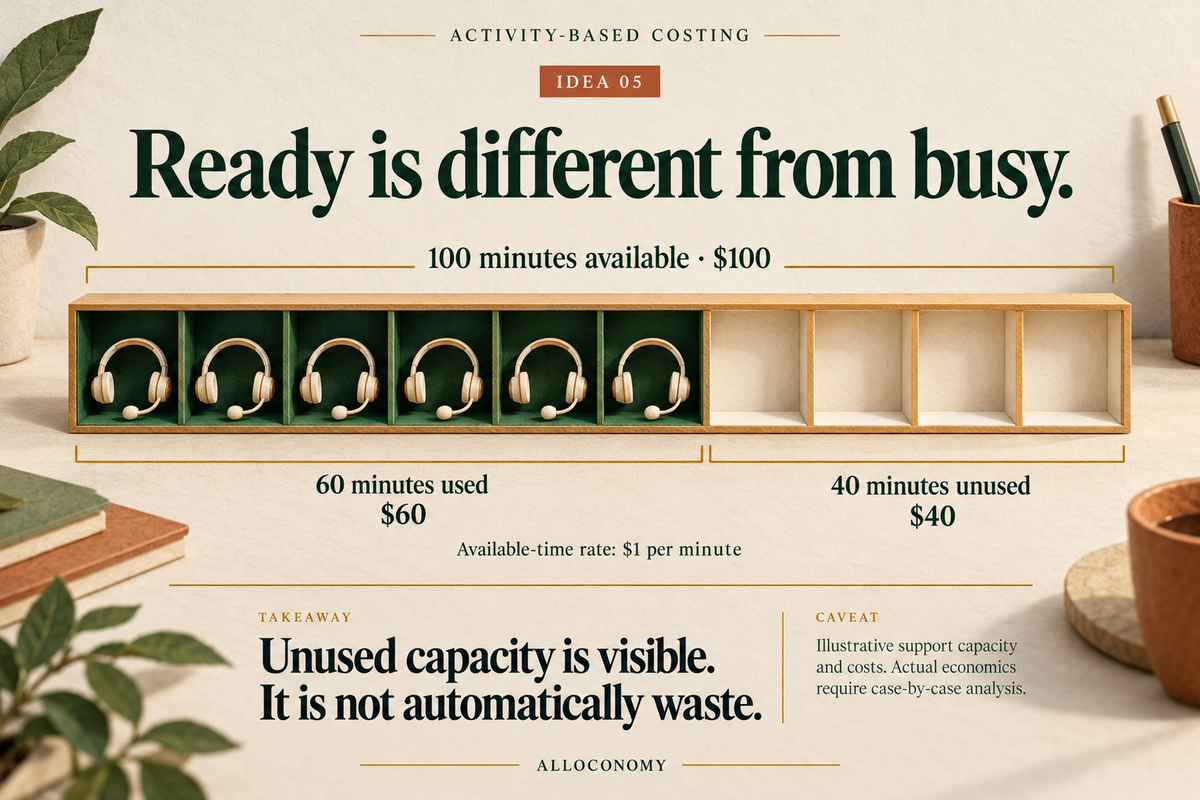
Imagine a small software help team. After allowing for breaks and other necessary work, it has 100 useful support minutes in a period. Providing that time costs $100. These are invented numbers.
The cost of available support time is $100 ÷ 100 = $1 a minute.
Customers use 60 minutes. Their support work receives 60 × $1 = $60. The remaining 40 minutes, worth $40, are shown as unused capacity.
We can still explain the whole bill: $60 used + $40 unused = $100 supplied.
If we instead divide the whole $100 by only the 60 busy minutes, we get about $1.67 per busy minute. That mixes two questions: how costly it is to provide time, and how much of that time customers used.
Why keep the unused part visible?
The manager can now ask a clearer question: why were 40 minutes unused? Perhaps it was a quiet day. Perhaps the team needs spare time to answer quickly when several people need help together.
Unused capacity is not automatically waste. It is simply capacity we should see and understand. The goal is not to keep every person busy every second.
Apply it to Walmart fulfillment and SaaS
A warehouse can have shelf space ready before goods arrive. Empty shelf space and occupied shelf space are different states of the same resource. Hiding the empty part in every stored item's cost can make slow periods look like the items themselves became harder to store.
A SaaS company can also have support capacity ready before customers ask questions. The little example above helps distinguish the resource it provides from the portion customers use.
We have measured only one resource group. This is not the cost of running the entire warehouse or software company.
Try it
A team provides 200 useful minutes at a cost of $100. Customers use 150 minutes. What is the rate, and what remains unused? Answer: 50 cents per minute; $75 used and $25 unused.
Carry this idea: show what you made available, what customers used, and the difference between them.
Source
Kaplan and Anderson's explanation of time-driven ABC supports separating practical capacity supplied from capacity used. The small numbers here are original teaching examples.