A Useful Map Does Not Need Every Pebble
Start with the work that matters. A simple map of delivery, streaming or software can teach more than a huge spreadsheet nobody can explain.
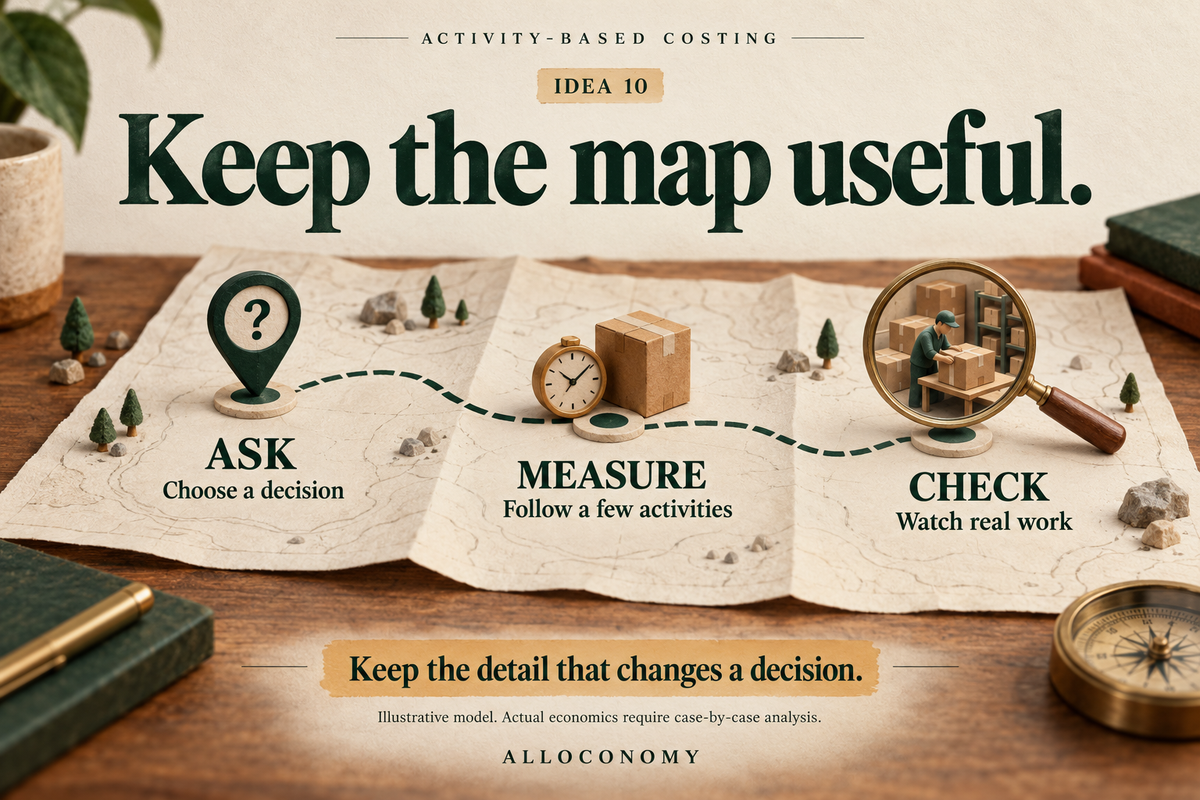
A map helps you get somewhere
Maya draws a map from home to the library. She includes the streets, a crossing and the library door. She does not draw every leaf on every tree.
Her map leaves things out, yet it helps Mayan arrive. A useful cost model works the same way. It should include enough detail to explain the work and support the decision.
Collecting information also takes time. If people spend all afternoon recording tiny differences, the model itself has become another job.

Start with one useful question
Imagine a small subscription app whose support team is overloaded. The owner wants to know where the team's time goes.
A first study might separate three activities: helping customers get started, answering everyday questions and fixing billing problems. For a short sample, the team records minutes spent in each group.
Suppose the sample shows 60 minutes on setup, 30 on everyday questions and 10 on billing. Setup deserves a closer look. Perhaps one confusing step is causing repeated calls.
The study does not need 200 categories to reveal that lead. Nor should the owner assume one small sample describes every future week. Watch more real work as needed and update the map when the process changes.
Put the ten ideas together
First, state the decision. Then name the customer promise and the activities it creates. Notice whether each activity happens per item, per group or for the service as a whole.
Choose measures that fit the work. Use them to compare resource use instead of assuming equal shares. Show available and used capacity separately when that distinction matters. Include the extra steps and the whole customer journey relevant to the question.
Before taking action, ask what money and work would actually change. If time is freed, choose what to do with it. Finally, keep only the detail that helps explain or improve the decision.
Try the map in another business
For a Prime example, begin with separate paths for delivery, video and music. One membership count is too broad for all three.
For YouTube or Netflix, decide whether you are studying content work, delivery of viewing sessions or account support. For YouTube, also distinguish a creator's business from the platform.
For Walmart fulfillment, separate storage, packing and returns. For DoorDash, separate the platform, merchant and Dasher. For hotel listings, separate listing checks, bookings and support. For SaaS, separate setup, running the app and helping customers.
These are starting maps, not complete models of those companies. The real work should tell us what to add next.
Try it
A shop wants to reduce the time spent correcting wrong addresses. Which is more useful first: recording the colour of every package, or counting address corrections and the minutes they take? Answer: corrections and minutes. They connect directly to the decision.
Carry this idea: a model earns its detail by helping someone understand the work or choose a better action.
Source
IMA: Implementing Activity-Based Costing provides a practical implementation framework. The simple starting maps and examples above are our teaching synthesis.