Give Saved Time a Job
Saving ten minutes does not decide what happens next. A packing team, a hotel listing site and a software business show how to make freed time useful.
Finishing early creates a choice
Mayan finds a quicker way to label parcels. Maya's team finishes its packing work twenty minutes earlier.
What has improved? The team has more time available. What happens to that time is the next decision.
It could pack more orders, fix repeated mistakes, answer customers sooner or provide a less rushed day. A time saving becomes useful through a chosen next action.

Follow twenty minutes
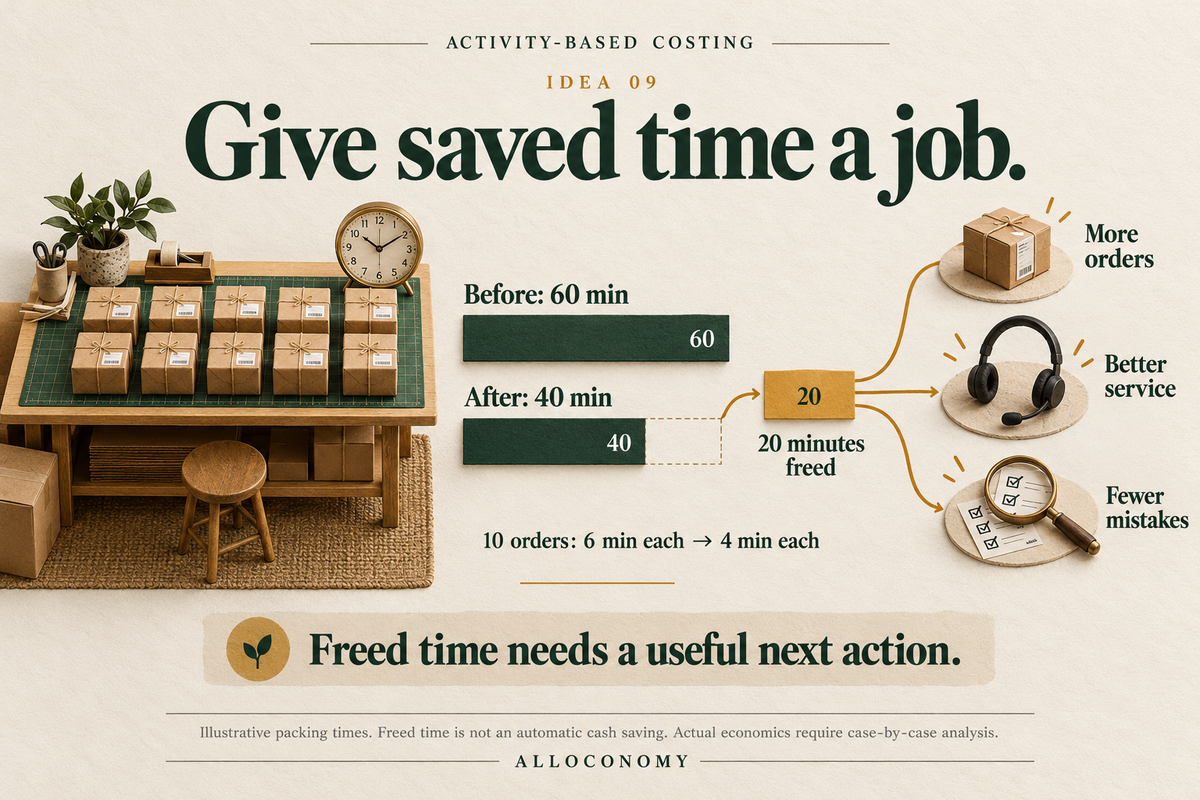
In our invented example, ten orders each take 6 minutes to pack. Total time is 10 × 6 = 60 minutes.
A clearer process reduces each order to 4 minutes. Total time becomes 10 × 4 = 40 minutes. The team frees 20 minutes.
At the new 4-minute rate, those twenty minutes could fit five more similar orders. That is capacity for five orders, not proof that five paying orders will arrive.
If there is demand, the team may use the time for extra orders. If customers are waiting for help, it may improve response times. If extra paid overtime would otherwise be needed, the change might avoid some of that spending. We must check which outcome actually happens.
The bill may stay the same
Suppose the team's pay for the day stays fixed. Completing the ten orders faster does not automatically reduce today's payroll bill. That does not make the improvement worthless. It means we should name its benefit honestly.
“Twenty minutes freed” is an observed operating result. “Twenty dollars saved” needs a separate explanation of which payment changed.
This is why work measures and money measures belong together. Each tells a different part of the story.
Apply it to hotel listings and software
A hotel listing site could replace repeated questions with a clearer form. Reviewers might then spend less time asking for missing information. The freed time could help them review more listings or check quality more carefully.
A SaaS business could improve a confusing setup screen. Fewer setup calls could let its support team answer other questions sooner. The company should check both that the calls fell and that customers still completed setup successfully.
In each example, the sequence is the same: identify the changed activity, measure the time freed, choose its use and check the result.
Try it
A team frees 30 minutes. Similar jobs now take 5 minutes each. How many more could fit? Answer: six. What else must be true before calling those six extra sales? Customers must want them, and the business must be able to complete the other required work.
Carry this idea: when you say “we saved time,” finish the sentence with “and here is how we used it.”
Source
ACCA: Activity-based management connects activity analysis with improvements. The scenarios and calculations here are original teaching examples.