One Item, One Batch, One Service
Packing a parcel, unloading a truck and running a warehouse repeat for different reasons. Learn to spot the difference with fulfillment and streaming.
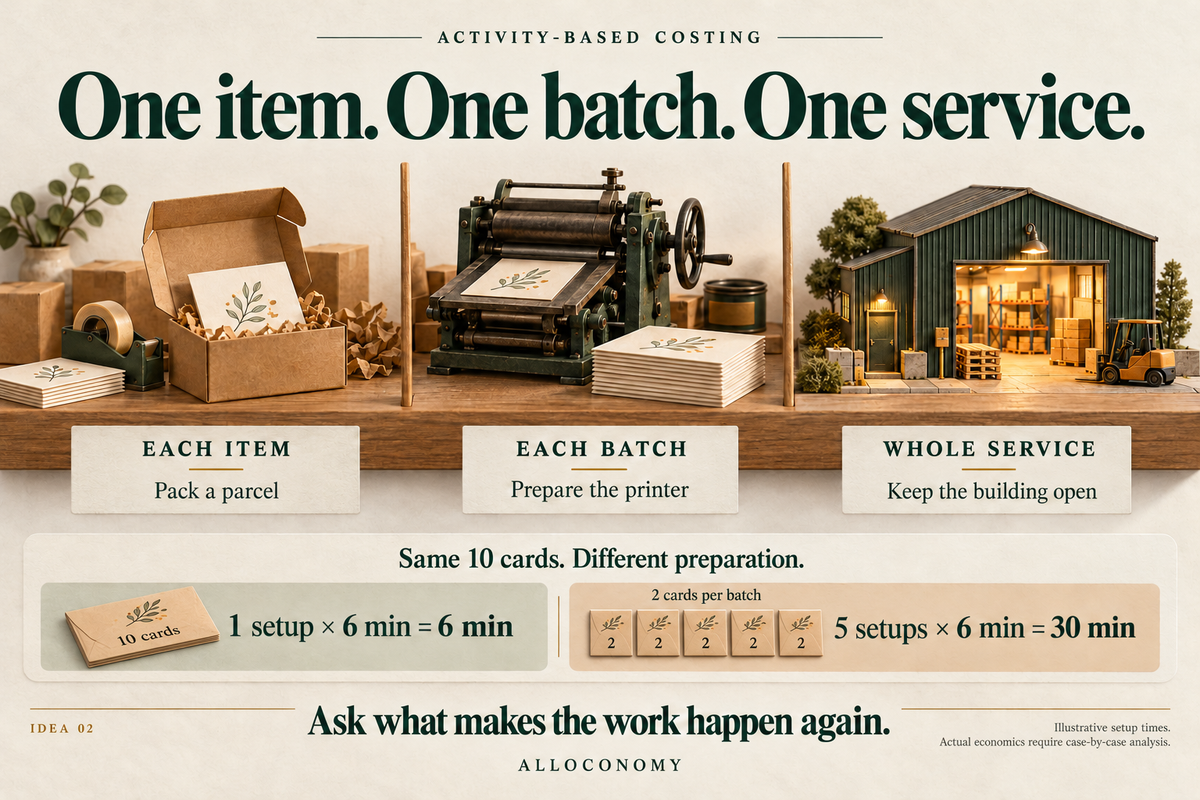
Ten cards, one setup
Maya and Mayan print ten invitation cards. Before printing, they put the paper in place and check the design. Then they print each card.
Printing repeats ten times. Preparing the printer happens once for the group. The group is called a batch.
If they split the same ten cards into five separate batches, they still print ten cards. But they prepare the printer five times. Same number of cards; more preparation.

Three useful levels
Some work happens for each item, such as packing each parcel. Some happens for each batch, such as preparing a machine for a group of items. Some supports the whole service, such as keeping a building open.
We can also have work for a product type or a customer, such as creating one design or setting up one customer account. The habit is the same: ask what makes the activity happen again.
Suppose preparing a printer takes 6 minutes. One batch needs 6 preparation minutes. Five batches need 5 × 6 = 30 minutes.
If each card takes 1 minute to print, printing still needs 10 minutes in either case. Total work rises from 16 to 40 minutes because preparation repeats more often. These are teaching numbers.
Apply it to Walmart Fulfillment Services
Walmart Fulfillment Services describes storage, shipping, returns and customer service for sellers. Walmart's overview.
Imagine a simple fulfillment centre. A worker picks and packs each order. Receiving a truckload is work for a group of goods. Setting up information for a new product is work for that product type. Keeping the building open supports the centre as a whole.
If ten small deliveries replace one large delivery, receiving work may rise even when the total number of products stays the same. A model that counts only products can miss this.
That observation does not tell us to make every shipment enormous. It tells us where to look when asking why the work changed.
Apply it to YouTube and Netflix
For a YouTube creator, recording a video is work for that video. A thousand extra views do not make the creator record it a thousand more times. For YouTube, delivering those extra views creates platform activity. Those are different businesses and different jobs.
For Netflix, making a title available and delivering a viewing session are also different activities. We should not assume that every cost repeats whenever someone presses play. Nor should we assume that all extra viewing is free. First identify the activity and its level.
Try it
A bakery bakes 100 cookies in one batch, then considers baking the same 100 cookies in five batches. Which activity probably repeats more often: mixing a batch or putting one cookie in a bag? Answer: batch preparation repeats more often; bagging still follows the number of cookies.
Carry this idea: a cost divided by ten items is not necessarily a cost caused ten separate times.
Source
OpenStax's ABC chapter explains unit, batch, product and facility levels. The scenarios here are original illustrations.