The Sale Is Only Part of the Work
A customer can need setup, support and returns after paying. Follow a software customer and a hotel booking to understand the cost of serving someone.
Selling the bike is not the end
Maya sells Mayan a bicycle. She also promises to adjust the seat, show him how the gears work and help if a wheel rubs.
The sale happens once. Some of the promised work happens later. If Maya looks only at the money received and the bicycle's purchase price, she misses part of serving this customer.
The cost to serve means the resources used to look after a customer through the activities we are studying. We need to say which activities and which time period we include.

A software customer, step by step
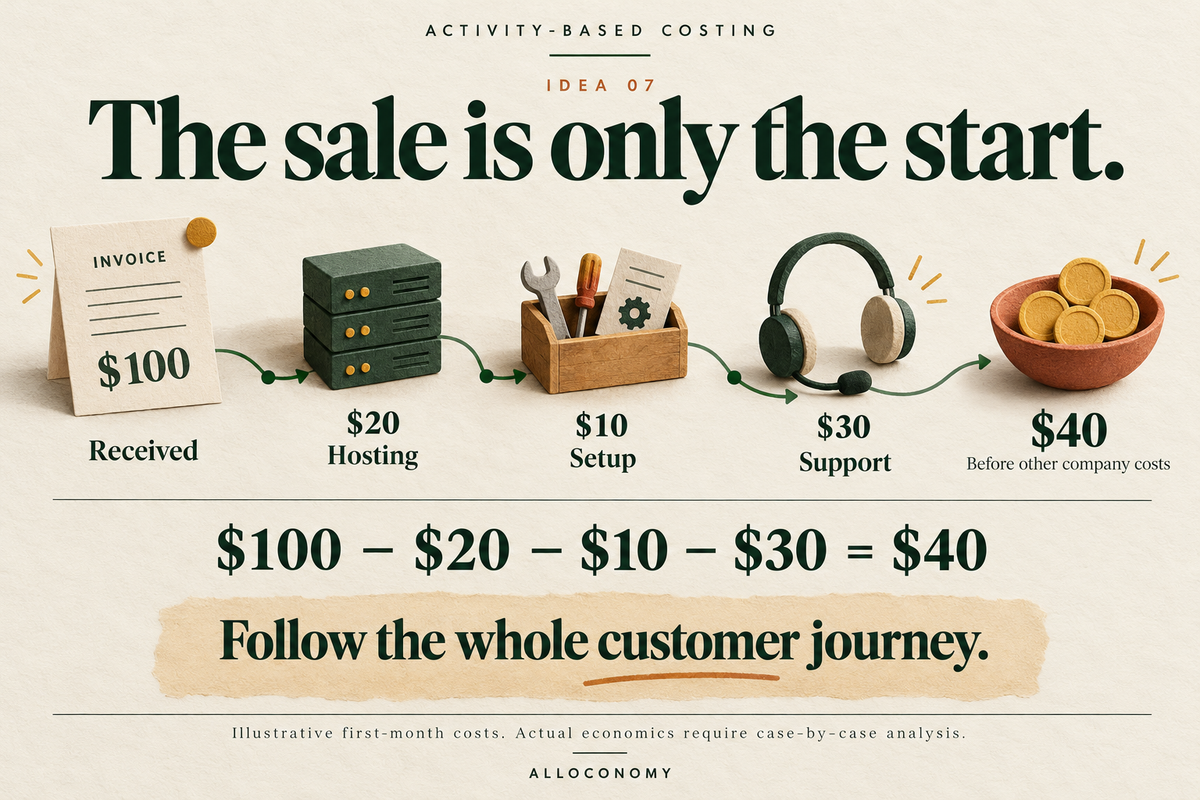
Imagine a SaaS business studying one customer's first month. The customer pays $100. The business traces $20 of hosting resources, $10 of setup work and $30 of support work to this customer.
That leaves $100 − $20 − $10 − $30 = $40 before other company costs. These are invented amounts. We have not counted every cost of running the company, so we should not call the $40 its final profit.
Another customer pays the same $100 and uses the same hosting and setup, but needs $5 of support. That customer leaves $65 on the same basis.
The difference comes from a particular part of the journey: support. The business can investigate that work rather than guessing from sales alone.
Ask the right profit question
“Does this product make money?” and “Does this customer make money?” are related questions, but they are not identical. One product may be bought by customers with very different service needs.
A sales channel adds another view. A channel is the path through which the sale happens, such as the company's own website or another seller's marketplace. Each path can create its own activities and fees.
Choose the question first. Then follow the work relevant to that question. Do not add several overlapping views together and count the same work twice.
Apply it to hotel listings and Prime
For a hotel booking site, the journey may include checking a hotel's listing, processing a booking and answering a traveller's question. The platform earns its own fees; the full room payment is not necessarily its revenue. The hotel separately provides the room and the stay.
For a Prime membership example, look across the benefits used during the period, rather than declaring the relationship profitable from one parcel or one film. Video, music, delivery and account support can all be parts of the journey we choose to study.
Try it
A customer pays $80. The activities in your study use $15 of resources to provide the service and $25 of support. How much remains before other costs? Answer: $40. Name the omitted costs before calling it final profit.
Carry this idea: say “profit after which activities?” before comparing two results.
Source
The Open University: tracing costs to customers explains customer-related activity costs. The company scenarios and figures here are illustrations.