When AI Can Build Everything, What Is Worth Building? What Is Worth Learning?
Learn to choose what is worth building. One ₹50 decision, 17 real openings, and what employers pay for work across engineering, accounting, economics and finance.
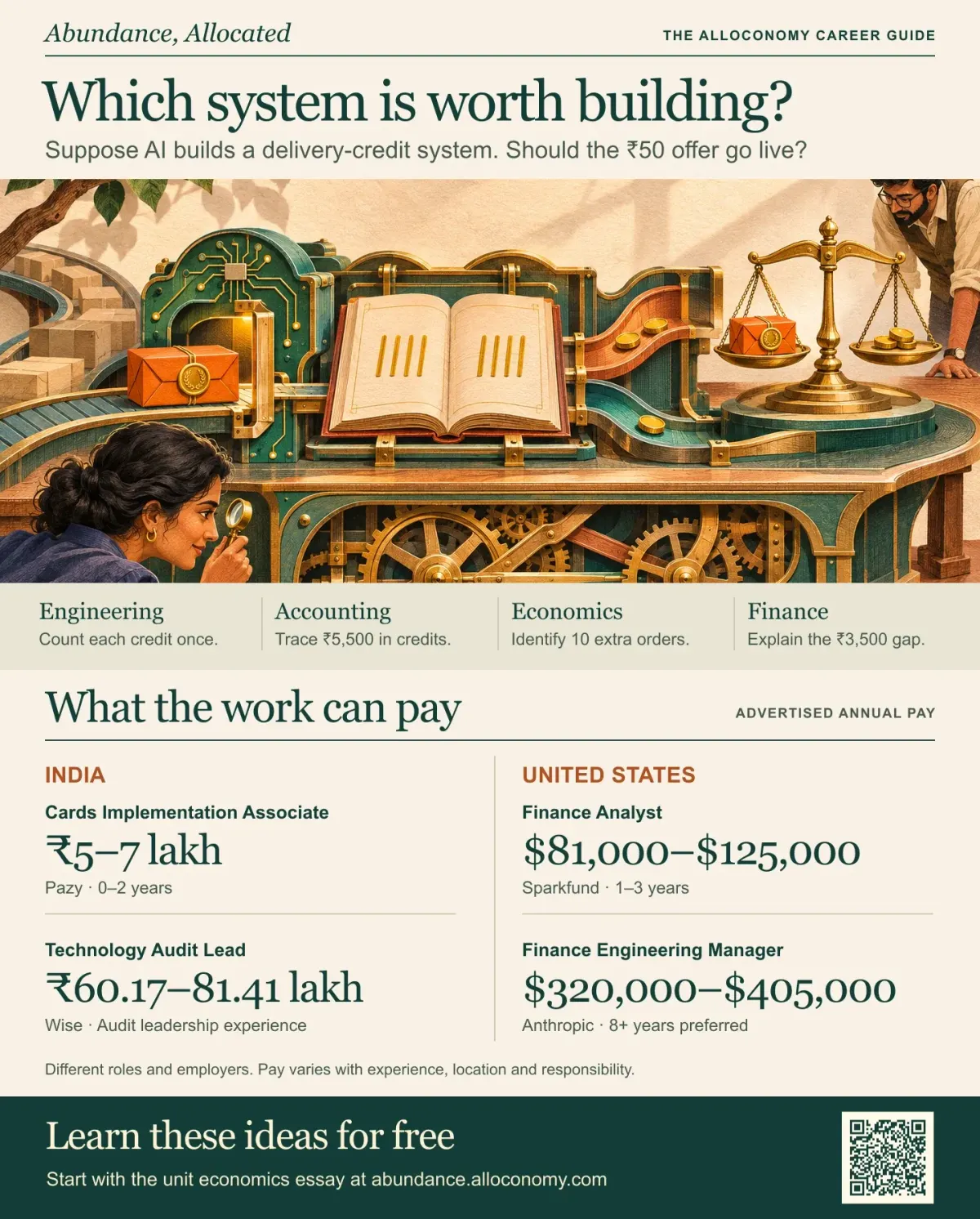
If you asked me to help build a system that gives customers ₹50 off delivery, I’d ask who will place an order because of that ₹50. We could spend an afternoon with an AI agent building a working version. We could put the offer in checkout, record every redemption, run test orders through it and give finance a way to reconcile the credits. We could get every part of it working and still have built an excellent way to lose money.
That’s the career question I’d put to anyone asking me what to learn. When you can build a working version of almost any idea you can explain, how do you choose which idea deserves customers’ money, your company’s capital and a year of your life?
For the delivery offer, engineering tells us whether the system issues one credit when checkout retries. Accounting tells us where the ₹50 landed. Economics asks which shoppers changed their minds. Finance adds up what those extra orders earn and what all the credits cost. Learn to follow that one decision through all four disciplines and you can help decide what gets built.
What can employers pay for work like this? Here are four advertised annual ranges from openings I checked on November 21, 2026.
| Where | An early-career opening | An experienced opening |
|---|---|---|
| India | ₹5–7 lakh · Pazy, Implementation Associate (Cards). The job description asks for 0–2 years. | ₹60.17–81.41 lakh · Wise, Internal Audit Technology Lead. Prior responsibility for leading audit engagements and reporting to boards and regulators. |
| United States | $81,000–$125,000 base · Sparkfund, Finance Analyst. The role asks for 1–3 years. The range varies by location. | $320,000–$405,000 annual salary · Anthropic, Engineering Manager, Finance Engineering. Prefers 8+ years in industry, including 3+ in engineering management. |
Look at what changes with experience. At Pazy, you might configure a client’s card limits and show its finance team how to reconcile a payment. At Wise, you would decide which risks merit testing across a payments business and explain the findings to its board. Sparkfund’s analyst models the economics of a proposed energy project. Anthropic’s manager owns the engineering behind financial records and services that other teams depend on. These are four different jobs at four employers. The paid responsibility grows from getting one decision right to designing and leading systems that many people trust.
I write Abundance, Allocated because learning to follow a transaction across disciplines changed the work I could take on. About eight of my 18 years of experience went into the economics of individual orders. I’ve sat with engineers who knew exactly how a charge was generated, accountants who could trace where it landed and economists who wanted to know whether changing it would change a customer’s behavior. I want to give you the kind of explanation I would give if you were sitting beside me. You can start with the free unit economics essay and try the delivery-credit decision for yourself below.
Why AI makes it worth learning across disciplines
In June 2025, Amazon CEO Andy Jassy described agents giving teams a head start and more room to invent better customer experiences. In October 2026, Terk Terkowitz, a VP and Distinguished Engineer at Amazon, made the connection to careers more explicit. He reported that engineers and managers closest to their products and businesses were getting the most out of agentic development, and encouraged engineers at every level to get closer to their customers. That rings true to me. The person who understands why customers abandon checkout has a better chance of asking an agent to build something they will use. Jassy’s message to employees · Amazon’s revised engineering guidance
In a field experiment at Procter & Gamble, researchers asked professionals from R&D and commercial teams to develop new product ideas. Working without AI, the two groups leaned in different directions. R&D tended to propose technical solutions. Commercial staff tended to propose commercial ones. With AI, people from both groups produced ideas that combined the two perspectives. On average, individuals using AI matched the quality of two-person teams working without it on that assignment. The analysis included 776 participants. The Cybernetic Teammate, Organization Science
The experiment measured product ideas. Now imagine giving the finance analyst who understands a duplicate payment an agent that can help build the service she wishes existed. She can put a stream of sample invoices through it, replay a failed payment, and see whether accounts payable gets one liability or two. An engineer can start from the other end and ask how much the proposed service would save, what it would cost to run and who would act on the exceptions. Both can take a working system to the person who knows the part they still need help with.
I explored this in AI Lets Us Own More of the Outcome. Its companion, The AI Labor Stack, follows the work beyond the model itself, including who tests it, who fits it into a workflow and who answers for the result. My case for learning broadly has a practical limit. Go deep in one field. Learn enough of the adjacent ones to recognize a bad assumption before it becomes a business decision.
Employers are already asking for that range
US hiring data shows how quickly agents entered job descriptions. Stanford’s 2026 AI Index, using Lightcast data, counted 1,310 US AI job postings mentioning the skill “AI agents” in 2024 and 15,217 in 2025. That is almost twelve times as many in a year, from a small base. It measures advertised skills. It doesn’t tell us how many people were hired or how many of those jobs required finance. Stanford AI Index, chapter 4, figure 4.4.7
The change reaches people early in their careers. PwC compared US job postings asking for zero to two years of experience in 2019 and 2025. Of the distinct skills newly requested in the most AI-exposed occupations, 52% had previously been associated with more experienced workers. In the least-exposed occupations the figure was 7%. Strategic decision-making and working across stakeholders were among the examples. The denominator is new skills. The finding helps explain why I’d teach someone to challenge a recommendation while they’re still learning to produce the analysis. PwC Global AI Jobs Barometer 2026, US entry-level analysis
In India, some agentic AI vacancies already specify the business outcome. Quess examined 8,500 agentic AI postings in a 90-day sample for its June 2026 workforce report. Five percent fell into a group covering product, workflow and adoption. The skills included workflow design and tracking return on investment. A Bengaluru opening at Razorpay makes that combination concrete. The product manager is expected to build with AI agents, run experiments and explain how a growth decision changes profit. Quess, India’s AI Workforce Report, p. 19 · Razorpay’s job description
People already in finance are picking up new responsibilities. In the FinOps Foundation’s surveys of people who manage technology spending, 31% of respondents reported managing AI spend in 2024 and 63% in 2025. In 2026, 98% put it in scope now or within the next twelve months. The 2026 survey had 1,192 respondents. For the person responsible for a cloud budget, understanding the economics of a training run can become necessary well before anyone creates a new job title. 2025 survey · 2026 survey and question wording
I see a growing need for people who can carry a decision across these fields. The evidence is strongest on the changing mix of skills and responsibilities. There is no worldwide time series for jobs requiring engineering, economics, accounting and finance together. That distinction matters in a softer market. Quess recorded a 3.5% quarter-on-quarter decline in overall technology hiring demand at Indian global capability centres in July–September 2026. A team can give an existing employee a much wider problem to own even as it adds fewer people. Quess quarterly hiring tracker
Try the work before you pick a title
Suppose a retailer randomly assigns 1,000 shoppers to its ordinary delivery terms and another 1,000 to a ₹50 credit. The first group places 100 orders. The second places 110, all of which use the credit. For this example, each order contributes ₹200 after its usual variable costs and before the promotion.
You have time to build one thing next. Would you build the system that gives every shopper the credit, or the one that tells you which shoppers it helps?
The offer group placed ten more orders. At ₹200 each, that adds ₹2,000 of contribution. The retailer paid the ₹50 credit on all 110 orders, a cost of ₹5,500. The estimated difference is a ₹3,500 loss per 1,000 shoppers offered the credit over the test period. A slide announcing “10% more orders” could be perfectly accurate and still lead to an expensive rollout.
At those economics, the offer group would need at least 134 orders to come out ahead in the test period. That gives the team a concrete reason to try a narrower offer. An economist would ask how much confidence to place in ten extra orders and whether the customers come back. A finance analyst would test the ₹200 assumption against what those particular orders cost to fulfill. A data engineer would check whether a row represents a shopper, an order or an attempt to redeem the credit. An engineering lead would want evidence that retrying a failed request cannot issue the credit twice. A program manager could use those answers to decide what must be measured and fixed before the next release.
Here is the system I would build first. Keep a group that gets the ordinary price. Record each offer, order, credit and refund, then let finance trace the ₹5,500 from the 110 redemptions in the subledger, the detailed record behind the accounts, to the general ledger. Replay a checkout message and verify the credit appears once. Let economics estimate how much behavior changed, and have finance calculate what the extra orders earned after fulfillment. That is enough to decide whether to stop, target the offer more narrowly or run a longer test. For a worked advertising example with a different answer from the one on the campaign dashboard, read Does the Allocation Create Economic Value?
Who hires for this work?
I checked 17 distinct openings across five countries on November 21, 2026, using employer career pages and Pazy’s own posting on Wellfound. Each displayed an application link or form. Some explicitly ask for AI. Others show where the underlying combination of software, economics, accounting and finance was valuable before agents arrived. When a vacancy closes, keep the description of the work.
United States
| Employer and opening | What you would actually work on |
|---|---|
| Anthropic · Finance & Strategy, Compute · San Francisco | Compare the cost and return of different chips and training runs. The result informs how much computing capacity to secure. The posting lists a US annual salary of $240,000–$325,000. |
| Anthropic · Engineering Manager, Finance Engineering · San Francisco or Seattle | Lead the team that turns billing and compute events into auditable financial records. A retry must produce one posting, and finance must be able to trace it back to its source. It calls for experience leading teams that operate high-volume systems and lists hands-on ledger or subledger experience as preferred. |
| Amazon · Senior Economist, Pricing Science · Seattle | Design experiments and build economic models to guide pricing investments. Specify the data those models require with engineers. The published Seattle base salary is $159,200–$215,300. The opening asks for a PhD in economics or equivalent. |
| Stripe · Technical Program Manager, Money-as-a-Service · Atlanta, Chicago or US remote | Coordinate engineering, product, finance and risk teams building the infrastructure that moves money for platforms. A marketplace payout has to work across all of them. |
| Sparkfund · Finance Analyst · US remote | Price investments in energy projects using the engineers’ estimates of cost and timing. One useful interview question is how a delayed installation changes the cash flows on a battery project. |
India
| Employer and opening | What you would actually work on |
|---|---|
| Pazy · Implementation Associate (Cards) · Bengaluru | Translate a client’s spending policy into card limits and approval rules, then teach users how to match expenses to receipts. Track whether the cards are actually used. |
| Wise · Assistant Manager, Finance Risk and Controls · Hyderabad | Identify where a financial process could fail and test the control with finance, product and technology teams. Wise advertises ₹19–27 lakh a year plus restricted stock units and asks for at least six years in controls, audit, assurance or a related field. |
| Wise · Internal Audit Technology Lead · Hyderabad | Lead the audit plan across regulated entities, use technology to evaluate controls, and report significant findings to the board and regulators. It calls for a professional qualification and experience managing multiple audits. |
| Razorpay · Senior Product Manager · Bengaluru | Build with AI agents, run product experiments and explain what a growth decision does to profit. The same person owns the product question and the evidence for investing in it. |
| Amazon · Business Intel Engineer I, FinOps · Bengaluru | Build reporting and tools for the teams that pay suppliers, collect receivables and prepare financial records. The posting asks for two or more years analyzing data. “FinOps” here means finance operations. |
| Amazon · Senior Financial Analyst, Customer Service Finance · Hyderabad | Explain cost per customer contact, staffing and capacity utilization. Reconcile data across systems. The role calls for a Chartered Accountant and values SQL experience. |
| Stripe · Engineering Manager, Accounting Products · Bengaluru | Lead engineers building accrual-accounting products from financial event data. Customers use this infrastructure to recognize revenue and reconcile their books. |
| EY · Senior, SAP and Vertex Tax Technology · Bengaluru | Turn jurisdiction, taxability and exemption rules into working integrations. Test whether the tax engine and the enterprise accounting system agree. EY asks for four to seven years of relevant experience. |
| Amazon · Pricing Analyst · Bengaluru | Set delivery-partner rates using local costs, capacity and partner profitability. This is an earlier-career route into pricing for someone who enjoys SQL and wants to understand the cost of the last mile. |
The work travels. Airwallex has distinct payments-economics openings in Amsterdam and Singapore. A change in a card network’s fee rules has to make it into the pricing configuration, the cost forecast and, eventually, a decision about merchant margins. In Osasco, Brazil, iFood’s junior payments analyst tracks payment cost and conversion, builds dashboards and works with product and technology teams on experiments. Airwallex Amsterdam · Airwallex Singapore · iFood Osasco
For a longer view, the US Bureau of Labor Statistics projects growth from 2025 to 2035 of 11.9% for operations research analysts, 10.2% for software developers, 7.2% for financial and investment analysts, and 4.7% for economists, compared with 3.5% across all occupations. Worldwide, employers surveyed by the World Economic Forum put fintech engineers among the roles they expect to grow fastest through 2030. These are projections for established occupations. They give you a backdrop for reading an individual vacancy. US occupational projections, table 1.2 · World Economic Forum jobs outlook
Pick the essay closest to your work
| If you want to… | Start with this essay, then try this |
|---|---|
| Explain a change in margin as a finance or BI analyst | The Anatomy of Change. Take two periods and separate price, volume and mix. Write down the first explanation the total alone led you to believe. |
| Price a product, a delivery promise or a scarce seat | Why Unit Economics? and The Economics of an Empty Seat. Decide whether to sell one more seat tonight. Then decide whether to add another show. Which costs change each time? |
| Design financial data that others can trust | Stocks vs. Flows. Show how opening cash plus receipts less payments gives closing cash. Decide which column can be summed across days before you build the dashboard. |
| Own a ledger, tax integration or finance program | What Are We Reconciling? and Balanced Books Can Still Be Wrong. Trace an order from shipment to invoice to settlement. Name the two records that should agree, when they should agree and who investigates a difference. |
| Evaluate AI infrastructure spending | Who Gets the AI Dollar? (member access). Follow $100 from the customer through the model, cloud and chip providers. Mark which costs are disclosed and which you would have to estimate before making an investment case. |
If you work with agents, start with Money Cheat Sheets for Humans Working with AI. Try explaining the difference between an expense and a cash payment to an agent, then give it a case where the two fall in different months. That short exercise tells you something about the model and about your own command of the subject. The AI Tsunami reading guide collects the wider argument.
Pick one row. Sketch your answer on a sheet of paper and ask a colleague from another function to mark the first assumption they would challenge. That conversation is a piece of interview preparation you can also use at work tomorrow. For an economist role, you’ll still need the methods the employer asks for. For an engineering manager role, you’ll need experience running systems and leading people. The essays give you business problems worth applying those skills to.
Why I write it this way
One of the hardest parts of my own work has been getting a reasonable answer to a deceptively simple question: which order should carry this cost? A carrier can invoice an entire route. A customer buys one item. Somewhere between those two facts a person chooses how to divide the bill. Change that choice and a perfectly balanced set of books can tell a different story about which customers are profitable. I wish someone had put examples like that in front of me earlier.
AI is part of how I write them now. I can talk through a problem as I would with a colleague, use an agent to find public evidence, and ask it to work through the case that breaks my first explanation. I choose the question, check the evidence and take responsibility for the answer. What Alloconomy Makes explains how I use these tools. The standard I’m aiming for is how it feels to sit beside someone who has done the work and will stay with your question until the numbers make sense.
If you came here because you’re deciding what to learn next, start with Why Unit Economics?. Bring a product, service or recurring cost from your own work. Pick the unit, trace the money and write down one thing you would build differently as a result. That’s one useful decision you can take into an interview or your next team meeting. To keep learning this way, subscribe free to Abundance, Allocated.