What Are We Reconciling?
Which number, against which record, on what basis? A practical explanation of reconciliation and the review that makes it useful.
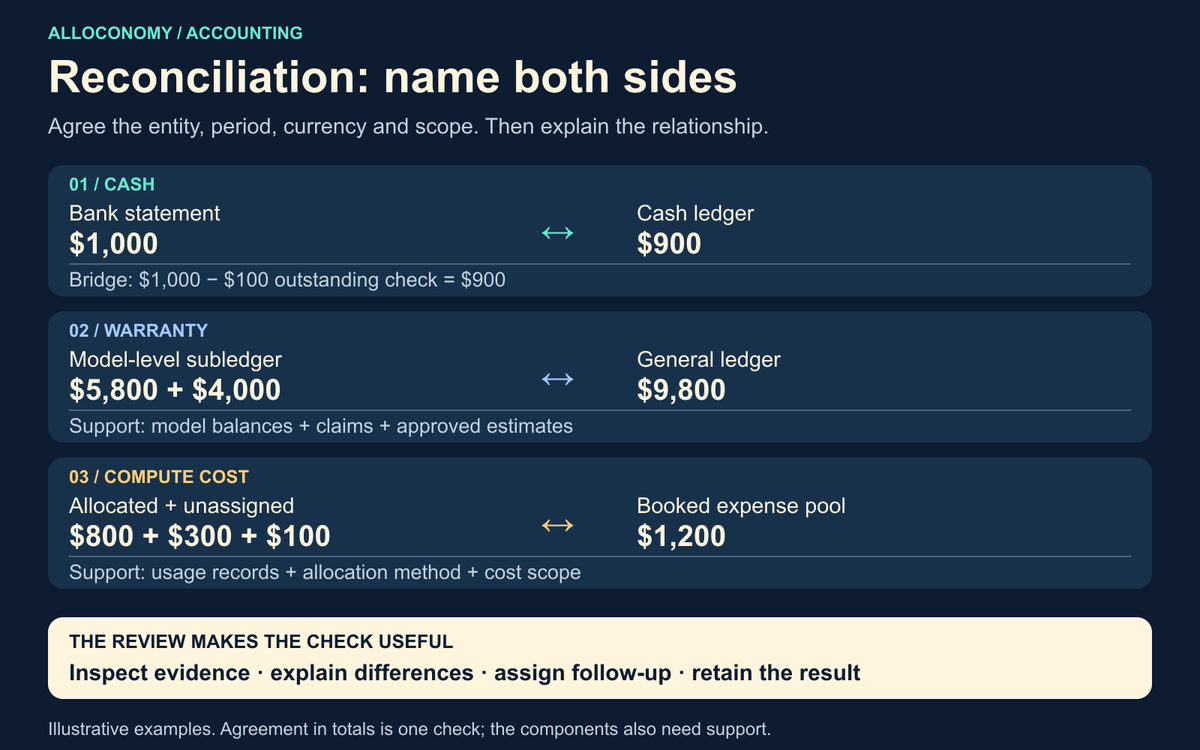
“Make sure it reconciles.”
I use that phrase often when talking about accounting data. It leaves an important question unanswered: what are we reconciling with what?
Sometimes we are comparing two records of the same activity. Sometimes we are explaining what makes up a balance. Sometimes we are checking that a detailed calculation accounts for the amount recorded in the books. Each needs a different kind of evidence.
I find it useful to define reconciliation as establishing that a recorded amount is supported, by comparing it with another record or a documented explanation of its components, and investigating the differences on an agreed basis. A useful result tells us what agrees, what remains different, why, and what action is needed.
Start by naming both sides
Before looking for a match, finish this sentence:
We are checking this amount against these records, for this entity, period, currency and scope, using this accounting or measurement basis.
That last part matters. A supplier's bill, an operational estimate and a recognized expense can describe related activity while covering different periods or including different items. The relationship needs to be specified before a difference becomes meaningful.
Oracle's reconciliation documentation distinguishes balance comparison from account analysis: one compares balances from different sources; the other explains the items making up a balance. It also includes period-to-period variance analysis. Those distinctions help explain why the same word appears in several accounting workflows.
Bank statement against cash ledger
Suppose the bank statement shows $1,000 at month-end, while the company's cash ledger shows $900. The company has recorded a $100 check that the recipient has not yet cashed.
The bridge is simple:
$1,000 bank balance − $100 outstanding check = $900 cash ledger balance.
The two records capture the payment at different times. The reconciliation identifies the specific check, shows that it was already recorded in the books and tracks it until it clears the bank. That explained timing difference can remain open at the reporting date.
A bank fee missing from the books would require a different response: investigate it and record the supported expense and cash movement. An old outstanding check needs follow-up, too. “Timing difference” should describe an identifiable event with a plausible resolution.
Microsoft's bank-reconciliation guidance matches bank statements to internal ledger entries and distinguishes outstanding payments from missing entries. That is the practical work behind the word.
Warranty detail against the general ledger
Take the fictional Tesla-inspired warranty design from our Data Engineering series. The warranty subledger owns balances by vehicle model; the general ledger holds the aggregate warranty balance.
Suppose the subledger shows $5,800 for Model 3 and $4,000 for Model Y, and the general ledger shows $9,800 for the same entity, currency and closing date. The first comparison is:
$5,800 + $4,000 = $9,800.
Now we need to explain the balances themselves. An illustrative warranty rollforward could be:
$8,000 opening reserve + $2,000 new provisions − $500 claims settled + $300 estimate increase = $9,800 closing reserve.
The model totals check the connection between subledger and ledger. The rollforward explains movement from opening to closing balance. Claim records and approved estimation work support the components. A reviewer can then examine whether the provision assumptions are reasonable and the underlying population is complete.
If the subledger totals $9,800 and the ledger holds $10,000, someone owns the $200 difference. It might be a posting outside the subledger, a missing transfer, a cutoff mismatch or an incorrect mapping. The work is to find the cause and resolve or document it with evidence. An unexplained balancing entry would hide the very problem the comparison was meant to reveal.
This is why the choice between a ledger segment and a controlled subledger matters. Wherever the model detail lives, we need a dependable route from its components to the amount in the books.
Operational data against booked accounting amounts
An AI business records $1,200 of compute expense. Its management report assigns $800 to Model A, $300 to Model B and leaves $100 unassigned.
$800 + $300 + $100 = $1,200 checks that the report accounts for the whole expense pool. Keeping the unassigned amount visible makes incomplete attribution discoverable.
The operational records answer a further question: what supports each model's share? Usage records might contain accelerator-hours, while the ledger contains dollars. Connecting them requires rates or an allocation method, plus treatment of shared capacity, discounts and other charges. Both sides must cover the intended service period and cost scope.
There are therefore two checks: does the allocated total connect to the booked expense, and does retained operational evidence support the distribution? Together they make the cost report explainable.
The same pattern applies elsewhere. A marketplace's completed trips can be connected to its revenue calculation through the relevant fares, fees, adjustments and recognition rules. Counting trips and summing recognized revenue answer different questions; a documented calculation connects them.
Two calculations of the same metric
An independent calculation can be a useful control. Imagine one pipeline constructs a supplier-payables balance from the invoice and payment subledger, while another obtains the posted balance from the general ledger. Comparing them can expose omissions or incorrect postings.
For an operational metric, two implementations of the same approved definition can expose transformation errors. First align the population, cutoff, units and treatment of cancellations or late events. Then investigate differences at the record level.
Independence is part of the design. Two reports that read the same incorrectly filtered dataset can agree perfectly. Their agreement checks less than a comparison supported by a separately maintained source. Even a strong comparison has a scope: matching totals can conceal an omitted item offset by a duplicate, so record-level matching and other completeness checks may also be needed.
An audit may use reconciliation work as evidence. The reconciliation itself establishes a narrower conclusion about the specified amounts and records.
Where controllership and review enter
By controllership, I mean the responsibility for keeping the books and financial reporting reliable: setting accounting policies, organizing the close, maintaining controls, investigating exceptions and standing behind the resulting numbers.
For an engineer, code review is a useful analogy for one part of that work. A preparer assembles a reconciliation and explains the differences. A reviewer checks the scope, source evidence, calculation and proposed resolution. Like a design review, the discussion should test the assumptions as well as the arithmetic.
A two-person review provides a second judgment. Its value comes from what the reviewer examines. In the warranty example, I would expect questions such as: does the schedule include every model, do its totals reach the correct ledger account, and what supports the estimate change?
Oracle makes this division concrete in its preparer and reviewer responsibilities: preparers supply balance justifications and supporting items; reviewers handle approval. Controllership owns the broader process in which that review operates.
What I would want an agent to show me
An agent can help match records, assemble a rollforward and investigate exceptions. I would want its result to identify the two sides, the common basis, the source versions, the explained differences, the unresolved items and their owners, and the review outcome.
The cutoff and versions deserve particular care. A reconciliation completed at month-end used the records available then. A rerun after late postings or corrected source data may legitimately produce a different result. In Which Version of the Past?, I explored the difference between business-effective history and what the system knew when a report was produced. The same distinction matters here.
That is the standard I want behind “it reconciles”: we can name what was checked, show the evidence, explain the remaining differences and reproduce the conclusion.
For the underlying accounting vocabulary, read Why the Chart of Accounts Still Matters. For the data-model decisions that make these checks possible, start with From Clay Tablets to OpenAI.
Come, Learn with me!!