The Economics of an Empty Seat
What cheap Tuesday tickets teach us about marginal costing—and the unit economics of operating at scale.
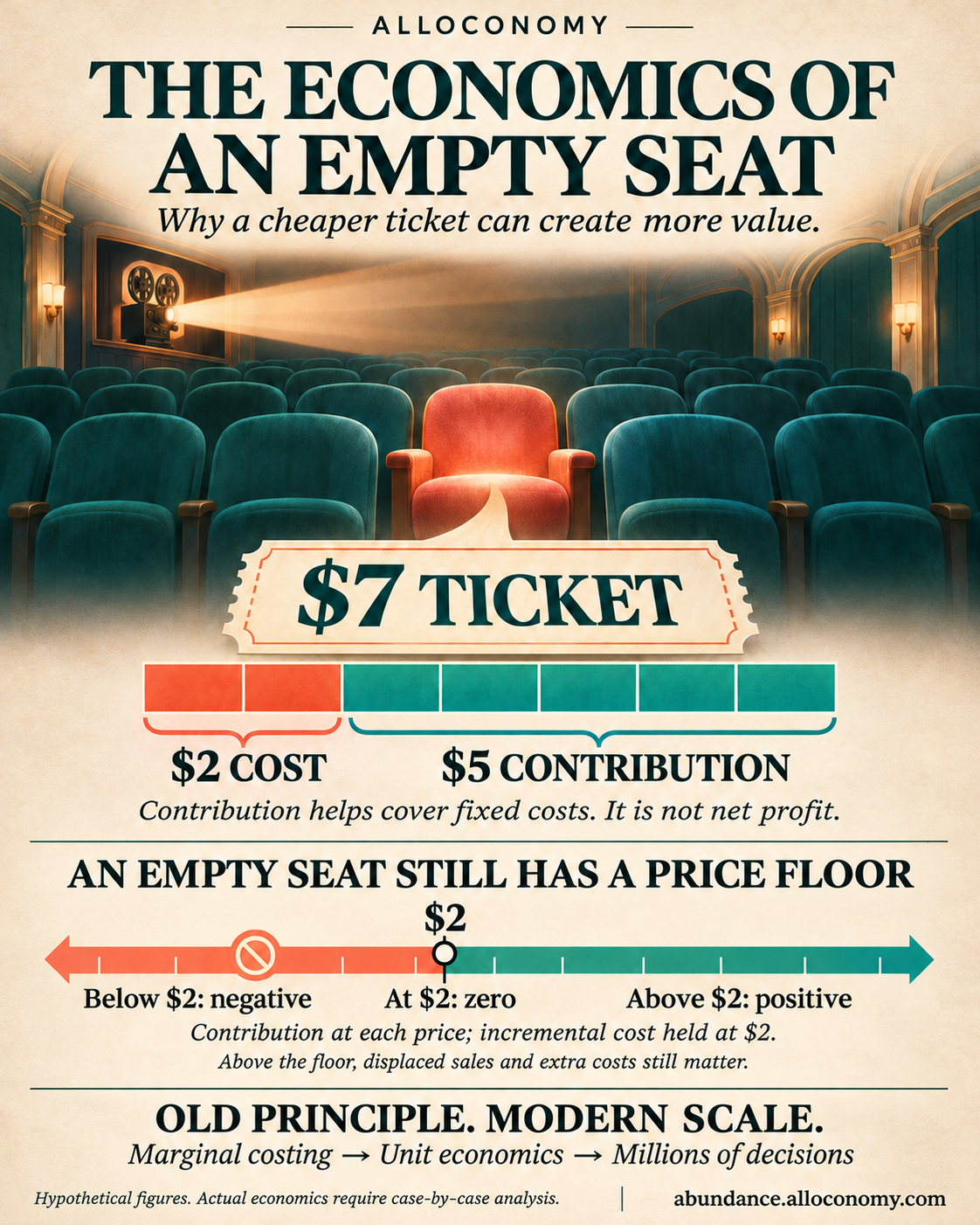
What cheap Tuesday tickets teach us about marginal costing—and the unit economics of operating at scale.
Planning a Seattle-area outing for Suriya’s Scene? The film, screen, and ending stay the same. Moving from Saturday to Tuesday can change the bill considerably.
Cinemark advertises Discount Tuesdays; Regal offers members Tuesday ticket discounts and half-price popcorn. In India, PVR INOX introduced Blockbuster Tuesdays in April 2025, with tickets starting at ₹99. Eligibility, locations, and exclusions vary.
Even T-Mobile Tuesdays joins the ritual, although customer rewards solve a different problem.
Why accept less money for the same experience?
The foundation is marginal costing. The modern challenge is applying it, unit by unit, at operating scale. Why Unit Economics? The Next Decision Needs More Than an Average explains the decisions this makes possible. Here, we start with the empty seat.
The seat has a deadline
The projector is running. The building is leased. Some employees are already on shift. One more viewer may leave those committed costs unchanged.
But tonight’s unused admission cannot be saved for tomorrow. A restaurant table at six and a hotel room tonight face the same deadline: their revenue-generating capacity expires with time.
An empty seat is unused capacity, not a formal financial “non-performing asset.”
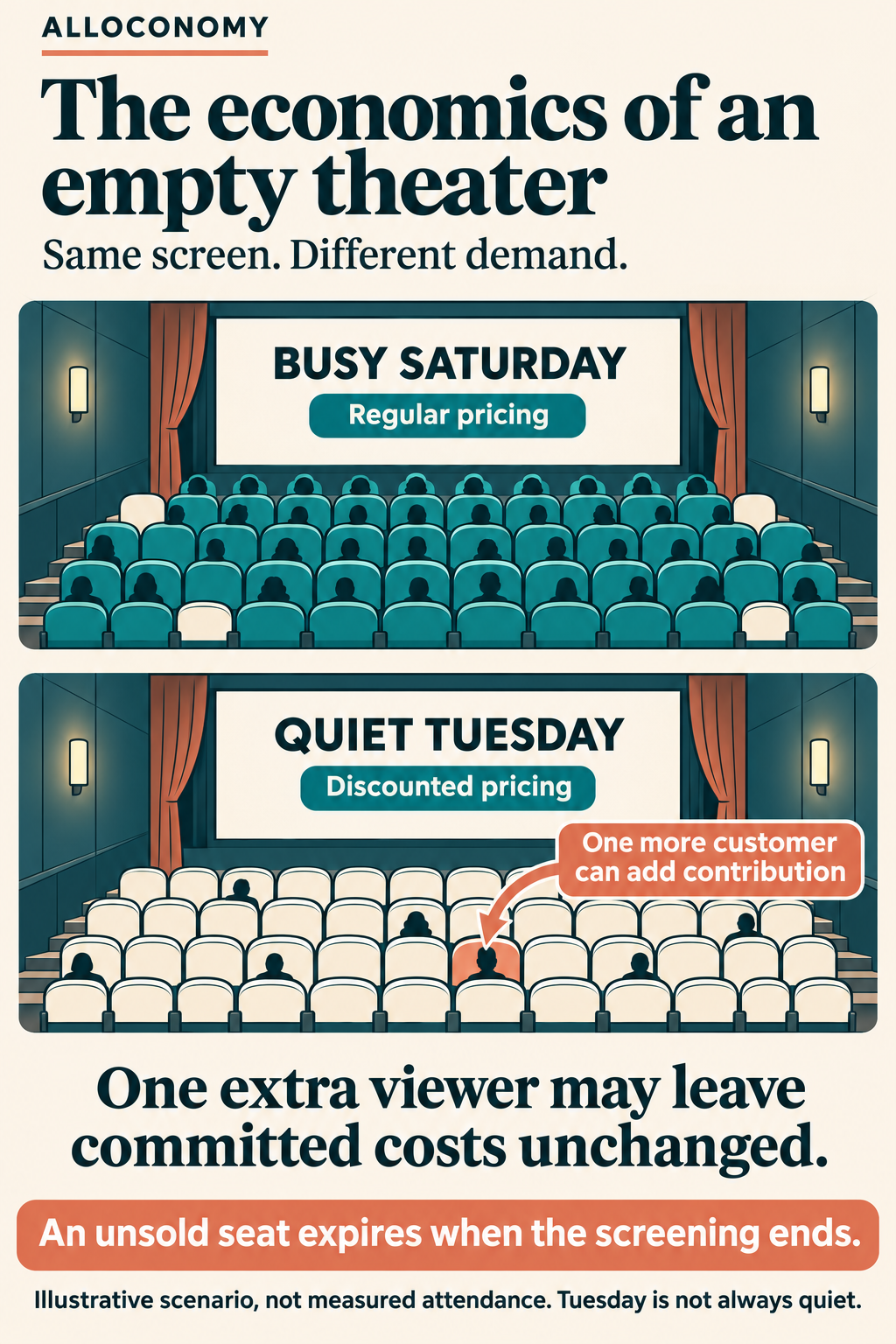
The auditorium lasts. The opportunity to sell a place in this screening does not. Attendance shown is illustrative.
Marginal costing, one ticket at a time
Marginal costing separates variable costs from fixed costs to reveal contribution. Jonathan N. Harris published an account of direct costing in 1936.
Consider one hypothetical cinema. An ordinary ticket costs $16. A discounted ticket brings in $7, and the variable costs attributable to that extra sale total $2.
Contribution margin = incremental revenue − incremental variable costs
$7 − $2 = $5 of contribution.
If the customer would otherwise stay home, the seat would remain empty, and nothing else changes, operating profit improves by $5. The cinema might still lose money overall. Contribution is not net profit.
These are invented figures. Real admissions can trigger payment fees and film-rental charges that vary with revenue. Rent may be unavoidable tonight; another screening or staff shift can create avoidable costs.
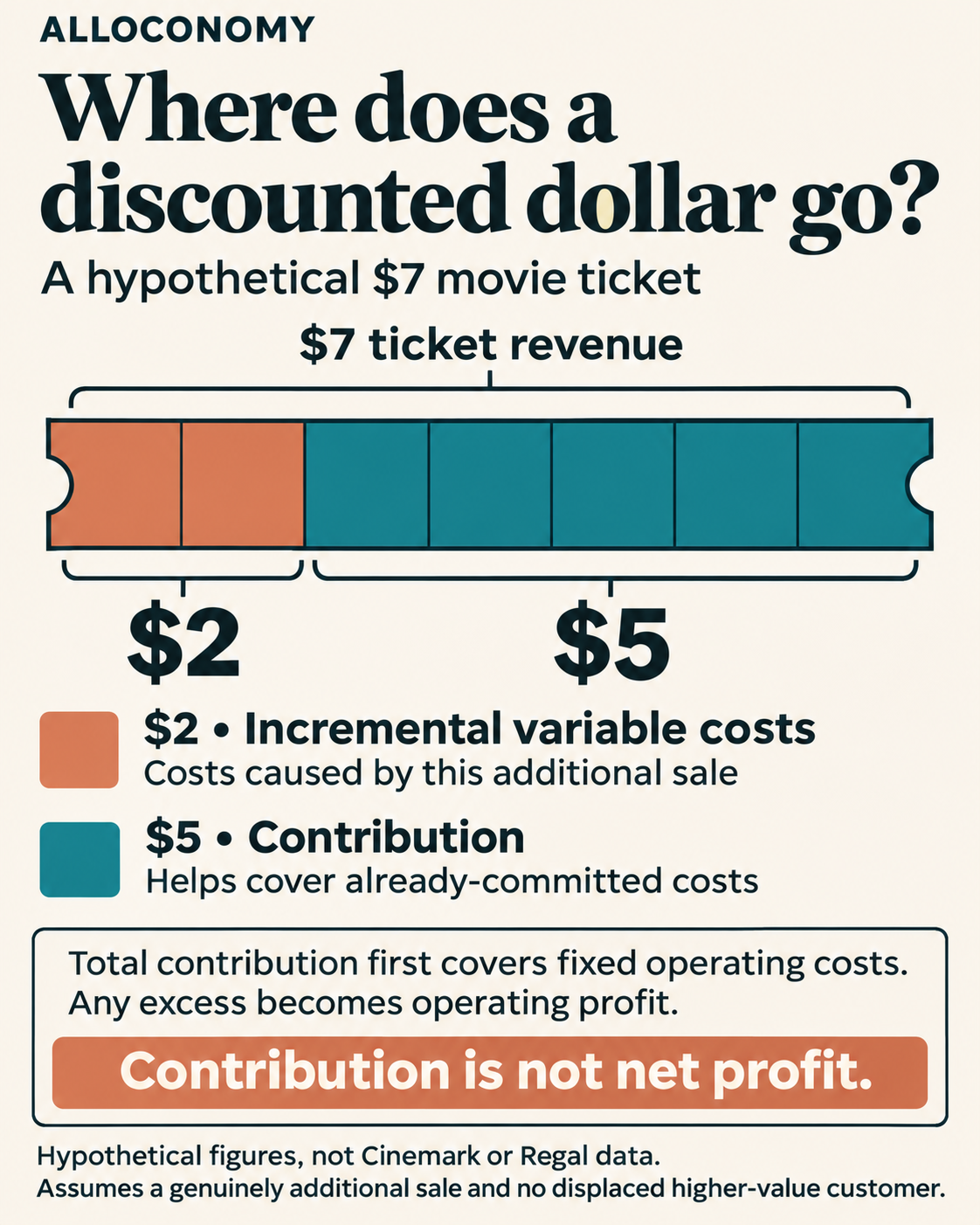
Marginal costing in one hypothetical sale: $7 revenue minus $2 incremental variable costs leaves $5 toward committed costs. These are not Cinemark or Regal figures.
The floor beneath the discount
An empty seat does not justify a sale that makes the business worse off.
Holding our hypothetical cost at $2, a ticket below $2 makes a negative contribution. At $2, contribution is zero; above $2, positive—but the wider decision still matters.
Staffing, commissions, and displaced higher-value sales can raise the floor. Contractual costs can change with price.
Allocated overhead is different. A Cost on Paper Is Not Always Money You Can Save explains why: assigning rent to a seat does not make it disappear when that seat stays empty.
A deliberate loss leader needs evidence that additional basket or future customer contribution outweighs its loss. Filling the room alone cannot justify it. Across its operations, the business must still recover fixed costs and earn adequate returns.
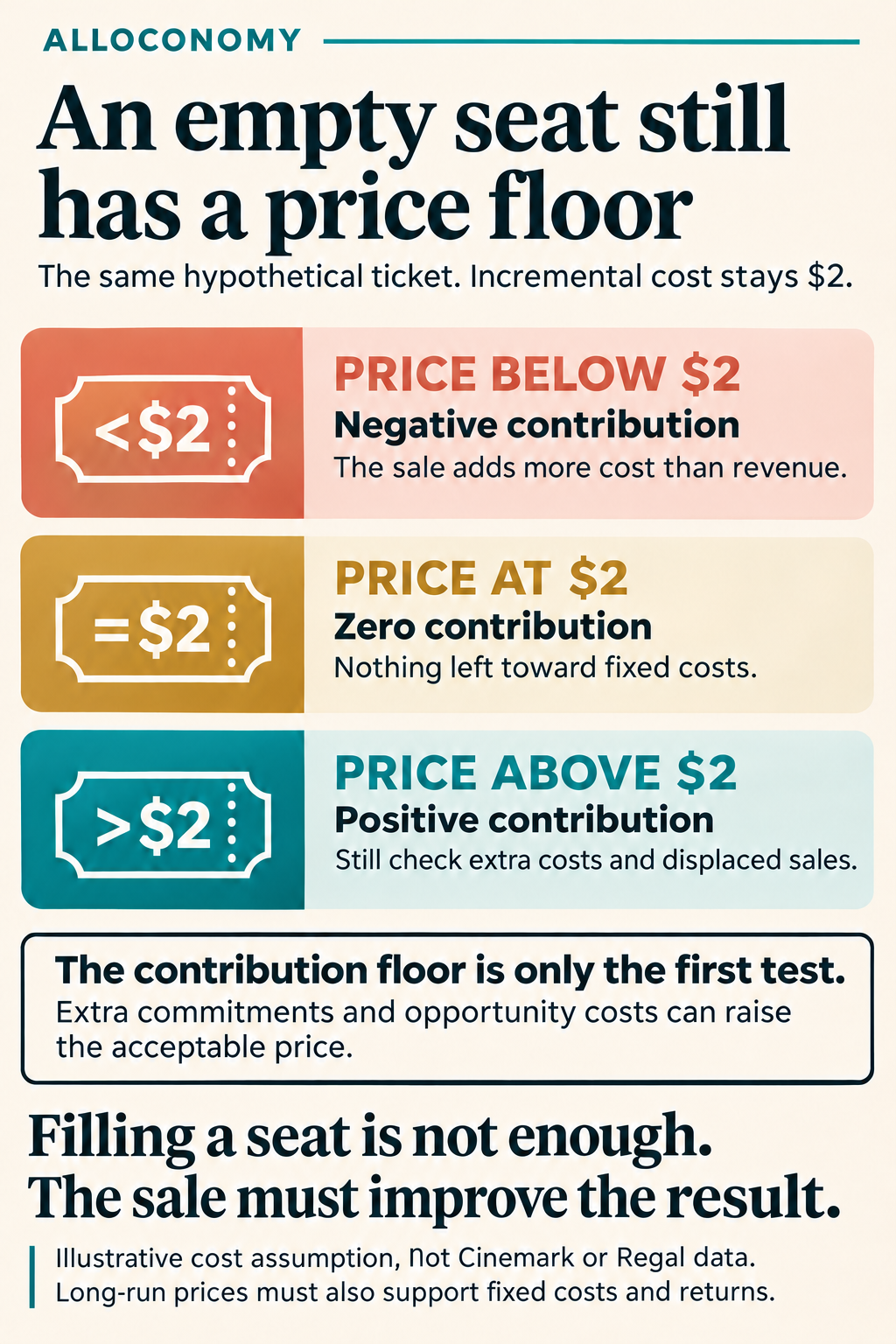
The short-run contribution floor is only the first test. Extra commitments and displaced sales can raise the acceptable price. Figures are hypothetical.
Scene, two evenings, two prices
At Cinemark Lincoln Square in Bellevue, Scene displayed $15.25 for Saturday, 7 November, at 6 pm, versus $7.75 for Tuesday, 10 November, at 7 pm. Both were standard-format Tamil screenings with English subtitles. Checked 7 November 2026; each added a $1.99 online fee, with a $7.25 Tuesday member price before that fee.
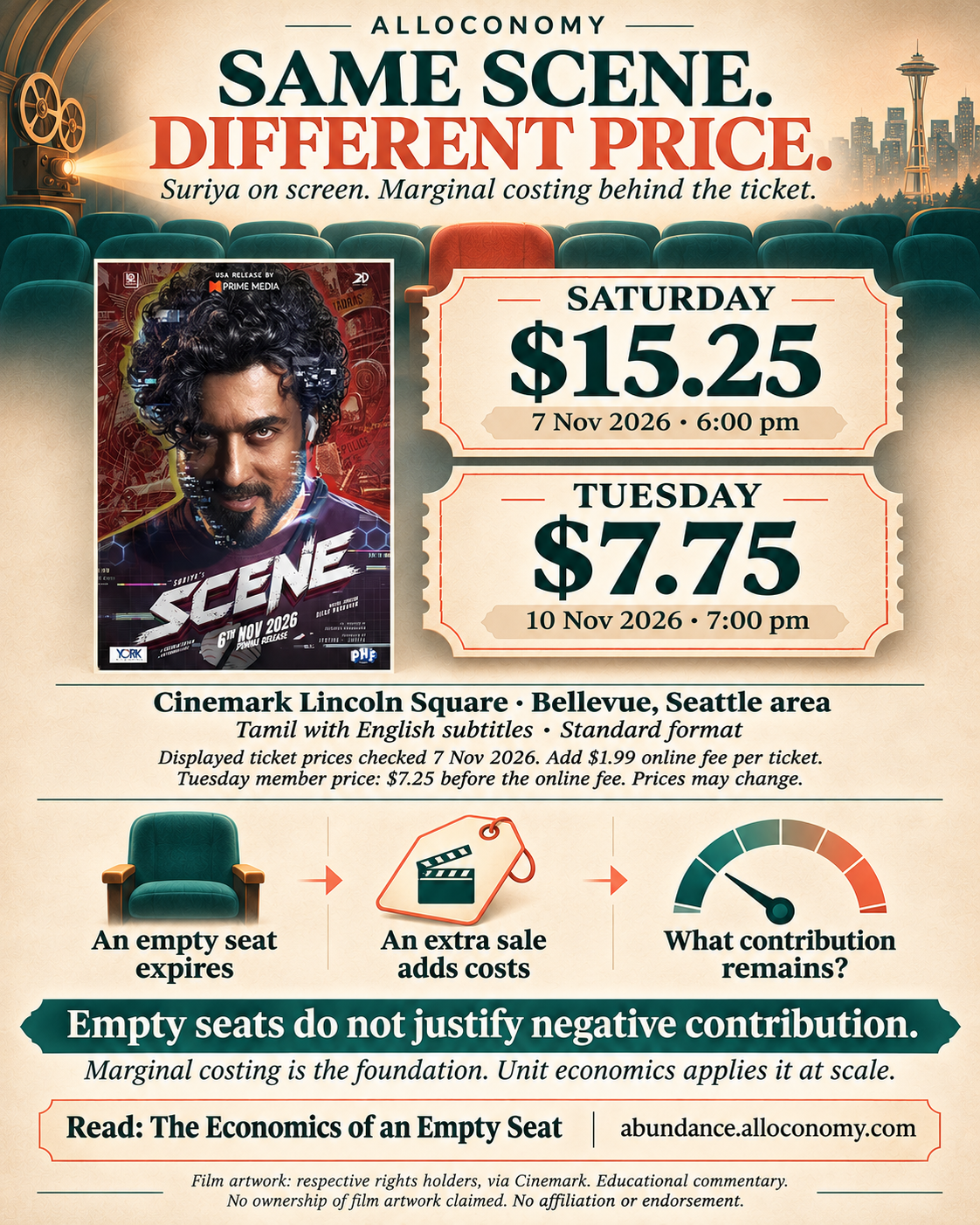
One venue, two dated screenings—not a Seattle-wide price promise. Film artwork: respective rights holders, via Cinemark. Educational commentary; no ownership of film artwork claimed, and no affiliation or endorsement.
The price difference is observable. The theater’s incremental costs and reasons for this particular price are not. Marginal costing explains how such a discount can work; ticket prices alone cannot prove profitability.
The same clock runs everywhere
An early-bird menu can bring dinner forward; India’s SOCIAL also lists happy-hour offers. Another sitting may use the same premises, but food and service still cost money.
Hotels sell room-nights. Resorts may discount midweek or off-season; business hotels can be busiest midweek. Marriott’s Bonvoy Escapes covers selected Thursday–Sunday hotel stays, with potentially any day at resorts. Cleaning and booking commissions affect contribution.
Airlines weigh selling now against a potentially higher-paying booking later. Delta describes demand and advance-purchase conditions shaping fares. This is revenue management: an apparently empty seat can still have an opportunity cost.
Bowlero Avondale’s Sunday–Thursday evening offers in Arizona depend on lane availability. A booked lane cannot accommodate another group.
Even the dishwasher participates. PG&E’s time-of-use plans charge less off-peak. Shifting consumption can ease costly peak demand without selling more electricity overall.
Explore the examples
One discount. Eight different stories.
Start with marginal costing, then explore capacity, demand shifting and customer rewards. Use the controls, arrow keys or a horizontal swipe.
Start with the floor: Below relevant incremental costs, a standalone sale makes a negative contribution. Filling capacity alone cannot justify it. Why unit economics matters →
Illustrative mechanisms, not measured profit effects. The electricity curve is schematic. Offers checked 7 November 2026; the PVR INOX launch is a historical 2025 example. Swipe is optional; every example is available through buttons and the selector.
Why not make every day cheap?
Discounts can cannibalize full-price sales, trigger extra labor, or teach customers to wait. Popcorn contributes after its own costs, but discounting snacks sacrifices revenue from customers who would have bought anyway.
Different prices for different willingness to pay are price discrimination; choosing a cheaper time is one method. Demand elasticity describes how strongly purchases respond. More customers need not mean more contribution.
T-Mobile rewards instead invite a customer-relationship view: retention and future contribution, or customer lifetime value. Partners may fund promotions to acquire customers; public offers do not disclose those splits or prove a causal retention benefit.
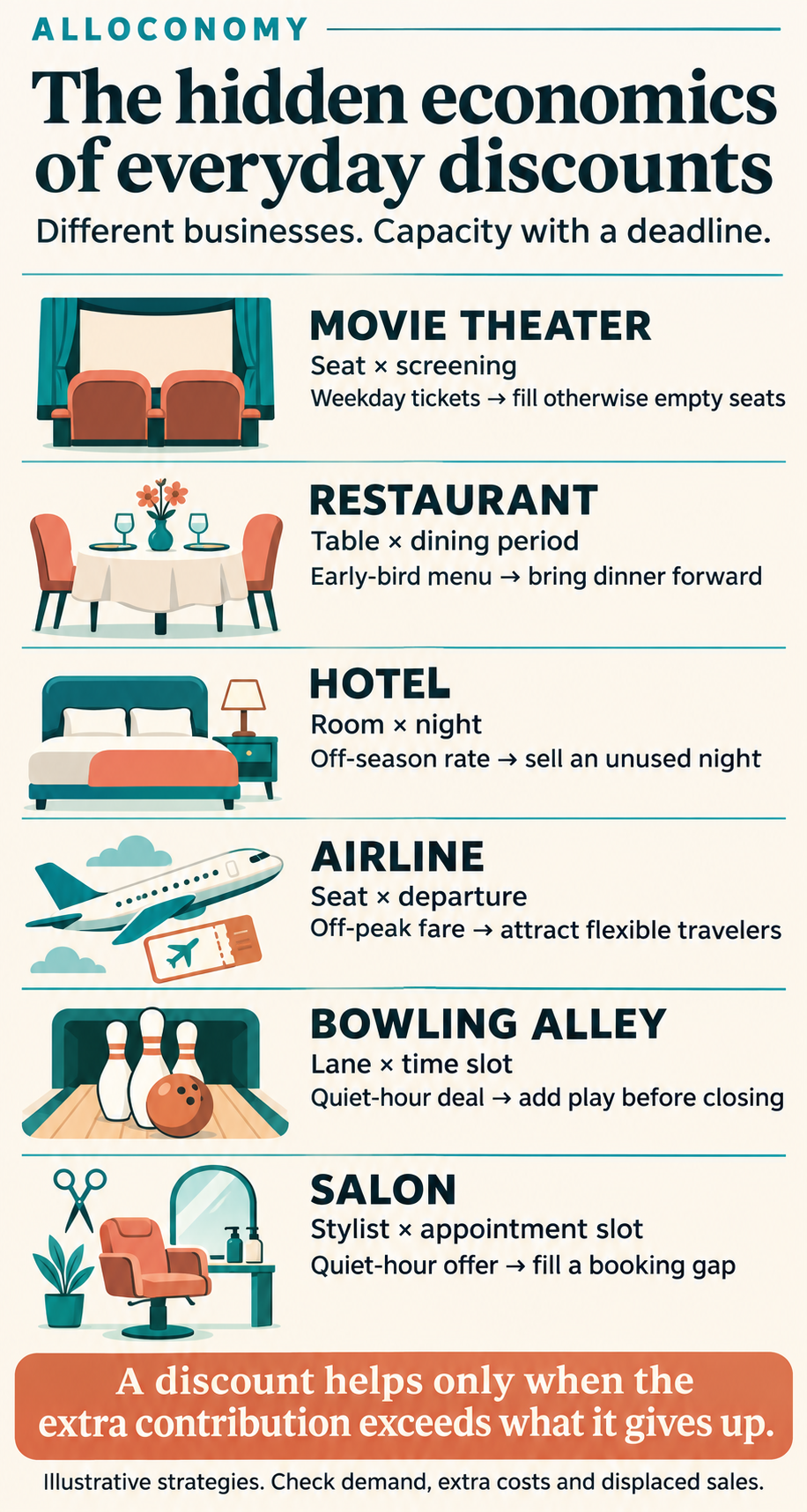
The unit of capacity changes; the test remains whether the offer adds more contribution than it gives up.
From one seat to millions of decisions
Repeat this across rides, orders, reservations, or subscriber-days. Transaction records, connected systems, and distributed computing can assemble revenue and relevant costs at enormous scale.
This capability is already documented: Uber described trip-level profit-and-loss computation in 2021. Such systems can support finely targeted decisions about promotions, service promises, and capacity. A pricing rule can flag or stop an offer whose expected contribution falls below the required floor. The advance is applying an established principle with greater reach, speed, and reliability.
The numbers still have boundaries. Refunds arrive later; risk costs require estimates; shared costs need defensible treatment. My Uber worked example follows those revisions. Granularity is not certainty, and a historical unit margin is not automatically the effect of the next decision.
Unit Economics: The Discipline of Close, Every Day, Every Unit explores that modern challenge: making the calculation trustworthy at operating scale. This essay supplies its foundation—understanding what one additional sale contributes.
The next discount invites three questions: What will go unused? What changes if someone buys? What contribution remains?
Sometimes abundance begins by allocating what already exists—before the opportunity expires.
Continue with unit economics
- Make the pricing decision: Why Unit Economics? The Next Decision Needs More Than an Average.
- Separate allocated from avoidable costs: A Cost on Paper Is Not Always Money You Can Save.
- Follow costs after a transaction: Uber: The Ride Ends Before Its Costs Do.
- Trust the cost boundary: Unit Economics: The Discipline of Close, Every Day, Every Unit.
References
Offers checked 7 November 2026. PVR INOX is a historical 2025 example; local terms and availability vary.
- Chandra and Paperman: direct costing’s history (1976 review)
- ACCA: contribution under marginal costing
- Uber Engineering: trip-level finance computation (2021)
- ACCA: relevant costs and opportunity costs
- Cinemark: Scene in Bellevue, screening and price context
- Cinemark: Tuesday offers
- Regal: promotions
- PVR INOX: August 2025 transcript
- Cinemark: 2025 annual report
- SOCIAL: offers guidance
- Marriott: Bonvoy Escapes
- Delta: pricing explanation
- Bowlero Avondale: specials
- PG&E: how rates work
- T-Mobile: Tuesdays
- T-Mobile: customer appreciation and loyalty
- Cornell: capacity-constrained service firms