What Deserves an Account?
Distinguish natural accounts, segments, values and combinations, then decide where an attribute belongs.
Suppose someone asks for “a new account for every project.” Before evaluating the request, I want to know what they are asking us to create.
Do they want a new expense category? A project field on the posting? A new value in an existing project field? Or permission to use that project with a particular company and cost center?
Those are four different changes. The distinction is the starting point for deciding what belongs in the chart.
Name the object being changed
Consider this illustrative combination:
Company A / Compute-services expense / Research / Project 17
| Object | Example of a change |
|---|---|
| Natural account | Introduce an economic category that needs separate accounting treatment or reconciliation. |
| Segment | Add Project as a controlled coordinate on relevant postings. |
| Segment value | Register Project 18 in the existing project master. |
| Posting combination | Allow Company A / Compute-services expense / Research / Project 18. |
A combination is a tuple of values. Its first use may be routine if it satisfies existing rules. Adding a segment changes what relevant postings must carry. A new natural account is itself a new value in the natural-account segment; it introduces an economic classification. A new project value introduces a project identity. That difference in meaning drives the review each needs.
ERP products package these concepts differently. Oracle’s chart configuration documentation distinguishes natural-account, balancing and cost-center segment roles. Microsoft Business Central’s dimensions documentation explicitly proposes using dimensions to represent departments and projects instead of creating separate general-ledger accounts for them.
For the rest of the series, the central question is: does this attribute need to be a controlled coordinate of the posting, or can its purpose be served by supporting records and downstream derivation?
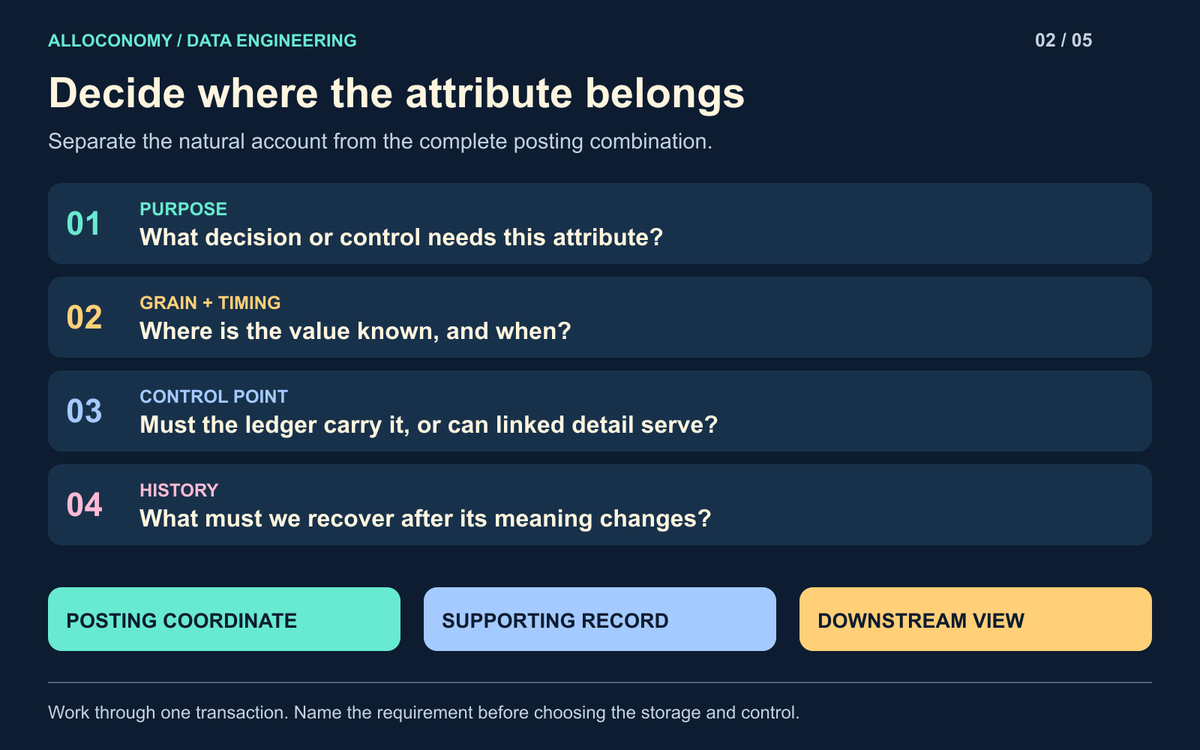
Four questions for a proposed attribute
I would work through these in order, using one actual transaction. “We want better reporting” is the beginning of the conversation; the next step is to name the report or control and show what it needs.
1. What must the business do with it? Perhaps it must reject spending against a closed project, reconcile a specific obligation or preserve responsibility for an expense. Perhaps it only wants to group last year’s projects into a new strategic portfolio. Write down the consequence of getting the attribute wrong.
2. When, and at what grain, is the value known? A purchase line may belong to one project. An invoice may span several. A shared compute bill may support dozens of models. If a single posting line covers several values, decide whether to split it, keep the detail in a subledger or allocate the amount later. Where allocation is necessary, document how and when it supplies the value.
3. Where must the requirement be enforced? A general-ledger balance needed by project may justify a project segment. A project subledger may instead enforce the budget and retain the detail while reconciling to summarized ledger postings. Put the control where it can operate reliably, and preserve the link between detail and summary.
4. What must remain reproducible when things change? If teams reorganize, retain the responsibility recorded with the entry. If a portfolio grouping changes, preserve the mapping used in an issued report. If a cost allocation changes, retain the method and result used before the change.
These questions lead to three practical outcomes: a posting coordinate, supporting detail, or a downstream classification. Some attributes legitimately appear in more than one place; their authoritative source and update rules should be clear.
Work through Project 17
Assume a company requires project-level expense balances in its general ledger, and it checks whether a project is open before accepting charges. Project is already a segment. A purchase line identifies Project 17 before posting.
The requirement, timing and control point line up. Retain Project 17 in the posting combination, with rules that allow it only for the appropriate company, accounts and cost centers. If one invoice spans two projects, its accounting distribution needs the corresponding split.
Now add a request: “Show spending on strategic projects.” The strategy team changes that grouping each quarter. Suppose the grouping affects management analysis only. Keep a dated project-to-portfolio mapping downstream. The posting already identifies the project, so the report has a durable key from which to derive the portfolio.
The historical and current portfolio views follow the distinction in my earlier essay Which Version of the Past?. It explains how Type 2 history and a current mapping can support both questions.
The result is a useful boundary: Project 17 travels with the posting; “Strategic” comes from a named reporting mapping. A reorganization changes the mapping rather than requiring a new natural account for each project’s new label.
Change the assumptions and the answer can change. If the company needs no project balances in the general ledger, but a project subledger provides the required control and reconciliation, that may be the better home for Project 17. Conversely, if a project classification determines an accounting treatment, the accounting workflow needs the relevant evidence and approved classification before it can apply that treatment.
When a new natural account earns its place
A new natural account is justified when the business needs a distinct accounting category: a separately reconciled obligation, a different treatment, or a required classification that existing accounts cannot express adequately.
For example, trade payables and a warranty provision describe different obligations and have different supporting reconciliations. Project 17 and Project 18 can incur the same kind of compute expense. Their identities belong in the project classification, if project is needed at that control point.
A company may also have prescribed local accounts. Establish those requirements before applying a general design preference. The principle is to match the account’s meaning to the accounting distinction it serves.
The decision I would take to a review
For each proposed attribute, I would write one short statement:
We need this distinction, for this named purpose, at this grain and time. We will enforce or derive it here, using this retained evidence, and preserve this history.
For our example: we need project expense balances and an open-project check when purchase lines post. We will use the existing Project segment, controlled project values and valid combinations. We will derive strategic portfolios from a versioned project mapping.
That statement is specific enough to challenge. Finance can check the control. Engineering can check the available data and joins. Reporting users can check whether the result answers their question.
There is still a cost question: how many values, combinations and exceptions will this choice produce? We will examine that in the fourth essay. First, let us apply this same method to four recognizable business models.
← Previous: From Clay Tablets to OpenAI · Next: Four Business Models, One Accounting Boundary → · Complete series guide