Accounting Agents Need a Memory
Use four report changes to test posting history, source evidence, allocations and dynamic groupings.
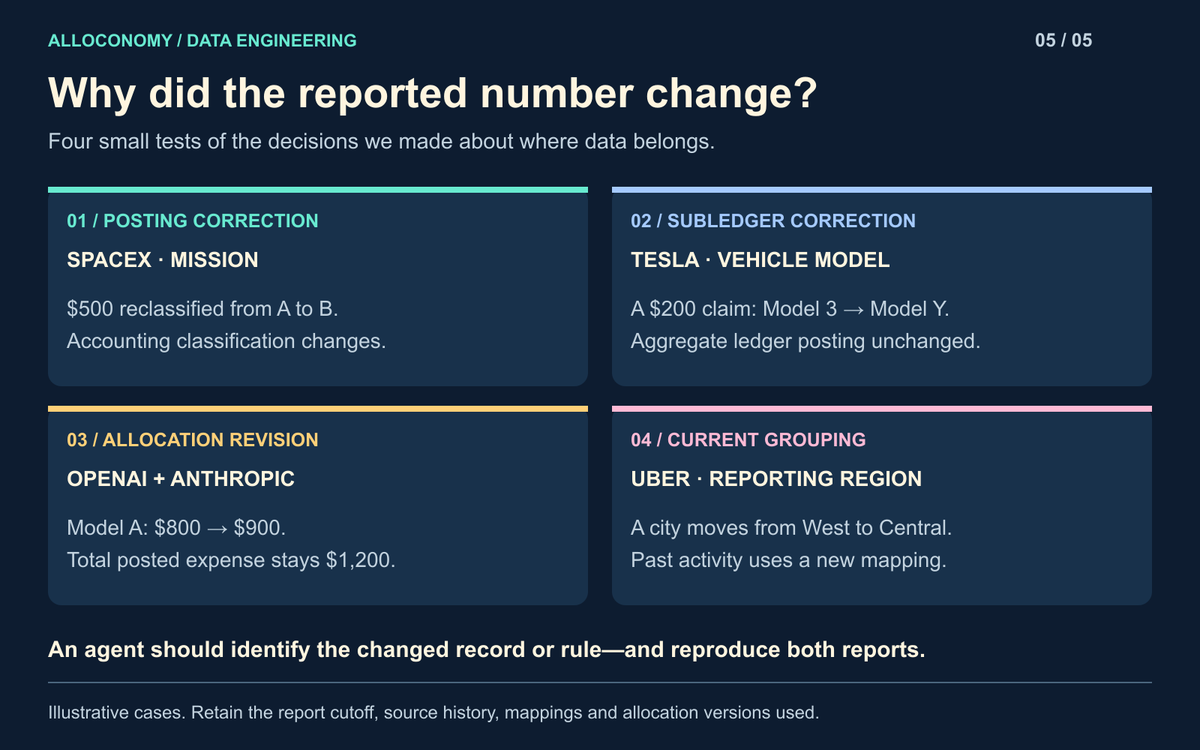
“Why is this number different from the report we issued last month?”
That is the question I would use to test the design we have built through this series. An agent should be able to identify what changed, retrieve the records behind it and show how the change affected the answer.
The question becomes manageable when we separate four possibilities: a general-ledger correction, a subledger correction, a revised allocation, and a different reporting grouping. Let us try each with the business models from the third essay.
The amounts and events below are invented for these exercises. Each example states the records the design would need to retain.
SpaceX: a posting was assigned to the wrong mission
In our launch-business example, Mission is a controlled posting segment. Suppose a $500 direct cost was posted to Mission A. Finance later determines that it belongs to Mission B and approves a reclassification.
The question: “Why did Mission B’s cost increase by $500?”
When the design works: the agent retrieves the original entry, the approved correction and the source evidence identifying Mission B. The original report included the cost under A. The subsequent report includes the correction that moves it from A to B. Total expense across both missions is unchanged, but the accounting classification has changed.
The explanation should be as concrete as the transaction: “The later report includes the approved $500 reclassification from Mission A to Mission B. It was posted after the earlier report’s cutoff.”
When it fails: someone overwrites the mission field on an extracted historical posting and keeps only the latest value. The agent sees Mission B in both report runs and cannot explain the earlier result.
What we learn: preserve the original posting and the accounting correction history. An ERP may represent dimension corrections through a journal or an audited correction mechanism. The warehouse needs to carry the relevant history, including the report’s cutoff, rather than silently replace yesterday’s classification.
Tesla: a subledger classification was corrected
Return to the warranty example, where vehicle model is controlled in the warranty subledger and the general ledger holds an aggregate warranty balance. Suppose a $200 settled claim was assigned to Model 3 in the subledger. Its supporting repair record shows that it belongs to Model Y, and the warranty team approves a correction. The amount, entity and aggregate general-ledger posting remain unchanged.
The question: “Why did claims settled for Model Y rise by $200?”
When the design works: the agent retrieves the original Model 3 assignment, the approved Model Y correction and the repair evidence. It shows the $200 movement between the models in the warranty reconciliation, with the aggregate claims total and linked ledger posting unchanged. It can reproduce the model balances reported before the correction and those reported afterward.
When it fails: the subledger extract keeps only today’s model assignment. The agent can reproduce the aggregate ledger balance but cannot explain the earlier model-level reconciliation.
What we learn: choosing the subledger as the control point makes its correction history part of the accounting evidence. Model detail outside the general ledger still needs disciplined records. If we had instead chosen a Vehicle Model segment in the ledger, this correction would also need to reach that posted classification.
OpenAI and Anthropic: attribution changed
Imagine an AI provider records $1,200 of compute-services expense for a month. The invoice and accounting posting are settled for this exercise. Management allocates that expense between two fictional model versions, called Model A and Model B, using the available usage evidence.
At the close, $100 remains unassigned. Later, additional usage evidence supports assigning it to Model A.
| Destination | v1: issued | v2: revised |
|---|---|---|
| Model A | $800 | $900 |
| Model B | $300 | $300 |
| Unassigned | $100 | $0 |
| Total | $1,200 | $1,200 |
The question: “Why did Model A’s attributed cost rise from $800 to $900?”
When the design works: the agent retrieves v1, v2 and the additional evidence supporting the $100 assignment. It identifies which report used each allocation. Both versions reconcile to the same $1,200 expense pool.
When it fails: the latest allocation overwrites v1. The agent can show today’s $900 but has no record of why the issued report showed $800. Another failure occurs if the previously unassigned $100 is added to Model A without being removed from “Unassigned,” inflating the allocated total to $1,300.
What we learn: retain the allocation’s inputs, method, version and results, and check that the allocated and unassigned amounts sum to the in-scope expense. This is the practical obligation that comes with deriving cost attribution downstream.
For these assumptions, the agent can say: “Recognized expense stayed at $1,200. Allocation v2 assigned the previously unassigned $100 to Model A.” That tells the reader exactly which kind of change occurred.
Uber: the question used today’s regions
Suppose the marketplace team moves a city from West to Central in its management hierarchy. The underlying trips and accounting entries are unchanged. A manager asks for last quarter’s activity using the new regional organization.
The question: “How would last quarter look under today’s regions?”
When the design works: the agent uses the retained trip city and the requested current city-to-region mapping. It labels the result “Last quarter, grouped by current regions.” If asked what was originally reported, it retrieves the mapping and data cutoff used in that issued report instead.
When it fails: a dashboard silently joins historical activity to the latest region mapping. Last quarter’s West total changes, and users interpret the movement as changed business performance.
What we learn: a dynamic reporting view needs an explicit time basis. “Regions as they were then,” “the report issued then,” and “today’s regions applied to old activity” can produce different results. Record the requested basis and the mapping used.
My earlier essay Which Version of the Past? explains how Type 2 history can coexist with current groupings, and why reproducing an issued report may also require the history of when information reached the system.
This flexibility is exactly what keeping management region downstream was meant to provide. Clear labels and retained mappings make it useful.
Give the agent something it can demonstrate
Across the four examples, a good answer has a small, repeatable structure: the two report versions being compared, the changed record or rule, the amount affected, and whether the accounting posting changed.
To support that answer, an issued report needs a recoverable set of inputs and definitions: its data cutoff, relevant posting or correction history, supporting-data versions, and the mappings or allocations it used. A saved result preserves what readers saw; those references help explain how it was produced.
I would test the system with the same questions before and after a known change. Can it reproduce the issued report? Can it produce the requested current view? Can it explain the difference from retained evidence? Where an input was never captured, the useful answer identifies that gap.
This gives us a practical way to assess the earlier design decisions. Mission controls helped explain a posting correction. Warranty subledger history helped explain a vehicle-model correction. Allocation versions explained a changed cost attribution. Region mappings supported a new view of unchanged activity.
The chart, the supporting records and the reporting model each carried a specific part of the explanation. That is the outcome I would want from the design—and the evidence I would look for before trusting an agent’s account of why a number changed.
← Previous: When the Chart of Accounts Keeps Growing · Complete series guide