Four Business Models, One Accounting Boundary
One attribute decision each for Uber, Tesla, SpaceX, and AI providers OpenAI and Anthropic.
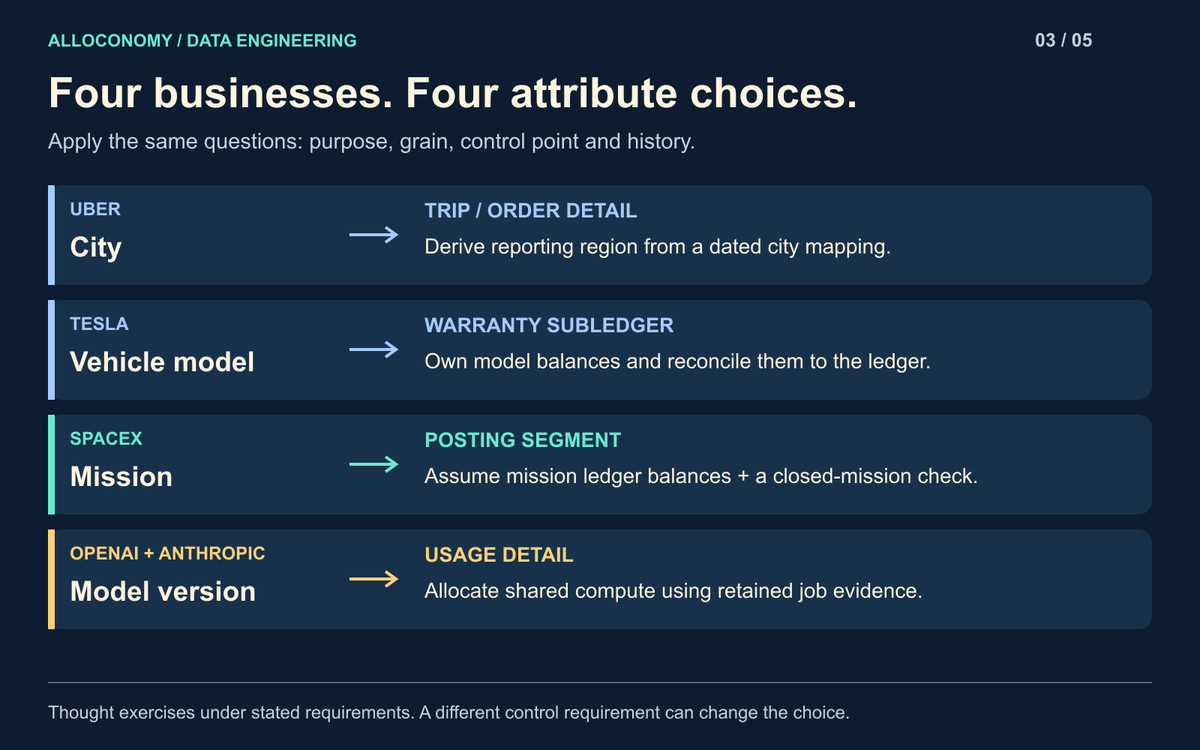
The principles become easier to judge when we make an actual choice.
This essay takes one attribute from each of four business models: a marketplace’s city, a manufacturer’s vehicle model, a launch business’s mission and an AI provider’s model version. Each case follows the same questions from the previous essay: purpose, grain and timing, control point, and history.
These are thought exercises inspired by Uber, Tesla, SpaceX, OpenAI and Anthropic. The requirements below are assumptions chosen to test the principles; the companies’ private accounting configurations are outside the exercise.
Uber: should city be a chart segment?
Uber describes its ride and delivery businesses in the Mobility and Delivery sections of its 2025 annual report. For our exercise, suppose a team wants to compare marketplace activity by city and regroup cities into management regions.
Purpose. In this exercise, city serves operational analysis. The accounting workflow already identifies the responsible legal entity and cost center, and has no separate requirement for city-level ledger balances.
Grain and timing. City is known on each trip or order. A summarized accounting entry may cover many cities. We need a retained link from that entry to the underlying transaction set, with amounts that reconcile.
Control point and choice. Keep city in the transaction records. Derive management region from a city-to-region mapping. Adding city to every posting combination would make a financial classification depend on a reporting requirement that the retained detail can already satisfy.
History. Save the mapping used for an issued regional report. If a city moves from “West” to “Central,” readers should be able to compare the old report with a view using today’s regions.
This is the historical-versus-current grouping choice explored in Which Version of the Past?.
What would change the choice? A requirement to reconcile or control city-specific balances in the ledger. We would then evaluate city as a posting dimension for the affected entries. The word “city” alone does not decide its home; the required use does.
Tesla: should vehicle model be a chart segment?
Tesla explains in its 2025 report’s Warranties section (p. 35) that its estimates draw on claims already incurred and the expected frequency and cost of future claims. That gives us a concrete reason to connect warranty balances with repair evidence.
For our exercise, consider vehicle model, such as Model 3 or Model Y. Finance wants to explain each model’s warranty reserve: opening balance, new provisions, claims settled, estimate changes and closing balance. A small, fairly stable set of models could reasonably fit in a chart segment. The decision turns on where that model-level accounting should be controlled.
Purpose. Assume the warranty team maintains and approves this model-level reconciliation in a warranty subledger. The general ledger holds the company’s aggregate warranty balance, and the subledger total reconciles to it at each close.
Grain and timing. The vehicle model is available for individual claims. Provisions and estimate changes also need a model classification in the subledger. An estimate spanning several models needs an explicit split or a separately identified shared amount, so that the model-level balances remain explainable.
Control point and choice. Under these requirements, retain vehicle model as a controlled subledger attribute. This supplies the required balances and their history without repeating model classification across general-ledger combinations. The choice depends on a dependable subledger reconciliation; a spreadsheet that cannot account for the total would not meet the requirement.
History. Preserve the model assigned to each claim or estimate, approved corrections, and the model-level reconciliation used at each close. Later marketing groupings of models can be derived from a dated mapping.
What would change the choice? Suppose finance must certify warranty balances by model directly from the general ledger, and its posting workflow must reject warranty entries without a valid model. Then a Vehicle Model segment on the relevant postings earns its place. The added setup and reconciliation may be modest enough to justify that control.
This is the trade-off: a model segment gives the ledger direct responsibility for model-level completeness; the subledger approach concentrates that responsibility in the detailed warranty system. Both need evidence for shared estimates. The design question is which system should own the control, and whether duplicating it adds enough value.
SpaceX: should mission travel with the posting?
SpaceX’s Smallsat Rideshare Program offers shared launches for small satellites. That provides the setting for a project-costing exercise. Focus on just one attribute: mission identity.
Purpose. Assume the finance team requires mission-level balances in the general ledger and wants to prevent new charges against a closed mission. This is a deliberately stronger requirement than the reporting requests above.
Grain and timing. Direct purchase and labor distributions identify the mission before posting. Shared costs need a defined treatment: either an approved distribution before posting or a separate shared-cost pool awaiting later allocation.
Control point and choice. Under these assumptions, use a controlled Mission or Project segment on the relevant postings. A new mission creates a value in that segment and valid combinations with the existing accounts and responsibility centers it needs.
History. Preserve the posted mission identity and its status history. A later grouping of missions into commercial portfolios can live in a versioned mapping.
What would change the choice? If mission control and balances can be fully provided by a project subledger, with reliable reconciliation to the general ledger, mission detail could stay there. The important design work is proving that the required control survives the move.
This is a case where additional posting detail earns its overhead: the attribute supports a named accounting control at the required level.
OpenAI and Anthropic: should model version be a segment?
I am grouping these companies because the modeling question is shared. OpenAI’s usage-reporting example groups customer usage by model and project; Anthropic’s reporting example shows daily usage grouped by model. Those documented usage attributes give us the starting point for a provider-side cost exercise.
Purpose. Imagine a provider wants to estimate compute cost by model version. Assume model identity changes no general-ledger posting rule and no model-specific balance is required in the ledger.
Grain and timing. A job or serving event can identify its model version. A supplier bill may cover shared capacity used by many models. The job identity is direct evidence; its share of the bill may require an allocation.
Control point and choice. Retain model version with the usage records. Link the relevant usage and shared-cost pools to accounting, then apply an explicit allocation method downstream. Each model release adds operational master data and mapping work. It need not add a new chart segment value or a family of natural accounts.
History. Keep the usage cutoff, allocation method and results used for each issued cost report. Later evidence may improve the attribution while the recognized expense remains unchanged.
A model-specific contractual cost requirement would strengthen the case for controlled model detail in the accounting workflow. We would then ask whether a subledger can satisfy it or whether the ledger itself needs that dimension. Again, the requirement identifies the control point.
What the four cases taught me
City, vehicle model, mission and model version all matter to their businesses. Importance alone did not tell us where to put them.
In these exercises, mission entered the posting combination because we required ledger balances and posting controls by mission. City and AI model version remained in operational detail. Vehicle model remained in a controlled warranty subledger that supplied the required model-level reconciliation. Regions, mission portfolios and allocated compute costs were derived using explicit definitions.
The question I would now bring to a real design review is more precise: show me the requirement that needs this attribute on the posting, and show me what we would lose if it lived in linked detail instead. That is where I expect the useful disagreements to begin.
← Previous: What Deserves an Account? · Next: When the Chart of Accounts Keeps Growing → · Complete series guide