What Could Break the AI Funding Cycle?
The warning signs are more useful than a confident boom-or-bust prediction. Learn what to watch as AI promises become operating businesses.
The AI financing landscape looks new because the assets, counterparties and numbers are unfamiliar. Much of its financial machinery is older: equity, secured loans, leases, guarantees, customer incentives and project companies.
What deserves attention is the combination. Fast-changing equipment is being installed inside slow-moving physical infrastructure. A small group of firms can be customers, investors and sources of credit support at the same time. Long commitments are negotiated before the ultimate economics of many applications are known.
The useful question is how well these familiar financing arrangements cope with those operating conditions.
Familiar financing, difficult new conditions
Customer warrants have a recognizable purpose: compensate a strategically important purchaser and align incentives. The unusual feature in the examined semiconductor deals is their potential scale and their connection to future computing platforms. Calling them a new asset class adds little to understanding the transfer between customers and existing shareholders.
An SPV is also familiar. Applied well, it can match investors to a defined set of assets and cash flows. The hard question is whether the contract lasts long enough, the equipment remains useful, and any promised separation survives guarantees or other recourse. A legal boundary is not a substitute for economic analysis.
Capacity commitments are familiar in industries that must build before serving demand. AI introduces difficult measurement questions: a nominal unit of capacity does not tell us the quality, availability or economic productivity of the service. A gigawatt is electrical capacity, not a fixed number of useful model outputs. Training and inference workloads can impose different operating requirements.
Long-term capacity contracts do not automatically create a liquid market in which those claims can be bought and sold. That would require evidence of standardized terms, buyers, sellers and reliable settlement. Shared infrastructure failures and several borrowers struggling at once are also familiar financial risks. New technology changes their shape; it does not make them disappear.
| Mechanism | Familiar financial idea | AI-specific question |
|---|---|---|
| Strategic investment | Finance a business with equity | Does the investor also sustain the customer's purchases? |
| Customer warrant | Reward future commercial activity | How much supplier value transfers after all vesting conditions? |
| Project vehicle | Finance defined assets and contracts | Are buildings, chips and power risks actually separated? |
| Guarantee | Substitute or supplement credit | Does one downturn activate many connected promises? |
| Capacity commitment | Underwrite investment with demand | When does usable, billable capacity actually arrive? |
| Equipment collateral | Recover value after default | Who buys a displaced cluster, at what net price? |
The constraint may be physical before it is financial
The IEA's April 2026 analysis projects data-center electricity use rising from 485 terawatt-hours in 2025 to around 950 in 2030. Those totals cover data centers broadly, not AI alone. The same report identifies grid, equipment and other bottlenecks. It is a scenario-based outlook, not proof that every announced project will connect on time. [1]
For a lender, a delayed transformer can matter as much as a change in an AI benchmark. The project can own expensive equipment and still be unable to deliver the service needed for billing. Money pays for the attempt to create capacity; it cannot instantly produce a grid connection.
On-site generation can reduce one dependency while introducing others: fuel, permits, generation equipment, reliability and operating cost. A campus announcement should therefore be translated into milestones: site control, power arrangements, construction, equipment delivery, commissioning, customer acceptance and recurring billing.
Each milestone converts a different kind of uncertainty into evidence.
Three paths through the same landscape
In a productive expansion, useful applications grow, customer spending becomes broader, cost improvements support margins and infrastructure arrives in time. Refinancing becomes less important as existing assets generate cash and debt amortizes. Some investments still fail, but failure is absorbed without disrupting the entire buildout.
In a profitable technology with overbuilt capacity, AI adoption succeeds while the supply of compute grows faster than what customers will buy at prices needed to justify past investment. Users benefit from cheaper service. Efficient operators gain share. Less competitive assets and capital structures suffer. This is a counterexample to the idea that technological success guarantees attractive investment returns.
In a funding interruption, investor appetite weakens before all projects mature. Laboratories reduce spending; operators defer equipment; contractors face delays; guarantees receive more attention. Some contracts protect cash flow and others do not. The outcome depends on liquidity and enforceable support, not simply on whether a company has impressive backlog.
These are scenarios, not probability forecasts. Assigning probabilities would require a defined portfolio, current prices and fuller contract and operating data than the public record provides.
A dashboard that does not pretend to know the future
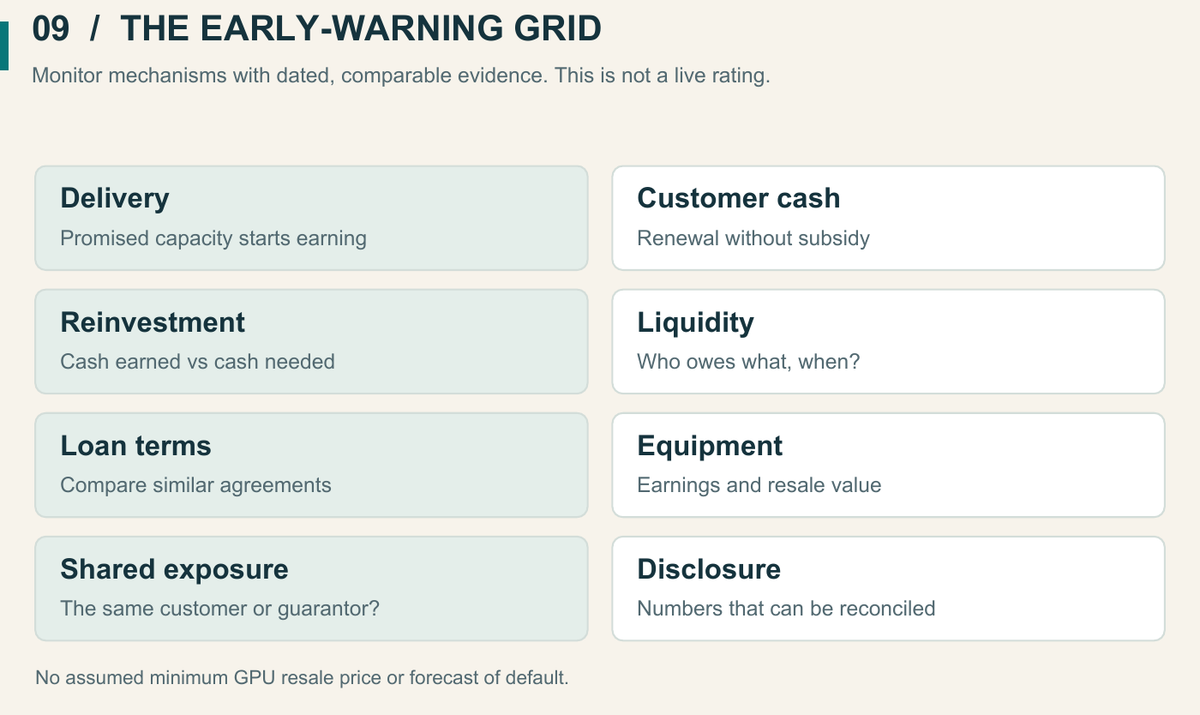
Start with the things that could prevent repayment: late delivery, weak customer cash, expensive refinancing or disappointing asset recovery. Then choose observations that would reveal those problems.
Delivery conversion: compare contracted, under-construction, energized, accepted and billable capacity for the same group of projects. Mixing a company's distant contracted pipeline with current operating capacity can make the apparent conversion rate meaningless. A widening gap matters most when debt costs begin before billing.
Independent customer cash: where disclosed, follow receipts, renewals and contribution after incentives from customers beyond the financing partners. Public-company revenue is not a clean proxy for the private laboratory's end-market collections. Record missing data instead of estimating it from funding headlines.
Cash after reinvestment: examine operating cash flow alongside cash capital expenditure and lease payments, with growth and maintenance spending separated where supportable. A single negative period during expansion is not a default signal. A persistent gap combined with weakening financing access deserves attention.
Debt service and liquidity: map repayment dates, unused committed borrowing, the conditions for accessing it, cash that cannot be freely used, and which company owes each debt. A nominal facility does not solve a cash shortage if the borrower cannot satisfy its conditions. A ratio should use the cash actually available to the entity that owes the debt.
Comparable financing terms: compare spreads, covenants, collateral and guarantees on a like-for-like basis. The CoreWeave comparison in Part 7 shows why a new structure's higher margin cannot automatically be called deterioration. Tighter loan conditions, earlier repayment dates and a lower amount lenders will advance against an asset may matter as much as the interest rate.
Equipment earning power and recovery: observe realized rental economics and verifiable transactions for comparable equipment, locations and configurations. List prices are not liquidation proceeds. A spot-price decline can help users and still impair collateral or renewal economics. No reliable universal GPU price floor is assumed here.
Concentration after guarantees: aggregate exposure to the ultimate payer and common shock, not just the number of SPVs. Several projects with the same customer or guarantor can be one large correlated position wearing several company names.
Disclosure quality: track whether firms reconcile commitments with deliveries, financing with drawdowns, and backlog with recognized revenue. Repeatedly changing definitions can make apparent growth harder to interpret even when every individual announcement is literally accurate.
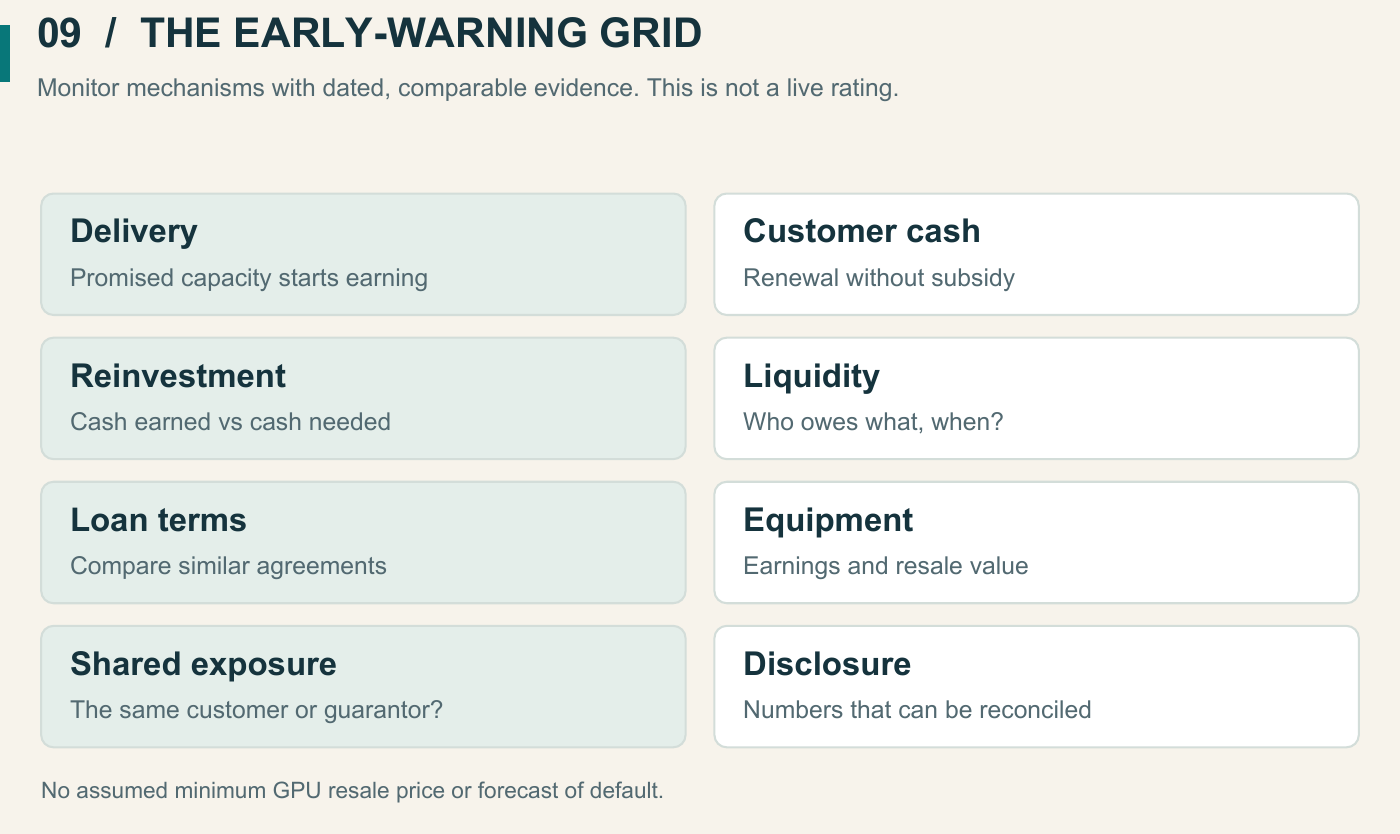
Figure 9. A checklist for reading future disclosures. These eight indicators connect to the failure mechanisms explained in the series. The grid assigns no current risk scores or forecast probabilities.
The first loss is not always the first visible problem
An equity price can fall before a borrower misses a payment. A project can require additional equity while senior creditors continue receiving interest. A customer can renegotiate before formally defaulting. A guarantee can remain unused while its existence changes bargaining power.
That is why “who loses first?” has two meanings. Contractual priority determines which claim absorbs a shortfall at a particular entity under a particular process. Market value can decline earlier and across several entities at once. The order in which market prices fall can differ from the contractual order in which creditors get paid.
Even in the simplified debt-and-equity example from Part 6, senior protection depends on the size of the loss. In an actual restructuring, enforcement costs, multiple collateral pools, intercreditor rights and guarantee recoveries complicate the sequence. A generic diagram should never be passed off as a verified liquidation outcome.
What would strengthen the case for the buildout?
Evidence of useful adoption matters, but the most persuasive combination is broader: timely energized capacity, customers renewing from operating budgets, improving cash contribution, debt amortizing against operating assets, and collateral whose recovery does not depend on everyone expanding at once.
A stronger balance sheet can deliberately fund years of research or subsidize adoption. That may be a rational strategic choice. Readers should distinguish that choice from a claim that the new assets already finance themselves. The question is whether the sponsor understands and can afford the commitment, and whether investors are compensated for bearing it.
Who ultimately pays for the intelligence?
The opening separated the estimated building bill for 2022–2026 from a possible way to earn it back later. Its 2027–2031 scenario assumed the entire investment still needed recovery, with 25 cents of every revenue dollar available after operating costs, taxes and further investment. Neither the five years nor that 25% share is an industry forecast. Financing agreements explain how building can proceed while the eventual outcome remains uncertain.
Funding the build. Investors contribute ownership capital, creditors make loans and customers may pay in advance. Established businesses can fund new capacity from money earned elsewhere. Suppliers can support customers through the arrangements explored in this series.
Earning the investment back. Customers paying enough for useful services, after the costs of providing those services and maintaining the business. Raising another funding round can pay the next construction bill; it does not by itself show that the original investment has earned a return. Some investors may instead sell their stake, passing the claim on future earnings to a new owner.
Absorbing a shortfall. That depends on the company, the assets and the agreements. Owners can lose their investment; lenders can lose principal once protections run out; a guarantor may owe a covered payment. A customer's advance can also be at risk if the promised service never arrives. No single loss order applies to every company in the network.
Over time, the system must either generate sufficient economic benefits for the parties funding it, receive continued subsidy on deliberate terms, or reprice the claims through losses and restructuring. There is no contradiction between useful AI, real infrastructure and some investors losing money.
Return to the opening cheat sheet when the next funding headline arrives. Identify the agreement, the asset and the payment date. Then ask whose money covers the gap if delivery or demand disappoints. Those details tell us how the building bill is being financed—and who is relying on future customers to make it worthwhile.
Sources and dates
Reporting checked through 26 September 2026. Dollar amounts are US dollars. Announcements describe disclosed commitments; illustrative examples are labelled in the text.
- IEA Key Questions on Energy and AI — 2026-04; Updated electricity outlook and bottlenecks.
Continue the series
Previous: CoreWeave and the Four Clocks of AI Infrastructure