AI Financing: The Cheat Sheet
Twenty financing concepts in the series’ order. Named examples make the relationships concrete; direct explanations connect them to the AI deals.
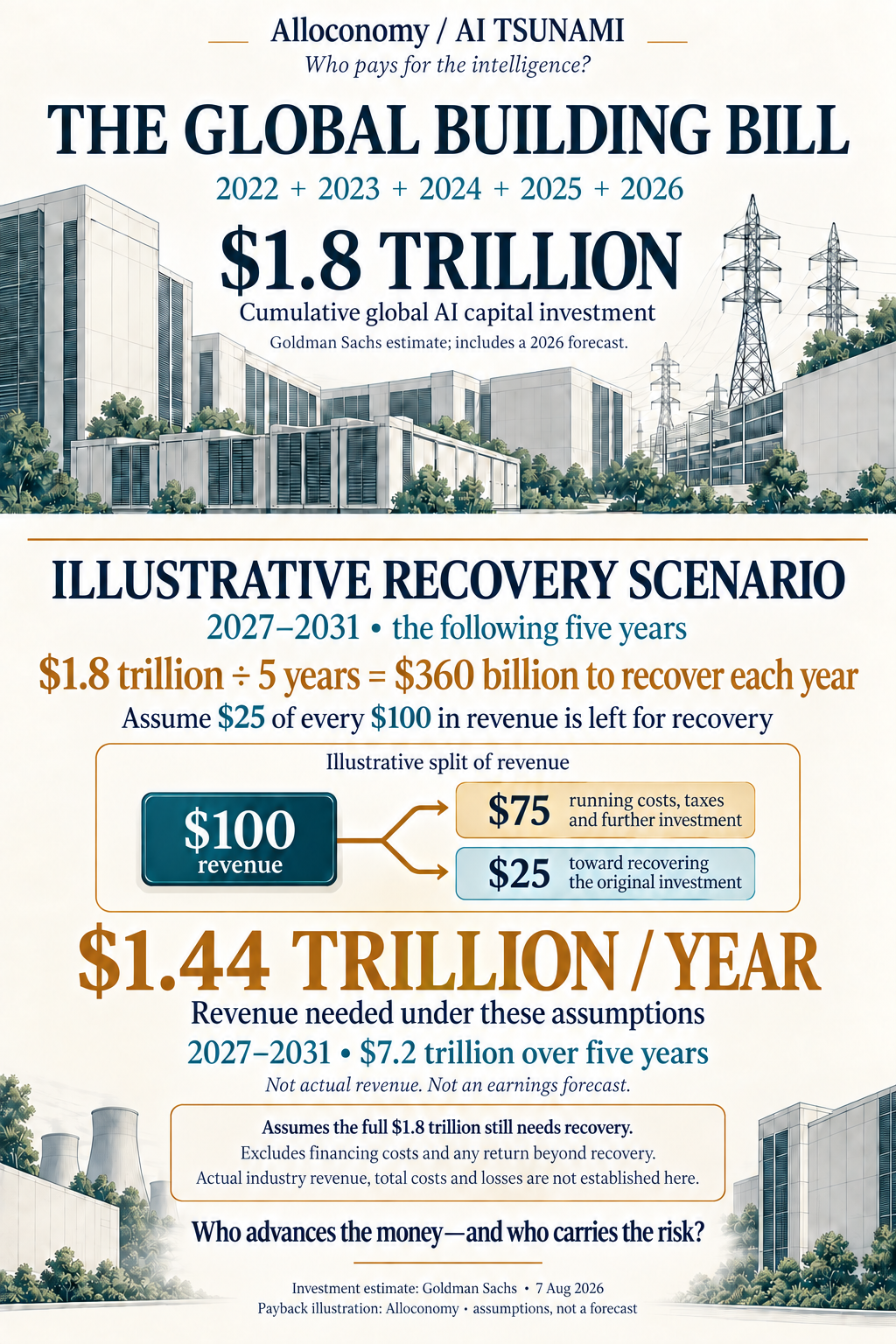
Who pays for the intelligence?
By the end of 2026, the world's AI building bill could reach $1.8 trillion accumulated since 2022, according to Goldman Sachs Research. Its estimate extends beyond US hyperscalers to private companies and firms abroad. It includes a forecast for the rest of 2026.
Now try a simple recovery scenario. Suppose the full $1.8 trillion still needs to be earned back at the start of 2027. Recovering it over 2027–2031 would take $360 billion left after costs each year. If 25 cents of every revenue dollar remained after operating costs, taxes and further investment, the businesses would need $1.44 trillion of annual revenue during those five future years.
Those are illustrative assumptions. The revenue figure is a hypothetical future requirement, not reported revenue or an earnings forecast. The scenario also excludes interest and the return investors would require beyond getting their money back.
Chips must be ordered, sites secured and construction financed before the customers who will use all that capacity have arrived. Who advances the money, through which agreements, and who carries the risk if the revenue arrives late? Follow the money through this series.
What about the industry's losses? The capital-investment estimate does not include all operating costs. The reviewed sources also do not establish matching, consolidated AI revenue for 2022–2026. Subtracting a few labs' sales from the global building bill would therefore produce a misleading “loss.” The financing question stands even without that number.
Meet the businesses that make the agreements easier to follow. Maya runs Stories Inc., a book publisher with its own printing business. Mayan runs Sapiens Inc., its printing-equipment supplier. Alongside Harbor Fund, Cedar Bank and MillHouse, they show how ownership, loans, leases, customer payments and guarantees move money—and leave different people responsible for different bills.
Investment dates, recovery assumptions and calculations
The investment period: 2022–2026. Goldman Sachs estimates global AI capital investment through end-2026. Its methods adjust for non-AI activity and extend beyond public US cloud companies. Attribution assumptions and potential lease overlap limit precision. The public article supplies a cumulative estimate, not a complete annual ledger; no annual breakdown has been invented here.
The hypothetical recovery period: 2027–2031. This is our five-year scenario, not a prediction by Goldman Sachs or Bain. We assume the full $1.8 trillion remains to be recovered on 1 January 2027. That is a simplifying assumption, not a measurement of the industry's outstanding losses or funding gap; the amount already recovered has not been established here. We also assume 25% of revenue remains after operating costs, taxes and further investment, before financing costs. This is an illustrative share left after costs, not an observed industry margin or a capex-to-revenue ratio. The five years are a teaching assumption, not a common repayment deadline or useful life for every asset.
The calculation. $1.8 trillion ÷ 5 years = $360 billion toward recovery per year. $360 billion ÷ 25% = $1.44 trillion of annual revenue. Across 2027–2031 that is $7.2 trillion of revenue, of which the assumed 25% leaves $1.8 trillion for recovery. No claim is made that this revenue was earned during 2022–2026 or will actually be earned later.
How the assumption changes the answer. Keeping the same five-year recovery period, leaving 10% after costs requires $3.6 trillion of annual revenue; leaving 20% requires $1.8 trillion; leaving 25% requires $1.44 trillion; leaving 30% requires $1.2 trillion. These are sensitivity examples, not a forecast range. A longer recovery period reduces the annual requirement if the other assumptions hold.
What this simple recovery scenario leaves out. This illustration recovers the initial amount without interest or an additional investor return, does not adjust future amounts for the time value of money, and assigns no value to assets remaining at the end. It does not establish economic profitability. A valuation would also need asset lives, replacement spending, financing costs, timing and a required return.
Counting the industry once. A lab's cloud payment is its supplier's revenue; a cloud company's chip purchase is the chip supplier's revenue. A combined industry account must reconcile these transactions. Funding rounds, valuations and commitments are not sales. Annualized revenue run rates are not revenue earned over a whole year.
All figures are in US dollars. One trillion is one thousand billion. Source and model review: 27 September 2026. The individual essays retain their own reporting dates.
This opening guide follows the eight-part series in exactly the same order. Use the glossary and lookup table, then follow each diagram to see who pays whom.
It continues the learning experiment in Money Cheat Sheets for Humans Working with AI, also explored in Money, Through Three Cultural Lenses. Read a short explanation, then try to explain who pays whom without looking.
The people and businesses in the stories are fictional. Each example is a separate “what if,” not another chapter in one company’s financial history. Teaching units are hypothetical; real company figures are named, dated and sourced. Definitions and calculations follow the linked essays.
Key terms, in plain English
These are roles in a transaction, not permanent labels. Maya’s Stories Inc. is a buyer when it orders machines from Mayan’s Sapiens Inc., and a supplier when it prints menus for cafés.
- Supplier / seller
- The business providing goods or services. Sapiens Inc. supplies machines; Stories Inc. supplies printed materials.
- Buyer / customer
- The business or person purchasing those goods or services. Stories Inc. buys machines; cafés buy its menus.
- Invoice / bill
- A request for payment stating what is owed. The seller sends an invoice; the customer may call it a bill. It does not prove payment.
- Claim / obligation
- A claim is a right under an agreement. An obligation is what someone owes, such as money or a service.
- Cash
- Money received, held or paid. A signed promise to pay is not cash already received.
- Revenue
- The amount a business earns by delivering goods or services under the applicable accounting rules. Cash may arrive earlier or later.
- Profit
- Revenue minus the expenses included in that profit measure. Profit and cash left in the bank can differ.
- Investor / equity
- An equity investor supplies money for an ownership stake, sharing business gains and losses. Equity does not promise scheduled loan repayments.
- Lender / borrower
- The lender provides a loan; the borrower owes repayment. Cedar Bank lends, while Stories Inc. borrows.
- Principal / interest
- Principal is the borrowed amount still owed, excluding interest. Interest is the charge for borrowing.
- Tenant / landlord
- The tenant pays to use property; the landlord provides it under a lease. Stories Inc. rents from MillHouse.
- Guarantee / guarantor
- A guarantee promises support for a specified obligation under stated conditions. The guarantor makes the promise; the beneficiary can claim under it.
- Asset / collateral
- An asset has economic value, such as a machine. Collateral is an asset pledged to secure an obligation; its sale may not cover the debt.
A quick reference in the series' reading order
Select a concept for its detailed explanation and flow diagram in this article. On a narrow screen, scroll the table sideways.
| Part | Concept and detail link | At a glance |
|---|---|---|
| 1 | 01. Three arrows, three different claims | Financing creates ownership or repayment claims; purchases and guarantees create different obligations. |
| 1 | 02. Repeated spending is different from final demand | Successive receipts are not separate pools of outside demand. |
| 2 | 03. Supplier loans and extended payment terms | Delivery today leaves the seller exposed to later repayment. |
| 2 | 04. A supplier becomes a shareholder | A supplier’s ownership investment and its equipment sale are separate claims. |
| 2 | 05. The supplier also commits to buy a service | A supplier can support receipts by purchasing its customer’s eligible unused capacity. |
| 2 | 06. A supplier lends its promise | A loan transfers cash. A guarantee adds a conditional payment route. |
| 3 | 07. Earn a right to buy shares | Earning a warrant, exercising it and measuring its value are different steps. |
| 4 | 08. The building owner and user can differ | A tenant’s minority stake does not erase its rent obligation. |
| 4 | 09. Support for a property's future value | A threshold is the comparison point—not the guarantee payment. |
| 5 | 10. Cash can arrive before revenue | Cash can arrive before the supplier has earned revenue. |
| 5 | 11. A real sale can still depend on new funding | Valid supplier revenue can depend on a customer that still needs financing. |
| 6 | 12. Read what the guarantee actually covers | Support for a tenant’s rent is not automatically support for the landlord’s loan. |
| 6 | 13. Collateral can fall short of the loan | Asset-sale proceeds can fall short even for a senior lender. |
| 6 | 14. Can this year's cash cover this year's debt payments? | After running costs, receipts must cover interest and principal due. |
| 7 | 15. Backlog is work still to perform | Contracted work still needs to become delivered service and collectible cash. |
| 7 | 16. Profit measures and cash for equipment differ | Net operating cash and cash spent on equipment are different measures. |
| 7 | 17. Identify the borrower and the repayment date | Check the amount actually borrowed and who must repay it. |
| 7 | 18. Four clocks have to work together | Opening, collection, debt dates and equipment life follow different clocks. |
| 8 | 19. Useful technology can still disappoint investors | Customers can benefit from lower prices while capacity owners struggle. |
| 8 | 20. Watch evidence that connects to repayment | Readiness, collections, reinvestment and available borrower cash connect the evidence. |
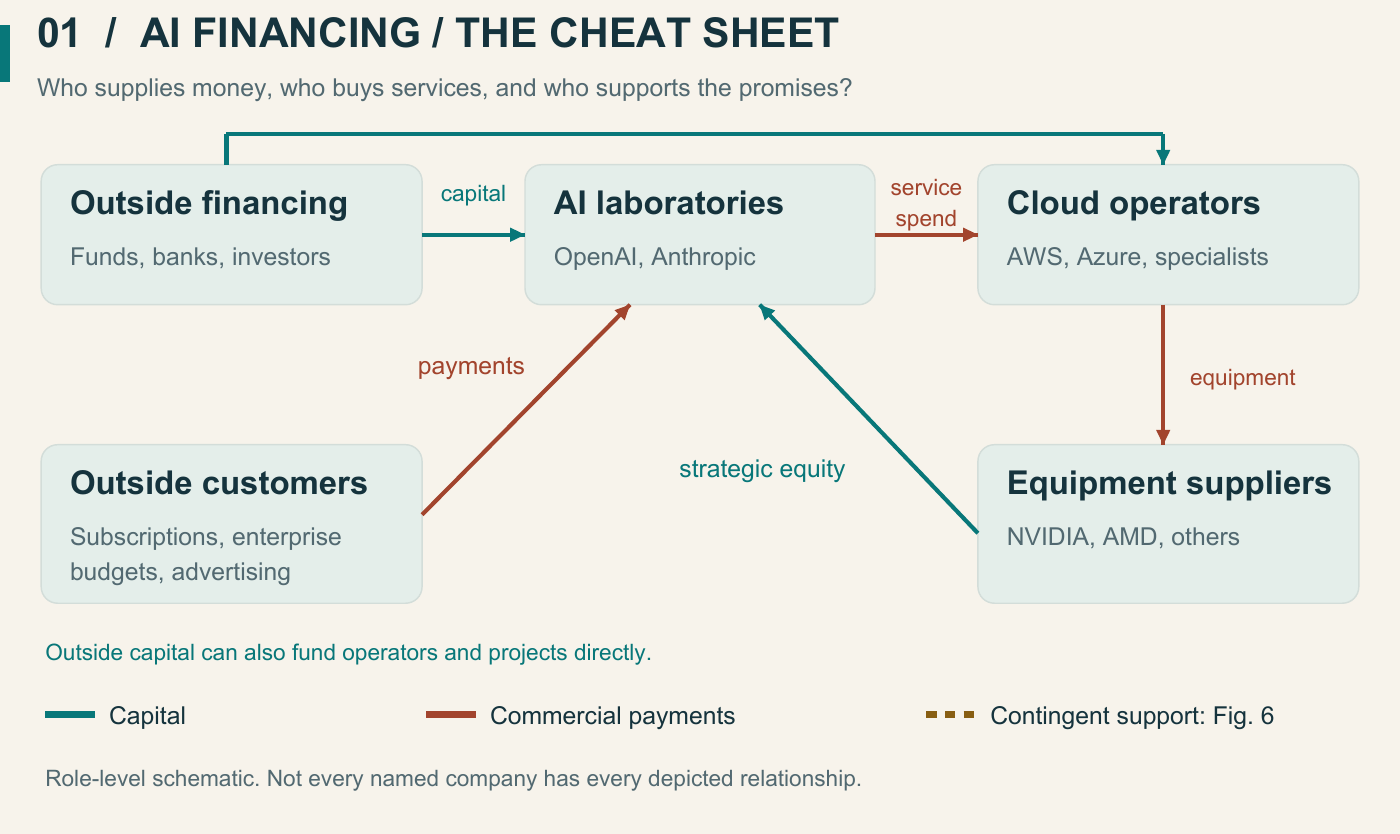
Figure 1. Conceptual map. Teal arrows show financing; coral arrows show purchases. Arrow widths do not measure dollars. A supplier can also become an investor. Conditional guarantees, the third kind of relationship, appear in Figure 6.
Part 1 · Follow the money
Separate financing, purchases and conditional support; avoid counting the same money twice.
Concept 01 · Part 1
Three arrows, three different claims
Money can enter a business as funding, leave as payment for a purchase, or stay put while someone promises to cover a future bill. Each agreement gives someone a different claim.
Two cash movements. One conditional promise.
The last arrow protects MillHouse’s covered rent claim; it is not an additional investment in Stories Inc.
Picture the arrangement
Harbor Fund puts money into Maya’s Stories Inc. in exchange for a share of the business. She uses some of it to buy a printing machine from Mayan’s Sapiens Inc. Separately, Sapiens Inc. promises MillHouse that it will cover specified rent if Stories Inc. fails to pay. Harbor Fund has invested, Maya has bought equipment for her company, and Mayan has committed his company to a conditional payment. Only the first two agreements move cash at the start.
Where the analogy stops. The promise covers only the rent and conditions in its agreement. It need not transfer cash at signing, and it does not guarantee every bill Stories Inc. owes.
Concept 02 · Part 1
Repeated spending is different from final demand
The same money can pass through several businesses. Adding their receipts measures successive transactions, not independent spending by the final customer.
60 + 40 + 15 = 115 of purchases, funded from the original 100.
Adding the investment to those purchases gives 215 of transactions, not 215 of outside customer spending.
Picture the arrangement
Harbor Fund invests 100 units in Maya’s printing business. Maya pays MillHouse 60 to use an equipped print shop. MillHouse pays Mayan’s Sapiens Inc. 40 for printing machines; Sapiens Inc. pays BoltCo 15 for parts. The purchases total 115, but that does not mean print customers have spent 115—or that 215 has entered from outside. Harbor Fund’s original money has passed through several hands.
Where the analogy stops. These are hypothetical teaching units, not industry margins. Each business also has costs. Receipts from print customers are separate from Harbor Fund’s investment.
Check your understanding · Part 1
An investor puts in 100; that money funds several purchases. Can you add every receipt and call it final demand?
No. Keep outside funding, intermediate purchases and receipts from final customers separate.
Part 2 · When suppliers support customers
Read loans, equity, service purchases and guarantees as four different agreements.
Concept 03 · Part 2
Supplier loans and extended payment terms
A seller can lend a customer money or give the customer longer to pay. Making the sale and getting repaid are separate questions.
The sale can be real while repayment remains uncertain.
Picture the arrangement
Maya needs a printing machine for Stories Inc. but cannot pay the full price today. Mayan’s Sapiens Inc. delivers it and lets her company pay in installments. She can start printing immediately. If orders disappoint, however, Stories Inc. may miss a payment. Mayan’s company has made a real equipment sale and is still waiting to be paid.
Where the analogy stops. This is a repayment obligation, not ownership. The actual security, interest and remedies depend on the agreement.
Concept 04 · Part 2
A supplier becomes a shareholder
A supplier can buy a share of its customer’s business. It then shares in the gains or losses as an owner, instead of expecting scheduled repayments on that investment.
Funding: 20 + 80 = 100. Spending: 70 + 30 = 100.
The 20 buys ownership; it is not a loan with scheduled repayments. The equipment purchase does not prove demand from print customers.
Picture the arrangement
Mayan’s Sapiens Inc. invests 20 units in Maya’s printing business for an ownership stake; Harbor Fund and Cedar Bank supply another 80 through investment and lending. Maya spends 70 on Sapiens Inc. printing machines and 30 on other setup costs. Sapiens Inc. has both a sale and a stake in the printing business. Its 20-unit investment succeeds only if the ownership becomes valuable; Stories Inc. does not owe it scheduled loan repayments on that investment.
Where the analogy stops. The 20/80/70/30 amounts match Part 2’s invented example. They show financing and purchases; they do not establish demand from print customers or AI users.
Concept 05 · Part 2
The supplier also commits to buy a service
An equipment supplier can also agree to buy services from the business it supplies.
Service purchase ≠ guarantee of every CoreWeave debt.
These arrows show the residual-capacity agreement. The separate chip sale and equity investment are not added to it.
NVIDIA supplies chips used by CoreWeave, which rents out computing capacity. Under the arrangement discussed in Part 2, NVIDIA also agrees to buy eligible capacity that CoreWeave has not sold to other customers. This can support CoreWeave’s receipts when other bookings are weak. CoreWeave must still make the qualifying capacity available under the contract. [1]
What this tells us—and what it does not. The agreement is a service purchase. It does not guarantee every CoreWeave debt or set a minimum resale price for the chips.
Concept 06 · Part 2
A supplier lends its promise
A guarantee is a promise to cover someone else’s specified payment if the agreed conditions are met. It can help that business obtain financing.
Cedar Bank makes the loan. Sapiens Inc. makes the promise.
Picture the arrangement
Cedar Bank is willing to lend Maya’s Stories Inc. money for printing machines if Mayan’s Sapiens Inc. guarantees specified repayments. Cedar Bank supplies the loan; Sapiens Inc. supplies the promise. If Stories Inc. misses a covered payment and the conditions are met, Cedar Bank can claim that payment from Sapiens Inc. Mayan has helped finance his customer without his company making the loan.
Where the analogy stops. The guarantee covers only specified payments under its terms. It does not mean Sapiens Inc. has already paid cash or will cover every Stories Inc. liability.
Check your understanding · Part 2
A supplier invests in its customer and agrees to buy eligible services. Are those the same claim?
No. Equity bears ownership risk; the purchase agreement creates its own commercial obligations. A loan and a guarantee would create different claims again.
Part 3 · Customer warrants
Distinguish vesting, exercise, intrinsic value and dilution.
Concept 07 · Part 3
Earn a right to buy shares
A warrant gives its holder a right to buy shares at an agreed price. The holder may first have to earn that right by meeting conditions.
A warrant’s value is not a cash payment from the supplier.
New shares reduce existing holders’ percentage ownership. The full intrinsic-value and dilution calculations appear below.
Picture the arrangement
Mayan’s Sapiens Inc. offers Maya’s Stories Inc. the right to buy newly issued Sapiens Inc. shares at a set price after qualifying printing machine purchases. Meeting those conditions earns Stories Inc. the right: that is vesting. Paying the agreed price to get the shares is exercise. If the shares become worth more than that price, Stories Inc. can benefit; issuing them also reduces existing shareholders’ percentage ownership.
Part 3 uses 10 million vested shares at a $200 exercise price. At $250 per share, immediate intrinsic value is $500 million. Separately, issuing 10 shares beside 100 existing shares gives the new holder 10/110, about 9.1%.
Where the analogy stops. An unexpired warrant can have time value even when immediate intrinsic value is zero. These are rights to acquire company shares, not loyalty points.
Check your understanding · Part 3
A warrant has 10 million vested shares and a $200 exercise price. Is $2 billion its value?
No. That multiplication is the cash exercise cost under those assumptions. At a $250 share price, immediate intrinsic value is $500 million; fair value can also include time value.
Part 4 · Buildings, leases and project companies
Separate ownership and rent from conditional support for future property value.
Concept 08 · Part 4
The building owner and user can differ
One company can own the building while another pays rent to use it. The tenant can also own a minority share of the landlord and still owe rent.
MillHouse owns the building. Stories Inc. owns its machines.
The 80% and 20% labels are ownership percentages, not dollar amounts.
Picture the arrangement
Harbor Fund owns 80% of MillHouse, and Maya’s Stories Inc. owns 20%. MillHouse owns a building fitted out for printing and rents it to Stories Inc. Maya’s company owns its own printing machines. It therefore has two relationships with MillHouse: it is both a minority owner and a rent-paying tenant. Its ownership stake does not cancel its rent bill.
Hyperion's disclosed owners are Blue Owl-managed funds at 80% and Meta at 20%. Meta also leases the property. The stated asset scope is long-lived infrastructure, not a pool of tenant GPUs. [2] [3]
Where the analogy stops. The story separates ownership, rent and equipment. A separate company alone does not establish accounting treatment or remove guarantees.
Concept 09 · Part 4
Support for a property's future value
A tenant may promise to cover part of a property’s future loss in value. The contract sets the value to compare against, the event that triggers payment and any limits.
- Qualifying value 70
- 100 − 70 = 30 shortfall
- Qualifying value 110
- No value shortfall
The payment follows the shortfall formula and contract limits.
No qualifying event means this diagram does not establish a payment.
Picture the arrangement
Maya’s Stories Inc. fits out a MillHouse building for printing. Stories Inc. promises to pay MillHouse a defined shortfall if the lease is not renewed in circumstances covered by the contract and the building’s value is below 100 units. If the qualifying value is 70, the simple shortfall is 30. At 110, there is no shortfall. The 100-unit threshold is the comparison point, not the payment.
Where the analogy stops. The threshold, qualifying event and valuation method belong to the contract. Real guarantees can add caps and exclusions; this is not an unconditional property buyback.
Check your understanding · Part 4
If a qualifying property-value shortfall is 30 against a threshold of 100, is the guarantee automatically a payment of 100?
No. The actual payment follows the shortfall formula, conditions and limits. The threshold is not automatically the bill.
Part 5 · Revenue, cash and dependence
A valid sale can coexist with a customer that still needs financing.
Concept 10 · Part 5
Cash can arrive before revenue
Being paid today for future work gives a business cash today. It earns revenue as it fulfils the agreed delivery requirements.
- At signing
- Cash +30 · revenue 0 · service owed 30
- End of year 1
- Revenue +10 · service owed 20
- End of year 2
- Revenue +10 · service owed 10
- End of year 3
- Revenue +10 · service owed 0
The 30-unit payment is received once, not again each year.
Revenue and service still owed are accounting measures, not extra cash transfers.
Picture the arrangement
MillHouse pays Maya’s printing business 30 units upfront for three years of evenly supplied company brochures. Stories Inc. receives all 30 today, but it still owes the brochures. Under this teaching example, it earns 10 of revenue each year. The service still owed falls from 30 to 20, then 10, then zero as Maya’s printing business does the work.
Where the analogy stops. The three-year schedule is invented and assumes even delivery. Actual contracts can recognize revenue differently. An advance payment is not an ownership investment.
Concept 11 · Part 5
A real sale can still depend on new funding
A customer can buy a real service using money from investors while collecting too little from its own customers to cover its costs. The sale can be valid even if repeat spending needs more funding.
45 of spending − 10 from customers = 35 funded from elsewhere.
The 40 of investment is financing, not sales revenue. The alternative 50-unit customer-receipt case is explained above.
Picture the arrangement
Maya’s printing business receives 40 units from Harbor Fund and 10 from print customers. It pays MillHouse 30 for use of an equipped print shop and spends 15 on other costs. MillHouse has delivered a real service, but Stories Inc. spends 35 more than it collects from print customers. If printing receipts instead rise to 50 against the same 45 of costs, Stories Inc. has 5 left before tax and new investment.
Where the analogy stops. The budget matches Part 5’s teaching example. Investor support does not by itself establish fraud; a valid sale does not establish repeat demand that pays for itself.
Check your understanding · Part 5
A customer prepays 30 for three years of even service. Is all 30 earned at signing?
Under the stated example, no. Cash arrives then, while revenue is earned at 10 a year as service is delivered.
Part 6 · Guarantees and losses
Identify the covered obligation; calculate recovery and payment capacity.
Concept 12 · Part 6
Read what the guarantee actually covers
Read whose bill a guarantee covers, who can claim, what triggers payment, how much can be claimed and when the promise expires.
The guarantee arrow ends at MillHouse, not Cedar Bank.
Cedar Bank can benefit from steadier rent without having a direct guarantee of its own loan.
Picture the arrangement
MillHouse borrows from Cedar Bank to build premises for Maya’s printing business. Mayan’s Sapiens Inc. guarantees specified rent that Stories Inc. owes MillHouse. If Stories Inc. misses covered rent, MillHouse can claim under that guarantee. Cedar Bank’s construction loan is a separate agreement. Rent support may reassure Cedar Bank, but it does not automatically give Cedar Bank a guarantee of its loan from Sapiens Inc.
In the Google-backed arrangements, Fluidstack owes specified lease payments, the project owner has its own borrowing, and Google's support helps make the project financeable. The support does not turn every project liability into Google debt. The developers also granted Google warrants as part of these arrangements. [4] [5] [6] [7]
Where the analogy stops. Stories Inc., MillHouse, Cedar Bank and Sapiens Inc. are separate businesses. Who can claim, how much and when depends on the contract; Sapiens Inc. must also be able to pay.
Concept 13 · Part 6
Collateral can fall short of the loan
A borrower can pledge equipment or other assets to secure a loan. Being first in line to collect from those assets does not mean they will sell for enough to repay the loan.
Bank loss: 70 − 55 = 15. With the extra 10: loss = 5.
Starting equipment cost was 100, financed by 70 of debt and 30 of equity. The 40% value fall leaves 60 before recovery costs.
Picture the arrangement
Maya’s printing business buys printing machines for 100 units: 70 borrowed from Cedar Bank and 30 supplied by its owners. Stories Inc. fails. Its machines sell for 60, and recovery costs consume 5. Cedar Bank receives 55 against its 70 loan, losing 15, or 21.4%, despite its first claim on the printing machines. An additional, covered guarantee payment of 10 from Mayan’s Sapiens Inc. would reduce that loss to 5—if Sapiens Inc. can pay.
Where the analogy stops. Assume no earlier loan repayments, accrued interest or other creditors. Sale values, costs and guarantee recovery are illustrative, not a forecast.
Concept 14 · Part 6
Can this year's cash cover this year's debt payments?
Compare the cash left after running costs with the interest and loan principal due. Less cash than the scheduled payment means a shortfall.
- Base case
- (100 − 40) ÷ 45 = 1.33×
- Stress case
- (70 − 40) ÷ 45 = 0.67×
Under stress, only 30 is available for a 45 payment: 15 short.
Assumes no additional tax, replacement spending or other payments reduce the available cash. A payment due is not evidence that it was paid.
Picture the arrangement
Maya’s printing business collects 100 units and pays 40 in running costs, leaving 60 for Cedar Bank’s scheduled 45 of interest and principal. That is 60 ÷ 45, or 1.33 times coverage. If receipts fall to 70 while costs stay at 40, only 30 remains: 0.67 times coverage. Stories Inc. is 15 short of its bank payment before anyone sells a printing machine.
Where the analogy stops. This simplified budget assumes no additional tax, replacement spending or other payments reduce cash available for debt service. Costs are held fixed. Variable costs or an enforceable minimum-payment contract could change the result.
Check your understanding · Part 6
A senior lender is owed 70 and net asset-sale proceeds are 55. Does its priority remove the loss?
No. With the stated assumptions it loses 15, or 21.4%, before any additional covered and collectible recovery.
Part 7 · CoreWeave's four clocks
Connect backlog, operating cash, borrowing, construction and equipment life.
Concept 15 · Part 7
Backlog is work still to perform
An order book records work promised for the future. It is not money already earned or collected.
$103.7bn RPO is included in the broader ~$104bn backlog.
Do not add the two. Payments may be prepaid or collected later; the arrows show relationships, not a universal billing schedule.
CoreWeave still has to supply the computing services, meet contract terms and collect payment. At June 30, 2026, it reported $103.7 billion of remaining performance obligations, or RPO: contract revenue assigned to future work. Its broader backlog was approximately $104 billion. These are overlapping views of future business, so adding them would count the same work twice. [8] [9]
What this tells us—and what it does not. Cancellation, acceptance and collection terms matter. Companies define backlog differently; use the definition and date attached to each figure.
Read Part 7: CoreWeave and the Four Clocks of AI Infrastructure
Concept 16 · Part 7
Profit measures and cash for equipment differ
Cash from running the business can be positive while spending on expansion creates a much larger funding need.
$14.117bn − $3.663bn = $10.454bn on this defined comparison.
The gap requires other cash resources or financing. It excludes other investing items and is not a complete free-cash-flow measure.
In the first half of 2026, CoreWeave generated $3.663 billion of operating cash and paid $14.117 billion for property and equipment, including internal-use software. Those equipment payments exceeded operating cash by $10.454 billion. A profit measure such as adjusted EBITDA cannot settle that cash comparison: EBITDA leaves out interest, taxes and the expenses that spread long-lived asset costs over time, and “adjusted” makes further company-defined exclusions. [9]
What this tells us—and what it does not. This subtraction excludes other investing items. It is not a complete free-cash-flow measure and does not alone show whether CoreWeave can repay its debts.
Read Part 7: CoreWeave and the Four Clocks of AI Infrastructure
Concept 17 · Part 7
Identify the borrower and the repayment date
A borrowing limit is not money already borrowed. Check how much was drawn, when it must be repaid and which company the lender can pursue.
The unused 40 is not cash already borrowed.
The dotted support arrow is a contract question, not an assumed guarantee. A shared name alone gives no claim on the parent.
Picture the arrangement
Maya creates Stories East, a separate company for a new print shop. Cedar Bank approves a loan limit of 100 units; Stories East initially draws 60. The agreement says when that borrowing must be repaid and which assets Cedar Bank can claim. Whether Cedar Bank can also pursue the original Stories Inc. depends on the guarantees and other terms—not on the shared Stories name.
Where the analogy stops. The branch structure is invented. Limits on a lender’s claims can have exceptions; comparing loan prices requires comparable security, maturity and guarantees.
Read Part 7: CoreWeave and the Four Clocks of AI Infrastructure
Concept 18 · Part 7
Four clocks have to work together
A project’s opening date, customer payments, loan deadlines and equipment life have to fit together. A problem with one can squeeze the others.
- Construction
- Power connection: three months late
- Customer cash
- Menus cannot yet be delivered
- Debt
- Interest keeps accruing
- Technology
- New machines may lower market prices
A three-month power delay does not pause the debt clock.
Later, newer machines can pressure renewal prices even if the old ones still work.
Picture the arrangement
Maya has paid for printing machines for a new Stories Inc. branch, but its power connection is three months late. Interest keeps accruing. Cafés have ordered menus, but their contracts start paying only when the branch can deliver them. Later, Mayan introduces printing machines that print more cheaply, making renewal prices harder to defend. Opening, customer payments, bank repayments and equipment competitiveness each follow a different clock.
Where the analogy stops. This is a timing example, not a forecast of equipment life. A late opening does not prove long-term demand has failed, and working printing machines do not settle a bank payment.
Read Part 7: CoreWeave and the Four Clocks of AI Infrastructure
Check your understanding · Part 7
A large backlog exists, but a project opens late and a loan payment is due. Has the backlog settled the cash problem?
No. Delivery, billing, collection, available borrower cash and debt dates must still be reconciled.
Part 8 · What to watch next
Separate technological success from investment returns; monitor evidence of repayment.
Concept 19 · Part 8
Useful technology can still disappoint investors
More people can use a technology while some of its investors lose money. What customers pay must still cover the costs of building, operating and financing the capacity.
Useful machines + growing use can coexist with poor returns.
This is one possible outcome, not a forecast that AI capacity is currently overbuilt. Owner distributions are one form of return; the investment’s sale value can also change.
Picture the arrangement
More people buy books, so Maya and several rivals open automated printing businesses. Books become cheaper and easier to find. But if the new print shops can produce far more than customers want, competition can push prices too low for Stories Inc. to recover its machine and borrowing costs. The machines work and readers benefit; Harbor Fund’s investment can still disappoint.
Where the analogy stops. This illustrates the overcapacity scenario. It does not assert current AI overbuilding; Part 8 also considers productive expansion and a funding interruption.
Concept 20 · Part 8
Watch evidence that connects to repayment
Read the next funding headline by asking what evidence connects the promised growth to actual repayment.
Then check loan terms, collateral, shared exposures and disclosures.
A headline contract or opening announcement does not answer all eight questions.
Check eight things, in the article’s order: whether projects open on time; whether customers can pay from their own sales; what cash remains after reinvestment; whether the borrower can meet its next bills; how terms compare across similar loans; what pledged equipment could recover; whether several firms depend on the same customer or guarantor; and whether disclosures let you verify any of this.
What this tells us—and what it does not. Missing information stays unknown. These questions do not assign a default probability or guarantee an equipment resale value.
Check your understanding · Part 8
AI use grows while rental prices fall. Must every infrastructure investor earn an attractive return?
No. Customers can benefit while some assets earn too little to recover their purchase and financing costs.
Try the sheet on a real funding headline
OpenAI announced $110 billion of investment in February 2026, then closed an expanded round in March with $122 billion of committed capital. Adding the two would count overlapping financing. “Committed” also leaves open when the money is received. [10] [11]
Amazon's announcement combined a $50 billion investment—$15 billion initially and $35 billion subject to conditions—with a $100 billion expansion of an existing $38 billion AWS agreement over eight years. Put the investment in one column and future service purchases in another. Microsoft separately disclosed a $250 billion incremental Azure purchase commitment in October 2025; an April 2026 amendment changed the partnership's exclusivity terms. Dates belong beside the numbers. [12] [13] [14]
The same care applies to construction plans. BlackRock's AI Infrastructure Partnership described a $30 billion capital target and up to $100 billion of investment potential including debt. Stargate's launch described an intention to invest $500 billion over four years; a later announcement included projects already described elsewhere. A target, a funding round and a project list cannot simply be added together. [15] [16] [17]
Close the sheet and explain one relationship
Choose one concept and describe it without its story. Name the parties, what changes hands, the payment date and what could prevent repayment. Then replace the fictional businesses with the real companies in the linked essay and check who has each claim.
Keep four questions beside the next headline: What kind of claim is this? Has cash moved? What must be delivered? Who pays if the plan fails?
Sources and dates
Reporting checked through 26 September 2026. Dollar amounts are US dollars. Announcements describe disclosed commitments; illustrative examples are labelled in the text.
CoreWeave Form 8-K: NVIDIA capacity order — 2025-09-15; Item 1.01.
Meta announces Hyperion joint venture — 2025-10-21; Joint venture terms.
Meta June 2026 Form 10-Q — 2026-07-29; Louisiana data center venture disclosure.
TeraWulf initial Fluidstack hosting agreements — 2025-08-14; Google backstop and lease terms.
TeraWulf CB-5 expansion SEC exhibit — 2025-08-18; Expansion and financial support.
Cipher initial Fluidstack agreement — 2025-09-25; Transaction highlights.
Cipher June 2026 Form 10-Q — 2026-08; Google warrant and HPC leasing notes.
CoreWeave June 2026 Form 10-Q — 2026-08-12; Notes 2 and 10; June 30 reporting date.
CoreWeave Q2 2026 earnings release — 2026-08-11; Income statement, cash flows and backlog definition.
OpenAI closes funding round — 2026-03-31; Opening paragraph.
OpenAI announces February funding round — 2026-02-27; Opening funding announcement.
Amazon and OpenAI strategic partnership — 2026-02-27; Investment and capacity terms.
Microsoft FY2026 Q1 earnings call — 2025-10-29; CEO discussion of OpenAI agreement.
Microsoft-OpenAI amended agreement — 2026-04-27; Agreement bullet points.
BlackRock AI Infrastructure Partnership expansion — 2025-03-19; Partnership membership and fundraising targets.
Stargate announces five new sites — 2025-09-23; Planned capacity and investment summary.
Stargate launch announcement — 2025-01-21; Opening and initial equity funders.