Who Pays When an AI Promise Breaks?
A strong company can make another firm’s promise easier to finance. Follow the guarantee, the collateral and the loss that can remain.
A developer has a site, a customer and a signed lease. It still needs money to build.
A lender asks whether the customer can pay for long enough to service the loan. If that customer's credit is uncertain, another company can support specified obligations. The resulting guarantee may transform a difficult project into one a lender will fund, without the guarantor writing a check at signing.
This is one of the most important functions of large technology-company balance sheets in the AI buildout. They can supply capital, buy services and make someone else's promise more credible. Each role creates a different exposure.
Google, Fluidstack and the data-center owner
TeraWulf's August 2025 announcements describe hosting arrangements with Fluidstack at Lake Mariner. The initial Google backstop was $1.8 billion. An expansion added $1.4 billion, bringing the total to approximately $3.2 billion, alongside additional warrants and approximately 14% pro forma ownership at that point. The expanded base leases represented $6.7 billion of contracted revenue; the larger $16 billion figure included potential lease extensions. [1] [2]
Do not add $1.8 billion and $3.2 billion as independent guarantees. The latter is the expanded total. And do not turn a contemporaneous pro forma warrant-based percentage into a claim about Google's current shareholding.
A separate Cipher announcement described a $1.4 billion Google backstop of Fluidstack lease obligations and warrants corresponding to approximately 5.4% pro forma ownership at announcement. Later filings document the initial warrant shares and subsequent arrangements. This is another project relationship, not an extension of TeraWulf's balance sheet. [3] [4]
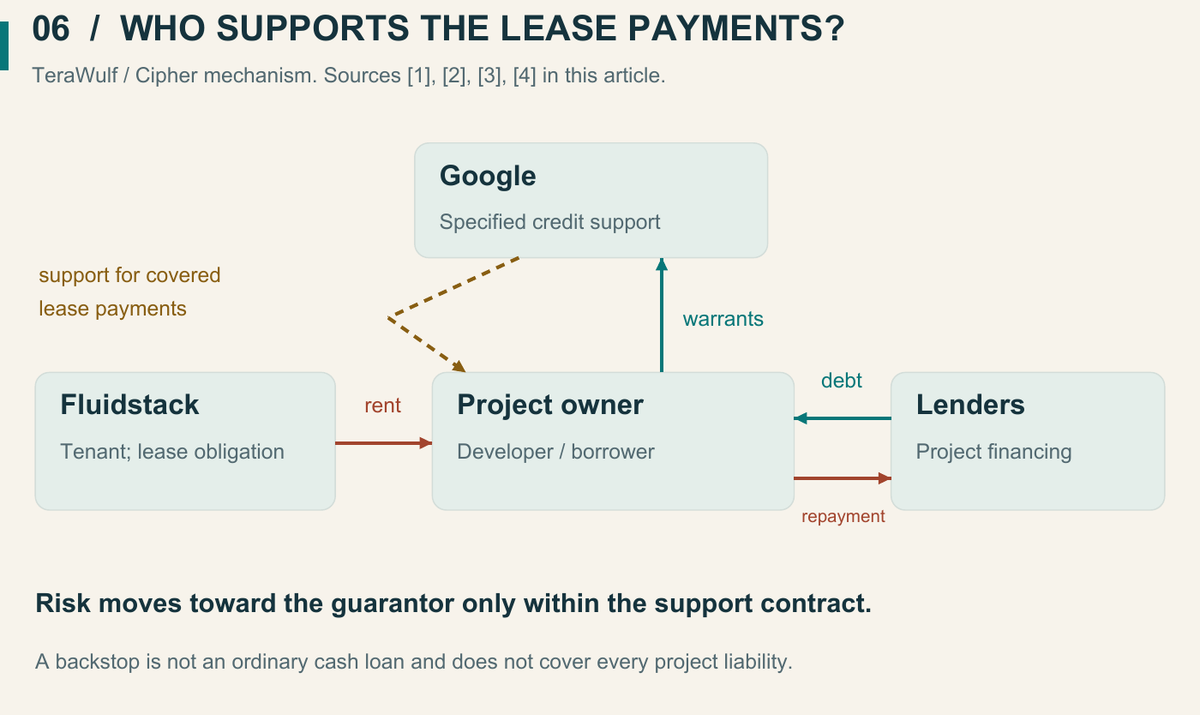
The direction matters. Fluidstack is the tenant. The developer or project owner builds and supplies space or capacity. The backstop supports specified tenant obligations and thereby helps project financing. Calling it a loan from Google to Fluidstack obscures the structure.
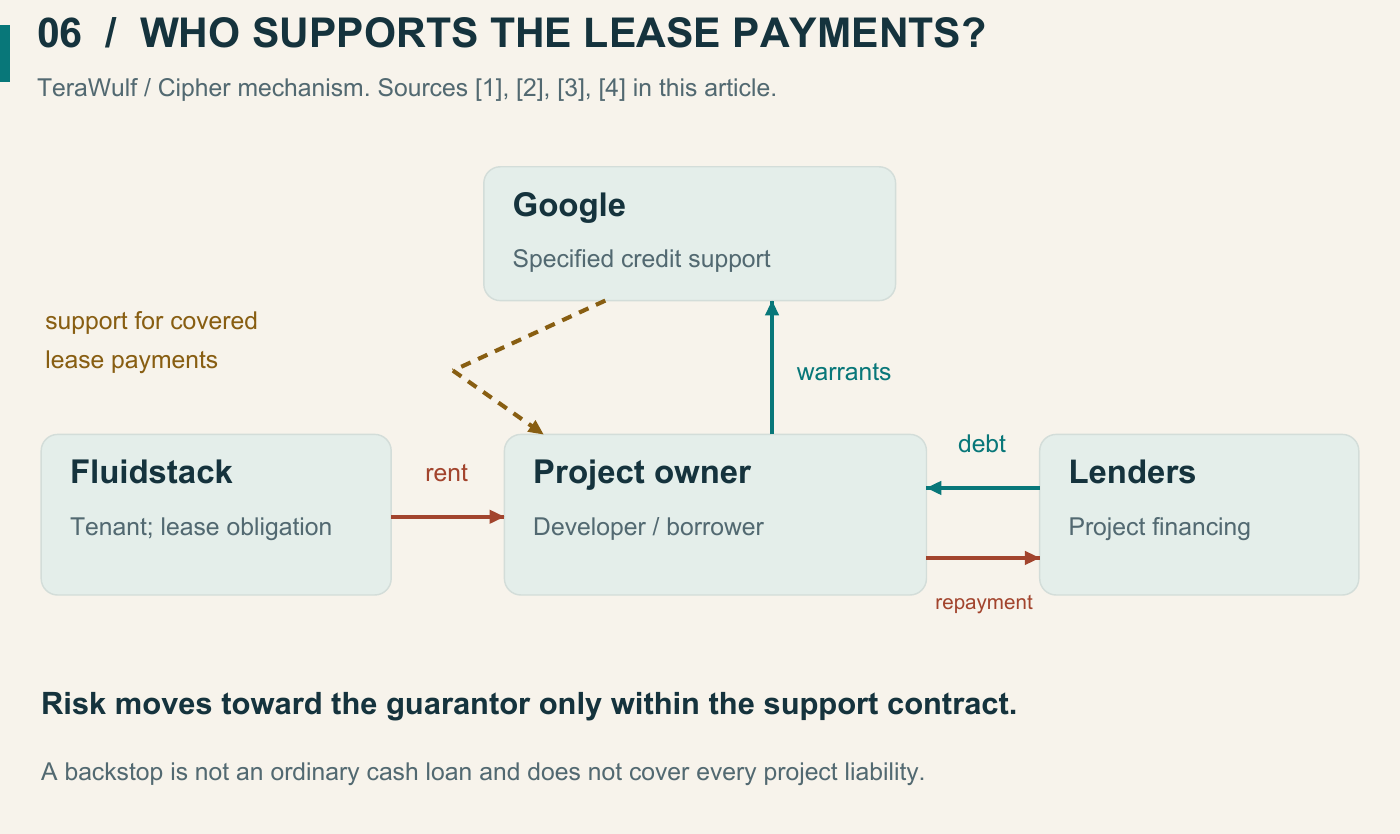
Figure 6. Mechanism described in the TeraWulf and Cipher disclosures. Fluidstack owes the lease payments; Google supports specified obligations; the project owner has its own borrowing. The dashed arrow identifies support for lease payments to the owner, not a cash loan to Fluidstack. Coverage and enforcement depend on each contract. Sources: [1] [2] [3] [4].
The guarantee changes who can bear the loss
For the lender, a strong guarantor can improve recovery expectations. For the developer, the support can unlock cheaper or more available financing. For the guarantor, warrants can provide compensation and strategic alignment. For existing developer shareholders, the bargain includes potential dilution.
The guarantor now bears a defined part of the risk. A guarantee is valuable only if the obligation is covered, the triggering conditions are met, the claim can be enforced and the guarantor can pay when needed. These are different tests.
They become especially important when the guarantor has multiple connections to the same sector. A broad downturn can weaken equity investments, customer demand and the value of collateral while increasing calls on guarantees. Counting the legal counterparties is therefore not enough to establish diversification.
This is often called wrong-way risk: the protection becomes less useful in the very state where it is needed. The term identifies a correlation to investigate; it does not say that a particular guarantor is unable to pay.
Three protections that should not share one name
A payment guarantee supports specified amounts owed by another party. A residual-value guarantee addresses an asset-value shortfall under defined conditions. A capacity-purchase commitment requires purchase of a service, often subject to availability and delivery.
They can all improve a financing story. They do not create identical remedies. A landlord seeking rent, a lender enforcing collateral and a supplier claiming a purchase payment may have different rights, beneficiaries and timing.
Before valuing any support, write down five fields: the protected obligation, the beneficiary, the trigger, the cap and the expiry. Add a sixth: the source of cash after a valid claim. If a public announcement leaves a field unknown, the model should preserve the unknown rather than assume a universal corporate guarantee.
The 40% collateral test
Collateral is an asset pledged to help repay a lender if the borrower cannot. Senior debt has priority over junior claims within the relevant arrangement. Priority decides who gets paid first; it cannot create money that the assets fail to recover.
Here “recovery” means what a creditor collects after a failure. In the opening, it meant earning back the original investment through the business. Selling equipment after default and earning money by using it are different routes, with different amounts and timing.
Use the cheat sheet's fictional printing business: Maya's Stories Inc. buys machines for $100, funded with $70 of senior debt from Cedar Bank and $30 from its owners. Cedar Bank initially has a 30% equity cushion. Now Stories Inc. fails and the machines' sale value falls by 40%, to $60. Assume another $5 is spent on recovery, disassembly and sale. Only $55 remains for creditors.
The senior lender loses $15 against its $70 claim, or about 21.4%, before considering other recoveries. Equity is exhausted. If there is an additional, fully collectible $10 guarantee that genuinely covers this loss, recovery rises to $65 and the lender still loses $5. A larger or differently structured guarantee would change the result.
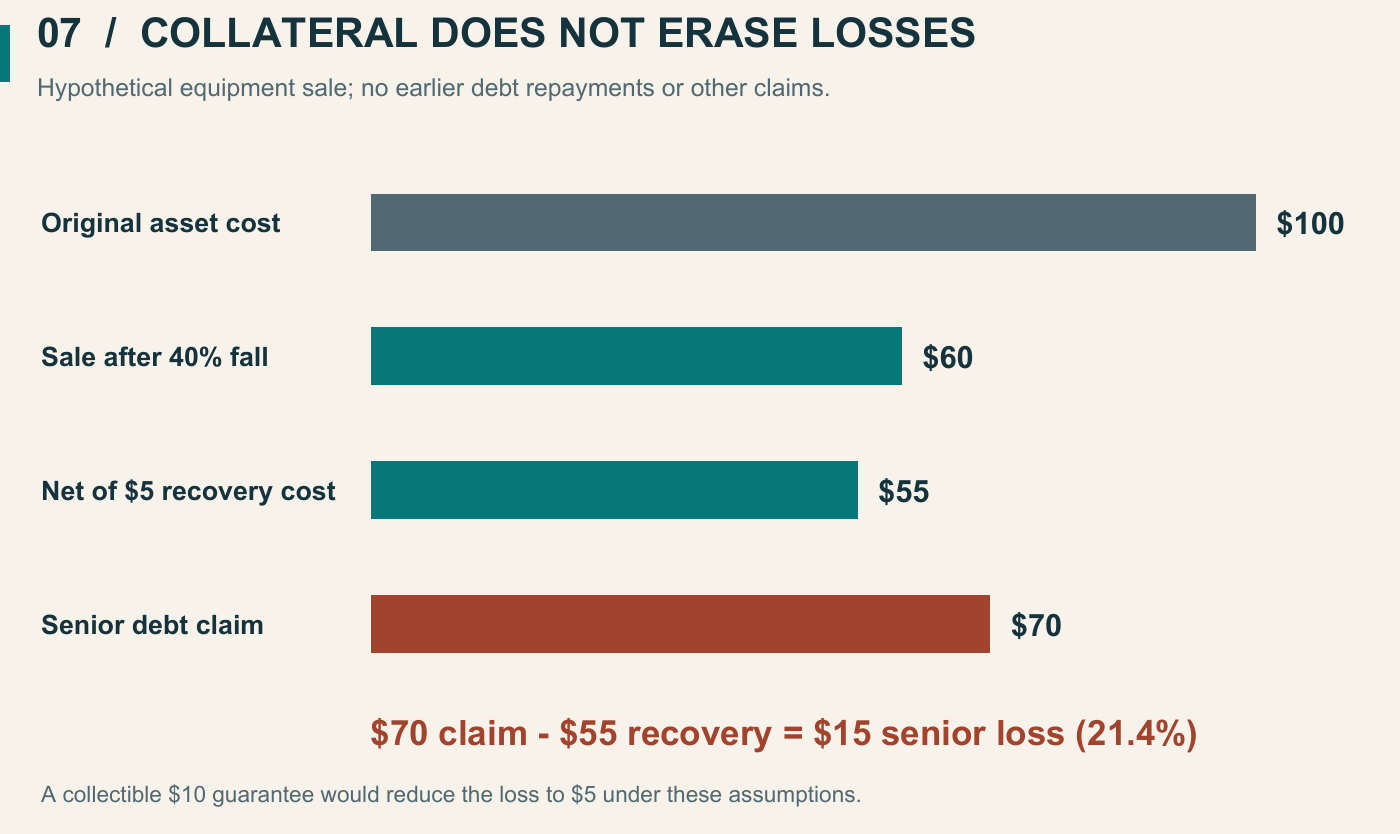
Figure 7. Hypothetical recovery example. The lender is owed $70 but receives $55 after the sale and costs. The $15 shortfall equals 21.4% of its claim. Assumes no earlier principal repayments, accrued interest or competing creditors; it does not value any company's equipment.
Even a highly rated senior loan needs this arithmetic. Its protection depends on how much was lent against the assets, how much principal has already been repaid, the current collateral value and any enforceable guarantee. A credit rating does not remove those dependencies.
The example is intentionally incomplete in ways real underwriting cannot be. A lender may already have received substantial principal before the decline. Alternatively, accrued interest and enforcement costs may increase the claim. Some equipment may have a buyer and some may be unusable without its original cluster. Each variation changes recovery.
Useful life, earning life and sale value
An accounting useful life allocates depreciation expense. Economic earning life describes how long an asset can generate competitive cash flows. Liquidation value is what a buyer will pay under the circumstances of sale. These quantities can diverge.
A GPU that is no longer ideal for the most demanding training job may still be useful for other workloads. That possibility does not establish a universal schedule of two years in training, two years in premium inference and two years in batch work. Demand, power efficiency, software support, interconnects and the price of new systems determine how long it remains economical to use.
Extending an accounting life can raise near-term accounting earnings without adding a dollar of cash or improving the equipment's resale price. Equally, faster depreciation in the accounts does not force a functioning machine to stop earning. The lender must underwrite cash generation and recovery separately.
The operating stress arrives before liquidation
Use another invented project. Annual receipts are $100, cash operating costs $40 and debt service $45. Cash available for debt service is $60, so the debt-service coverage ratio is 1.33 times: $60 available for every $45 due. A ratio below one means these receipts do not cover the scheduled payments.
Debt service includes both interest and repayment of the borrowed principal. For this simplified example, assume no additional tax, replacement spending or other payments reduce the $60. In a real loan assessment, those uses of cash also need to be checked. This is a different question from the opening's five-year investment-recovery calculation.
If receipts fall 30% while costs remain $40, only $30 is available: coverage falls to 0.67 times. If some costs fall with usage, the outcome improves. If a binding minimum-payment contract survives the fall in usage, receipts may not decline immediately at all. If a delivery failure suspends billing, they may fall faster.
There is no responsible way to apply “revenue down 30%” to every contract without examining why the decline occurs. Utilization risk, customer-credit risk and failure to deliver are different shocks.
What this changes for you
For a lender, the task is to map enforceable support and model when cash arrives. For a project sponsor, it is to understand what remains at risk after paying for the guarantee. For the guarantor's shareholders, the question is whether multiple small commitments become a large correlated claim under one adverse scenario.
For everyone else reading a headline, ask a shorter question: whose promise makes this financeable, and what exactly does that promise cover?
A guarantee can be valuable and well designed. It cannot create electricity, repair a late building or manufacture solvent customers. It works by reallocating a financial consequence. The risk map should make clear who can receive payment, who must provide it and what loss may remain.
Sources and dates
Reporting checked through 26 September 2026. Dollar amounts are US dollars. Announcements describe disclosed commitments; illustrative examples are labelled in the text.
TeraWulf initial Fluidstack hosting agreements — 2025-08-14; Google backstop and lease terms.
TeraWulf CB-5 expansion SEC exhibit — 2025-08-18; Expansion and financial support.
Cipher initial Fluidstack agreement — 2025-09-25; Transaction highlights.
Cipher June 2026 Form 10-Q — 2026-08; Google warrant and HPC leasing notes.
Continue the series
Previous: Can AI Revenue Be Real and Still Be Fragile?