Why Chipmakers Give Their Customers Equity
Some chip contracts reward the customer with a right to buy shares. Understand the bargain, the conditions and who pays through dilution.
Most customers negotiate a price. A sufficiently important customer can negotiate a piece of the supplier.
That is the attraction of a customer warrant: the right, subject to specified conditions, to acquire shares at an exercise price. The supplier gains an incentive for future business. The customer gains exposure to the supplier's success. Existing shareholders may finance part of the commercial bargain through dilution.
This adds another answer to “who pays?” A supplier can reward a customer with a potential ownership stake, leaving its existing owners with a smaller percentage if new shares are issued. The warrant's headline value is not another pile of construction money to add to the opening's investment estimate.
To read the deal, distinguish vesting, when the customer earns the right, from exercise, when it uses that right to acquire shares. Three numbers routinely get mixed up: the purchases needed for vesting, the money required to exercise, and the value of the warrant itself.
A promise to reward purchases is not an order
Qualcomm's September 2026 filing disclosed an Amazon-affiliate warrant for up to 25 million shares at $161.26, expiring in September 2036. Vesting depends on commercial arrangements, binding orders and actual purchases, up to a $60 billion payment ceiling. Some 3.75 million shares vested on issuance based on initial commitments. The warrant permits cashless exercise. [1]
The ceiling tells us how the incentive works. It does not say Amazon has placed $60 billion of firm orders. The initially vested shares are not proof that all remaining milestones will be met. “Up to” belongs in the headline because it belongs in the instrument.
The frequently tempting calculation, 25 million multiplied by $161.26, equals $4.0315 billion. That is the aggregate exercise price if every share were vested and exercised for cash at the stated price. It is not a disclosed $4 billion gift, an equity investment already made by Amazon, or the warrant's fair value. Cashless exercise further weakens any attempt to treat that multiplication as forecast cash proceeds.
A revenue ladder at Marvell
Marvell's August 2026 warrant gives Google rights over up to 58,970,907 shares at $206.58. The exhibit distinguishes 1,360,867 time-based shares from the performance-based portion. The latter vests through 240 milestones, each corresponding to another $500 million of qualifying revenue. [2] [3]
Multiplying 240 by $500 million produces a $120 billion qualifying-revenue ladder. That is a calculation from the contract, not an announcement of $120 billion already contracted, shipped or recognized. The separate time-based component also means not every warrant share follows the revenue ladder.
This is a useful example of why exhibits matter. A summary that simply calls the arrangement “equity for orders” misses both the time-based element and the definition of qualifying revenue. A model built from the headline can therefore produce a precise-looking answer to the wrong question.
AMD's different bargain
AMD issued OpenAI a warrant in October 2025 and Meta a warrant in February 2026, each for up to 160 million shares at $0.01. Purchase milestones linked to GPU capacity are part of the conditions, alongside stock-price and other requirements. AMD's June 2026 filing says neither warrant had vested or become exercisable at that reporting date and neither had affected the reported financial statements for those periods. [4] [5] [6]
A nominal exercise price makes the award economically different from an option struck near a substantial share price. But the maximum potential shares are still not shares already delivered. And a gigawatt milestone is not directly comparable across arrangements unless the equipment definition, power boundary and deployment terms match.
| Supplier / customer | Maximum shares | Exercise price | What the headline requires you to check |
|---|---|---|---|
| Qualcomm / Amazon affiliate | 25 million | $161.26 | Initial vesting, qualifying orders and purchases, $60bn ceiling |
| Marvell / Google | 58.971 million | $206.58 | Time-based shares plus qualifying-revenue milestones |
| AMD / OpenAI | 160 million | $0.01 | GPU, stock-price, technical and commercial conditions |
| AMD / Meta | 160 million | $0.01 | GPU, stock-price, technical and commercial conditions |
Contract snapshots at issuance, with AMD's June 2026 status update. Maximum counts are not issued ownership percentages. Sources: [1] [2] [3] [4] [5] [6].
What a warrant is worth
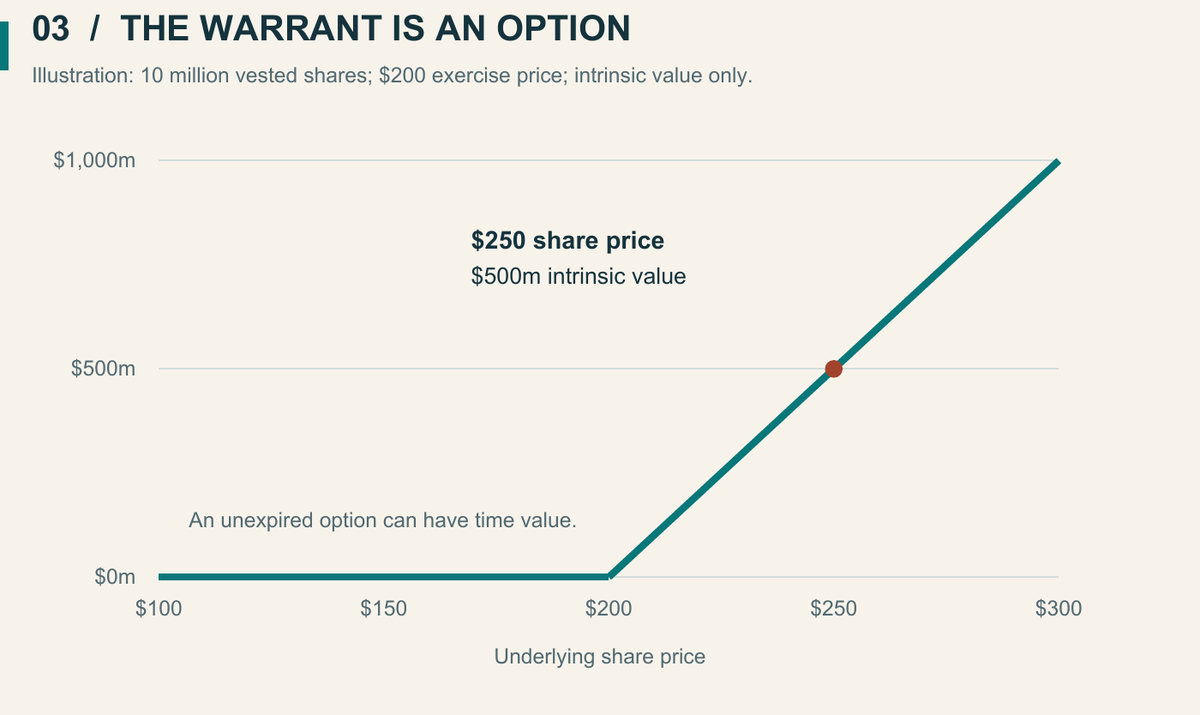
Consider a fictional, fully vested warrant over 10 million shares with a $200 exercise price. At a $250 share price, its immediate intrinsic value is $500 million: 10 million times the $50 difference. At $180, its immediate intrinsic value is zero.
That does not mean an unexpired warrant at $180 has no fair value. The possibility of a future price increase can make the option valuable. Valuation also depends on time to expiry, volatility, dividends, restrictions and the award's particular conditions. Performance-linked arrangements add further estimation issues. This example ignores taxes, transaction costs and instrument-specific adjustments.
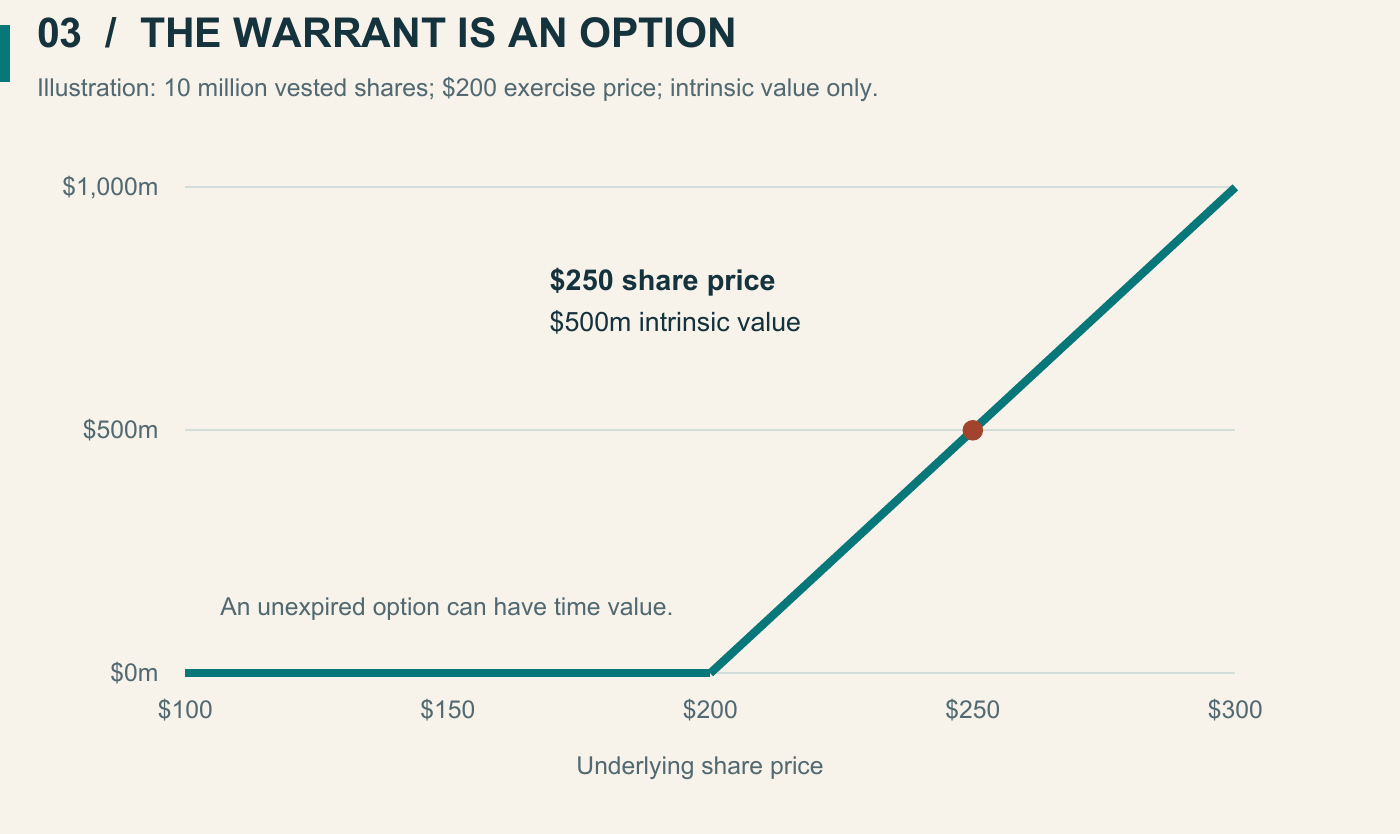
Figure 3. Hypothetical calculation. Ten million vested shares times the positive difference between share price and the $200 exercise price gives immediate intrinsic value. This excludes time value and is not a valuation of any company's warrant.
Dilution is a separate calculation. If a company has 100 shares outstanding and issues 10 new shares, the new holder owns 10/110, or about 9.1%, after issuance. Calling it “10% dilution” without defining the denominator is ambiguous. With multiple warrants, convertibles and employee awards, the relevant share count can change again. Cashless settlement can also change the number of shares ultimately delivered.
For the customer's procurement team, the warrant creates an incentive to help the supplier succeed. For the supplier's owners, it can make an apparently attractive sale more expensive than the invoice suggests.
How the customer incentive can reduce reported revenue
The Financial Accounting Standards Board (FASB) explains that consideration paid to a customer—cash or another benefit given as part of the bargain—generally reduces the transaction price and therefore revenue, unless it purchases a distinct good or service. Share-based consideration is measured and classified using Topic 718 alongside the relevant Topic 606 guidance. The 2025 update clarifies treatment of customer purchase-related performance conditions. [7]
That does not produce a universal rule that every warrant immediately reduces revenue by its maximum headline value. Measurement, classification, vesting expectations and recognition timing matter. A supplier's actual filings must establish how its particular award is treated. AMD's disclosed lack of financial-statement impact at June 2026 is a direct warning against inventing a current charge from the maximum share count. [6]
For a deliberately simplified accounting example, suppose a supplier invoices $500 million and recognizes $30 million of qualifying customer consideration against that revenue. Net revenue is $470 million. If the associated cost of goods is $300 million, gross profit is $170 million rather than $200 million before that consideration. The invoice can remain $500 million while the accounting transaction price is lower. These are illustrative assumptions, not Marvell's reported economics.
An analyst should not subtract the same warrant cost twice: once through reported net revenue and again as though it were an additional undisclosed operating expense. Equity dilution, reported revenue and cash proceeds must be reconciled, not piled into an alarmingly large total.
Does the bargain improve competition?
A powerful customer can help an alternative supplier fund development, reduce uncertainty and build a product that competes with an incumbent. That can expand supply and improve the customer's negotiating position. The reward is not necessarily pure waste for existing shareholders if the business it secures produces attractive returns after the incentive.
The opposite is also possible. A supplier can transfer substantial upside to a customer while retaining execution costs and disappointing margins. Volume alone is an incomplete success measure. A nominally independent procurement decision can become economically intertwined with the customer's investment payoff.
Ask how much additional profitable business the warrant is likely to win. We rarely get to observe the same negotiation with and without the incentive, so public information may not settle the answer. Investors should therefore use scenarios rather than presenting one estimated warrant value as the settled cost of the relationship.
What this changes for you
When the next equity-linked deal appears, read the maximum share count, exercise price, vesting schedule and expiry before interpreting its size. Then identify whether the commercial number is a ceiling, an order, a capacity target or recognized revenue. Finally, inspect the issuer's accounting and the post-issuance share denominator.
The deeper point is bargaining power. A customer able to earn ownership for purchasing can capture value from both using a product and improving the supplier's prospects. The supplier may still benefit. But its shareholders deserve an explanation of the return after the incentive, not applause for the largest possible purchase threshold.
Sources and dates
Reporting checked through 26 September 2026. Dollar amounts are US dollars. Announcements describe disclosed commitments; illustrative examples are labelled in the text.
Qualcomm Form 8-K: Amazon customer warrant — 2026-09-08; Item 3.02.
Marvell Form 8-K: Google collaboration — 2026-08-19; Item 1.01.
Marvell-Google warrant agreement — 2026-08-18; Definition of Vesting Event; Sections 2.01 and 3.01.
AMD Form 8-K: OpenAI warrant — 2025-10-06; Item 1.01.
AMD Form 8-K: Meta warrant — 2026-02-24; Item 1.01.
AMD June 2026 Form 10-Q — 2026-08-05; Warrants note.
FASB ASU 2025-04: Share-based consideration payable to a customer — 2025-05-15; Summary and amendments to Topics 606 and 718.
Continue the series
Previous: When AI Suppliers Finance Their Customers