What Is Still Unfinished?
Look inside a balance and connect an invoice to the payments and credits that resolve it.
Maya, Mayan and the businesses are fictional. All amounts, dates and terms are invented teaching assumptions; factual background is publicly sourced. This fresh case carries no balances from earlier series.
Mayan opens Sapiens Inc.’s receivables report. One number tells him what customers owe in total. It leaves him asking: “Who still owes us money, for what, and since when?”
Imagine three accounts showing $9,000. One contains recent invoices, still within their payment terms. Another contains a single long-overdue invoice. A third contains $12,000 of invoices and $3,000 received but not yet assigned to them.
The first invites cash planning. The second needs a collection conversation. The third needs someone to establish which invoices the payment belongs to before chasing the customer. The same total can demand different work.
The unfinished work inside a number
A balance sheet is a snapshot of assets, liabilities and owners’ equity at a date: what the business has, owes and retains for its owners. An aging schedule adds the dates and outstanding items behind a selected balance. SEC: financial statements; Microsoft: customer aging.
Our question throughout this series is: What is still unfinished inside this balance, how long has it been waiting, and what should someone do next? Answering it helps an operator choose the next conversation and helps an investor ask what stands between reported sales and cash.
“Unfinished” refers to individual items, not a requirement that the whole account reach zero. Ordinary receivables settle through cash coming in; ordinary payables through cash going out, correctly applied to the invoice. An item can also close through a supported credit or write-off. And a clearing account may track only one intermediate stage. Always ask what would resolve this particular item.
One machine, four records
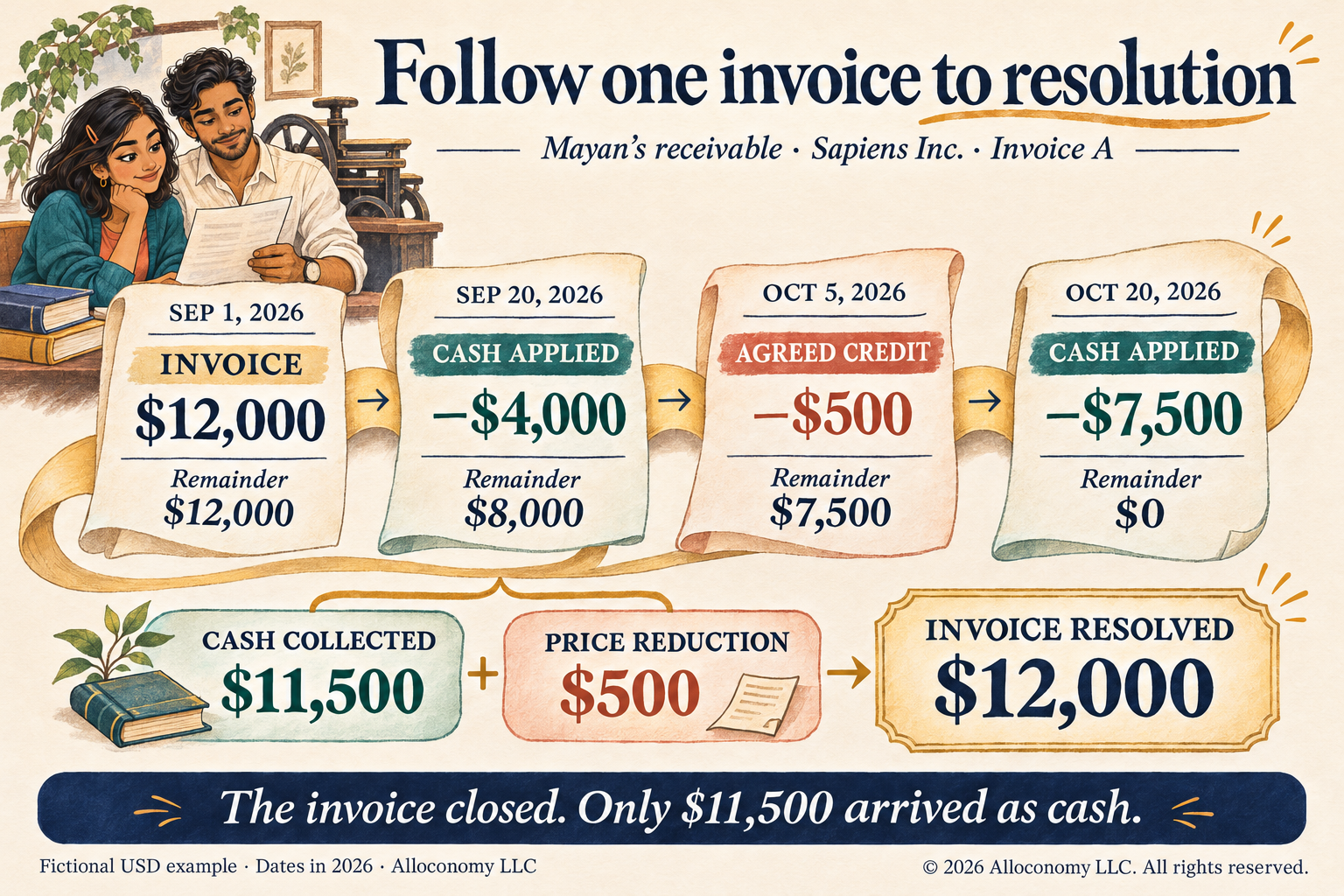
Maya runs Stories Inc., a book publisher and seller. Mayan supplies printing machines through Sapiens Inc. In this fresh fictional case, Maya buys a machine on credit for $12,000, due September 30, 2026. They later agree a $500 price reduction for a cosmetic defect.
Watch Mayan’s receivable—his company’s claim on Maya. Her payable belongs in her separate books.
| Date in 2026 | Record and evidence | Change in Mayan’s receivable | Unpaid remainder |
|---|---|---|---|
| September 1 | Invoice A; machine delivery and agreed terms | +$12,000 | $12,000 |
| September 20 | Receipt R1; Maya specifies invoice A | −$4,000 | $8,000 |
| October 5 | Credit note CN1; agreed reduction against A | −$500 | $7,500 |
| October 20 | Receipt R2; Maya specifies invoice A | −$7,500 | $0 |
Outstanding receivable = invoice amount − payments applied − applicable credits.
Call these linked records a match set: a group belonging to the same transaction or obligation. Systems use differing language—open items, clearing, matching groups and payment application. SAP’s open-item documentation illustrates clearing within an account; this essay’s label is a teaching convenience.
The invoice reference, customer identity, currency, remittance instructions and supporting agreement connect the records. Equal amounts alone would be weak evidence: two customers could each owe $4,000.
The first payment leaves work unfinished. The final payment clears the remainder, but only $11,500 arrived as cash. The credit note reduced the agreed claim by $500. An authorized bad-debt write-off could also reduce a receivable, through a different accounting treatment; it would not represent collection. Microsoft: partial payments and credits; write-offs.
Keep each invoice’s identity
The machine shows one invoice settled in installments. The reverse also happens. If Maya sends $5,000 for invoices X and Y, her instructions might allocate $3,000 to clear X and $2,000 against Y’s $4,000. Y still has $2,000 outstanding. Its original due date remains unless the terms are renegotiated. Oracle’s matching terminology describes one-to-many and many-to-one relationships; partial matching can preserve an unmatched remainder.
Mayan’s next useful step is small: ask his bookkeeper to attach the payment instructions and credit approval to invoice A. Then turn from that completed case to the invoices still open. Their dates are the subject of Part 2.