How Old Is What Remains?
Choose a cutoff, age the unpaid remainders and reconcile the result to the books.

Maya, Mayan and the businesses are fictional. All amounts, dates and terms are invented teaching assumptions; factual background is publicly sourced. This fresh case carries no balances from earlier series.
At October 31, Mayan wants an answer he can act on. The machine invoice has closed. What is left, and how long has it been waiting?
Use one defined scope: Sapiens Inc.’s fictional USD receivables control account at the end of October 31, 2026. A control account is the ledger total supported by the customer-level records. This teaching account starts at zero before the events below; it is before any loss allowance. Ignore tax and foreign currency. Dates, terms and applications are invented.
Freeze the activity at the reporting date
The machine records are carried forward from Part 1. B is completed maintenance for Stories Inc.; C is a spare-parts sale to Stories Inc.; D is an older repair invoice to fictional Cedar Books. The services are invented additions to this case.
| Event date, 2026 | Reference / invoice linked | Invoice added | Payment received | Credit applied | Item remainder after event |
|---|---|---|---|---|---|
| June 1 | D: Cedar Books repair | $2,000 | — | — | $2,000 |
| August 1 | B: maintenance | $6,000 | — | — | $6,000 |
| September 1 | A: machine | $12,000 | — | — | $12,000 |
| September 15 | R3 → B | — | $2,000 | — | $4,000 |
| September 20 | R1 → A | — | $4,000 | — | $8,000 |
| October 5 | CN1 → A | — | — | $500 | $7,500 |
| October 20 | R2 → A | — | $7,500 | — | $0 |
| October 20 | C: spare parts | $3,000 | — | — | $3,000 |
| October 25 | U1: payer/application unresolved | — | $500 | — | −$500 unapplied |
U1 is deliberately booked as a separate credit in this teaching control account. No evidence yet supports applying it to B, C or D. Its eventual classification also needs review.
Choose the clock before reading the age
We measure days past the invoice’s due date. Microsoft’s customer-aging documentation distinguishes due-date aging from transaction-date aging and separates the balance cutoff from the aging date. Here both reporting dates are October 31.
Due today or later means current, with zero days overdue. Thereafter the buckets include days 1–30, 31–60, 61–90, and 91 onward. A partial payment does not renegotiate our fictional terms or restart the unpaid remainder’s clock.
| Invoice | Invoice date, 2026 | Due date, 2026 | Outstanding | Days overdue | Bucket |
|---|---|---|---|---|---|
| A: machine | September 1 | September 30 | $0 | — | Settled; excluded |
| B: maintenance | August 1 | August 31 | $4,000 | 61 | 61–90 |
| C: spare parts | October 20 | November 19 | $3,000 | 0 | Current / not yet due |
| D: Cedar repair | June 1 | July 1 | $2,000 | 122 | Over 90 |
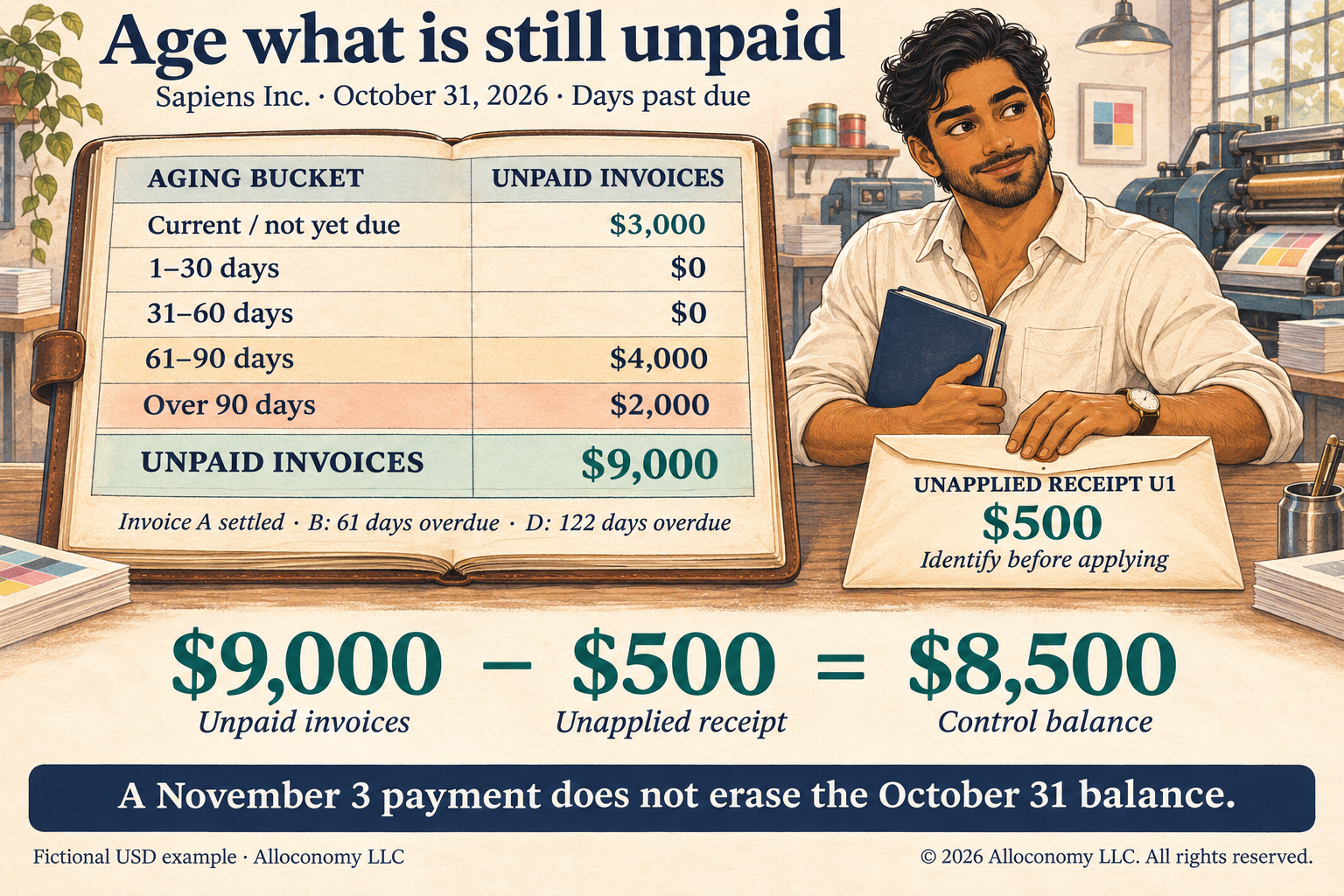
| Overdue bucket | Unpaid invoices |
|---|---|
| Current / not yet due | $3,000 |
| 1–30 days | $0 |
| 31–60 days | $0 |
| 61–90 days | $4,000 |
| Over 90 days | $2,000 |
| Total unpaid invoices | $9,000 |
B is 91 days old measured from its invoice date, but 61 days overdue. Those answers describe different clocks.
Make the total explainable
The ledger arithmetic is $23,000 invoices − $14,000 receipts − $500 credit note = $8,500. The schedule agrees: $9,000 unpaid invoices − $500 unapplied receipt = $8,500. The same entity, currency, date and account scope are essential. An unexplained difference calls for investigation, never an invented balancing item.
The $500 credit stays visible beside the aging buckets. Silently deducting it from Cedar’s old invoice would make an unsupported collection claim.
Suppose Maya pays B’s remaining $4,000 on November 3. B still belonged in the October 31 report at $4,000 and 61 days overdue. Reproducing that historical view requires the relevant transaction and application history, including later reversals or corrections—not just today’s open-item list.
Maya asks whether her earlier maintenance payment was counted. Mayan can point to R3 and the $4,000 remainder. He can now assign two concrete conversations: send Cedar its repair evidence and payment request; ask Maya about the maintenance balance with R3 already acknowledged. The recent spare-parts invoice belongs in cash planning. Someone separately investigates U1’s sender and remittance.
← Previous: What Is Still Unfinished? · Next: What Should Happen Next? →