What He Chose to Give
A memoir of my father, the life he built through sacrifice and quiet choices, and the human origins of Alloconomy.
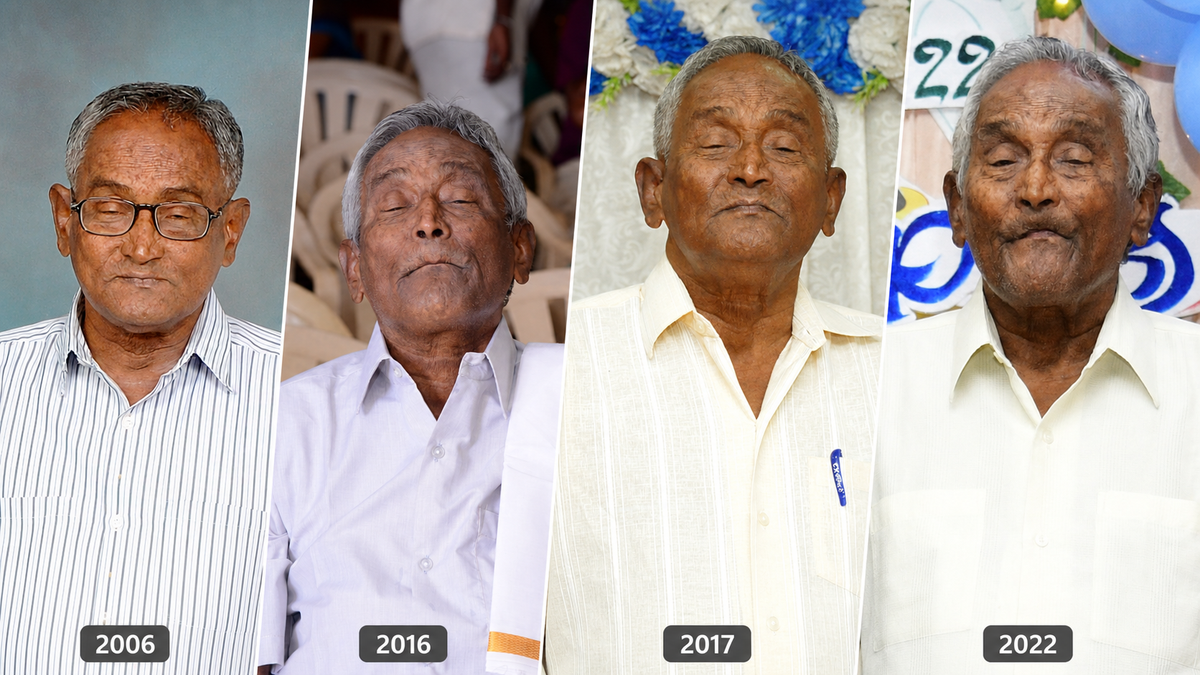
My father, the meaning of allocation, and the origins of Alloconomy
In loving memory of my father.
I am thirty-nine years old. On the rough arithmetic of an eighty-year lifespan, that places me close to the middle. My parents welcomed their first living child when my father was forty-four. He then lived long enough to see me reach thirty-nine. Those numbers do not summarize his life, but they frame the question his death has left with me: what did he do with the life available to him, and what will I do with the life his choices helped make possible?
For all thirty-nine years of my life, my father was part of its permanent architecture. Like many children, I first knew him mainly through the roles he played in relation to me: provider, protector, disciplinarian, companion, and eventually someone whose health required the family’s care. Only with age—and more sharply after his death—have I been able to see him as a person whose life had already crossed difficult terrain before I entered it.
I am not trying to turn that hardship into mythology or to present him as a flawless man. I learned from both his strengths and his limitations. What I want to preserve is more specific: the pattern of choices through which a man with little status, limited formal education, and very little surplus made a larger life possible for the people who came after him.
Before He Became My Father
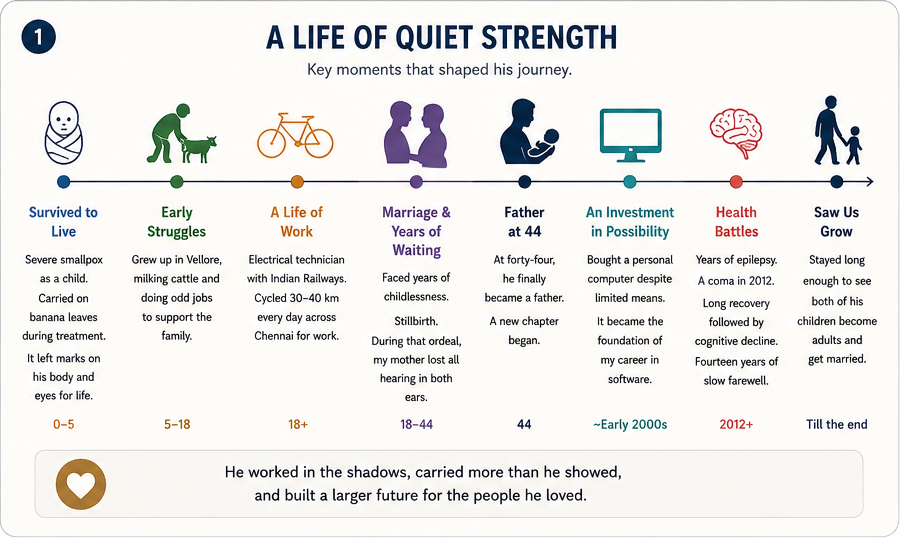
His life almost ended before it had properly begun. As a child, he survived a severe case of smallpox. In the stories he told us, the lesions across his body were so painful that he could not be placed on ordinary bedding. He had to be laid and carried on banana leaves while his family relied on the remedies available to them.
He survived, but the disease left permanent damage around his eyes. His eyelids remained visibly narrowed, and his eyes often appeared almost closed. His face carried the evidence of that childhood illness throughout his life.
He grew up around Vellore, tending cattle and milking cows, doing the work available to him and contributing where he could. Later, railway employment took him through towns in Tamil Nadu and Karnataka before his life became more firmly rooted in Chennai. He did not inherit a clear path. He assembled one from the opportunities within reach.
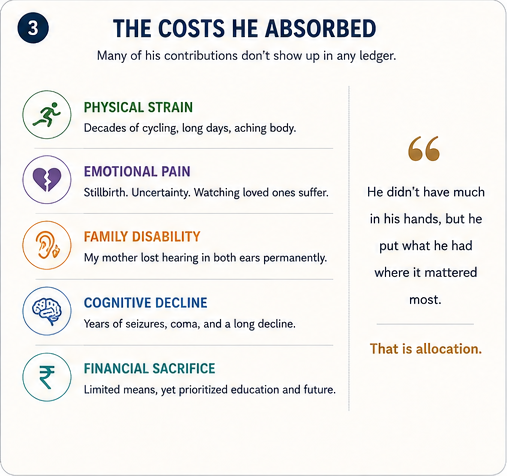
Building a family also required a long period of endurance. Before they had a living child, my parents experienced a stillbirth. During that ordeal and its aftermath, my mother lost all hearing in both ears. The loss of the child was therefore followed by a permanent change in the conditions of her own life.
What my mother endured—the stillbirth, the loss of her hearing, and the life she then built without the ability to hear—deserves a full account of its own. This is not that account. But the episode belongs in my father’s story because it became part of the marriage they had to sustain together.
They lived in a period and social environment in which childlessness carried considerable stigma, with women often bearing the harshest judgment. My father had to live with the grief of the stillbirth, the uncertainty of whether they would ever have children, and the responsibility of standing beside a wife whose life had been permanently altered. Through those years, he remained a patient and compassionate husband.
At forty-four, he and my mother finally welcomed a living child. He had waited almost half a lifetime to begin the daily work of raising a family. Once his children arrived, much of the rest of his life was organized around making their starting point better than his own.
The Work Behind the Walls
My father worked for Indian Railways as an electrical technician. He was far from the officer ranks and worked in a modest position within a large institutional hierarchy. Yet the work required practical skill. He installed, maintained, and repaired electrical wiring in railway residential quarters used by officers and other eligible employees.
The residents occupied the buildings. Workers like my father made the buildings function. The wiring disappeared into the walls, and the person who had done the work was rarely visible once the lights came on. People were most likely to notice him when something stopped working.
That is also a useful image for the way he contributed to our family. Much of what he made possible was structural rather than spectacular. It sat behind later outcomes without appearing prominently in them.
His working life was physically demanding. He travelled across Chennai largely by bicycle, often covering thirty or forty kilometers in a day for his job. This was not cycling as recreation or exercise. It was how he moved between the places where his labor was required.
There were days when the accumulated strain was visible at home. His legs and ankles would hurt, and he would lie down on the floor and ask us children to stand on his lower legs and press down with our weight. He would describe the relief, with characteristic satisfaction, as “delicious.” We treated it partly as play. Only later did I understand that we were pressing the cost of his working day out of his legs.
Despite the amount of effort he expended, he claimed remarkably little attention for himself. One incident from my school years captures that quality. I had secured the top position in my school, and an award was to be presented at a large public function. I could not attend, so my father went to the function accompanied by my maternal grandfather—his father-in-law.
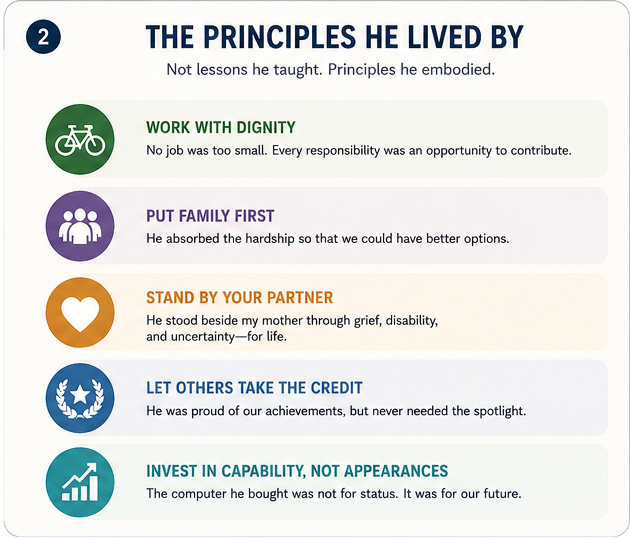
My father could easily have gone onstage to receive the award on my behalf. Instead, he let his father-in-law—my maternal grandfather—receive it while he remained in the audience, pleased simply to watch the moment unfold. He was proud of my achievement, but he did not need to turn it into his own public moment. He could contribute to an outcome without insisting on possessing the recognition attached to it.
An Investment in Possibility
When I entered college, I had already become conscious of our financial limits. I made a conservative academic choice partly because I was uncertain whether my father could afford a more expensive path. Children in families with limited means often begin editing their ambitions before their parents are forced to reject them. I was trying to reduce the burden on him.
My father nevertheless found the money to buy a personal computer for our home. He had little formal education and could not have known how the software industry would develop. He did not know C, C++, Java, or the professional world those languages might eventually open to me. But he understood the value of access.
That computer became my laboratory. I used it to learn C, C++, Java, and other foundations of programming during college. I did not have an expensive private course or a specialized information-technology education. The ability to use a computer repeatedly, experiment, fail, and try again gave me a meaningful head start into software.
On an ordinary household ledger, the computer would have appeared as an expense at a time when money was scarce. On the truer ledger of our family, it was an investment in capability and possibility. My father committed capital he could barely spare to an instrument whose return he could neither calculate nor guarantee.
The man who spent his working life keeping electrical systems functioning in other people’s homes bought the machine that switched on an entirely different world for me. Much of my later career can be traced, in part, to that decision.
The Long Final Chapter
My father lived with seizures for many years and recovered from several serious episodes. Each episode, and each recovery, took something from his body. In 2012, he went into a coma. He eventually emerged from it, but he did not return entirely as the person he had been.
Many aspects of his memory, reasoning, judgment, and independence had been diminished. From the outside, he had survived. Within the family, we understood that important parts of him had not returned with the rest.
The following fourteen years were not one dramatic event but a long process of decline shaped by seizures, neurological injury, treatment, physical weakness, and dementia-like cognitive changes. We adjusted our expectations and our relationship with him as his capacities changed. There is a particular kind of loss in watching a person remain physically present while some of the conversations and forms of connection once available are no longer possible.
Even so, he continued long enough to see both of his children become adults and get married. The man who had waited until forty-four to begin raising a child lived to see his children approach the age at which that chapter of his life had begun.
The child who had once been carried on banana leaves because his survival was uncertain lived for more than eight decades. His body had absorbed childhood disease, decades of physical labor, recurrent seizures, a coma, and years of cognitive decline. When that body finally stopped, it had already carried more than anyone could reasonably have expected from its beginning.
What His Life Taught Me About Allocation
Looking back, I can see my father’s life as a series of allocations, although he would never have described it that way. He allocated his physical strength to work, his wages to his family, scarce savings to education and technology, patience to a marriage tested by loss and disability, and recognition away from himself. Most of the return on those decisions did not accrue directly to him. It accrued to his children.
That is part of the hidden economics of family life: one generation bears costs so that another generation can inherit options. The transfer is not limited to property or money. It includes access, capability, confidence, education, stability, examples of conduct, and permission to imagine a larger future.
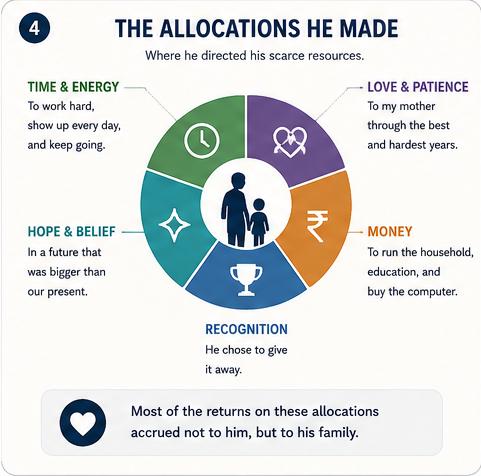
His life also showed me how incomplete our ordinary systems of accounting can be. The railway recorded his wages, but not the cumulative physical cost of cycling across Chennai. The household budget recorded the computer as an expense, but not the capability it created. The school recorded my rank, but not the network of sacrifice that made it possible. The institutional hierarchy recorded his position, but not the full value of the infrastructure he maintained.
Formal systems usually capture the visible transaction. They are less reliable at capturing the contribution behind it, the cost absorbed elsewhere, or the future options created by it.
The Foundations series follows this problem into organizations by separating observed fact, modeled attribution, and policy assignment.
This distinction matters because allocation and attribution are related, but they are not the same. Allocation asks where resources, opportunities, responsibilities, and rewards are directed. Attribution asks who actually contributed to the outcome. A third question asks who bore the cost. Families, organizations, markets, and governments often collapse these questions into one simplified story, usually centered on the most visible participant.
My father’s school-award story is a small example. The achievement carried my name. The visible recognition went to my maternal grandfather onstage, while my father chose to remain in the audience. Yet the outcome depended on work and sacrifice distributed across people who were not all visible in that moment. The same pattern appears at much larger scales in companies and societies: value is created through networks of contribution, while recognition and rewards are often concentrated elsewhere.
I do not want to romanticize the hardship that made my father’s resilience necessary. A humane system should not require essential workers to spend their bodies so completely for so little recognition. His endurance deserves respect. The conditions that demanded so much of it also deserve examination.
That dual responsibility—to honor the people who endured imperfect systems and to improve the systems themselves—is one of the moral foundations beneath Alloconomy.
From Inheritance to Alloconomy
Alloconomy is the name I am giving to a broader inquiry and body of work: how individuals, families, organizations, markets, and governments allocate finite resources among competing claims; how those decisions compound over time; who gains access and opportunity; who absorbs the cost; who contributes to the outcome; and who ultimately receives the reward and recognition.
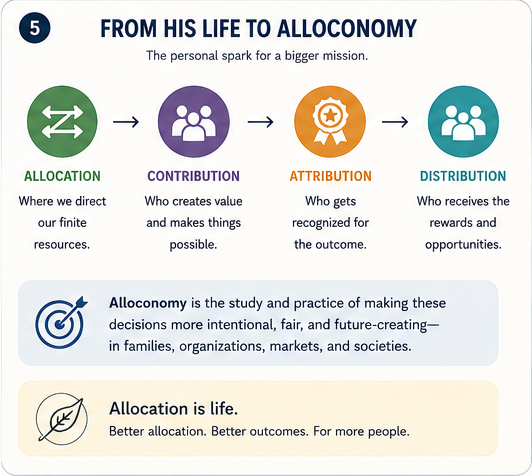
It begins with a simple proposition: allocation is life. We allocate money, but we also allocate time, attention, energy, health, trust, talent, learning opportunities, decision rights, recognition, and public resources. Every serious commitment directs something finite toward one possibility and away from another. Every “yes” funds a path. Every delay quietly funds a different one.
Allocation is also the operating system of abundance. Scarcity makes allocation necessary. Good allocation can make abundance possible. And as abundance grows in one dimension, allocation does not disappear; it shifts toward the constraints that remain—time, attention, energy, access, trust, infrastructure, institutional capacity, and human judgment.
Through essays, research, learning experiences, and software, I want Alloconomy to make those choices more visible, more understandable, and more deliberate. The objective is not merely to optimize for efficiency. It is to examine whether a system creates more capability than it consumes, whether contributions are recognized accurately, and whether the options created by progress are distributed in ways that allow more people to participate.
My father’s death did not give me a business idea. His life gave me a standard. His death made it harder to maintain the comforting assumption that meaningful work can always be postponed.
At thirty-nine, I am now close to the age at which he was still waiting to begin raising a child. I have inherited far more access, education, mobility, and opportunity than he possessed. The relevant question is no longer whether I have received enough. It is how deliberately I will allocate what I have received.
This memoir is the human origin of that question. The essay that follows it, “Allocation Is Life,” develops the wider argument: that allocation is not a specialized activity carried out only by investors, executives, or governments. It is the underlying structure of individual lives and collective systems.
My father spent his working life making sure that lights came on in buildings occupied by other people. He also helped make possible a life and career that he could not fully foresee. Much of his work, in both cases, remained behind the walls.
The lights are on because he did the wiring. What they illuminate next is now my responsibility.
Continue the reading path
Next — Part 1: Allocation Is Life →