One Month, Closed: Follow Every Adjustment
Reconcile every adjustment to the income statement, balance sheet, equity and cash flow.

Close one month all the way through
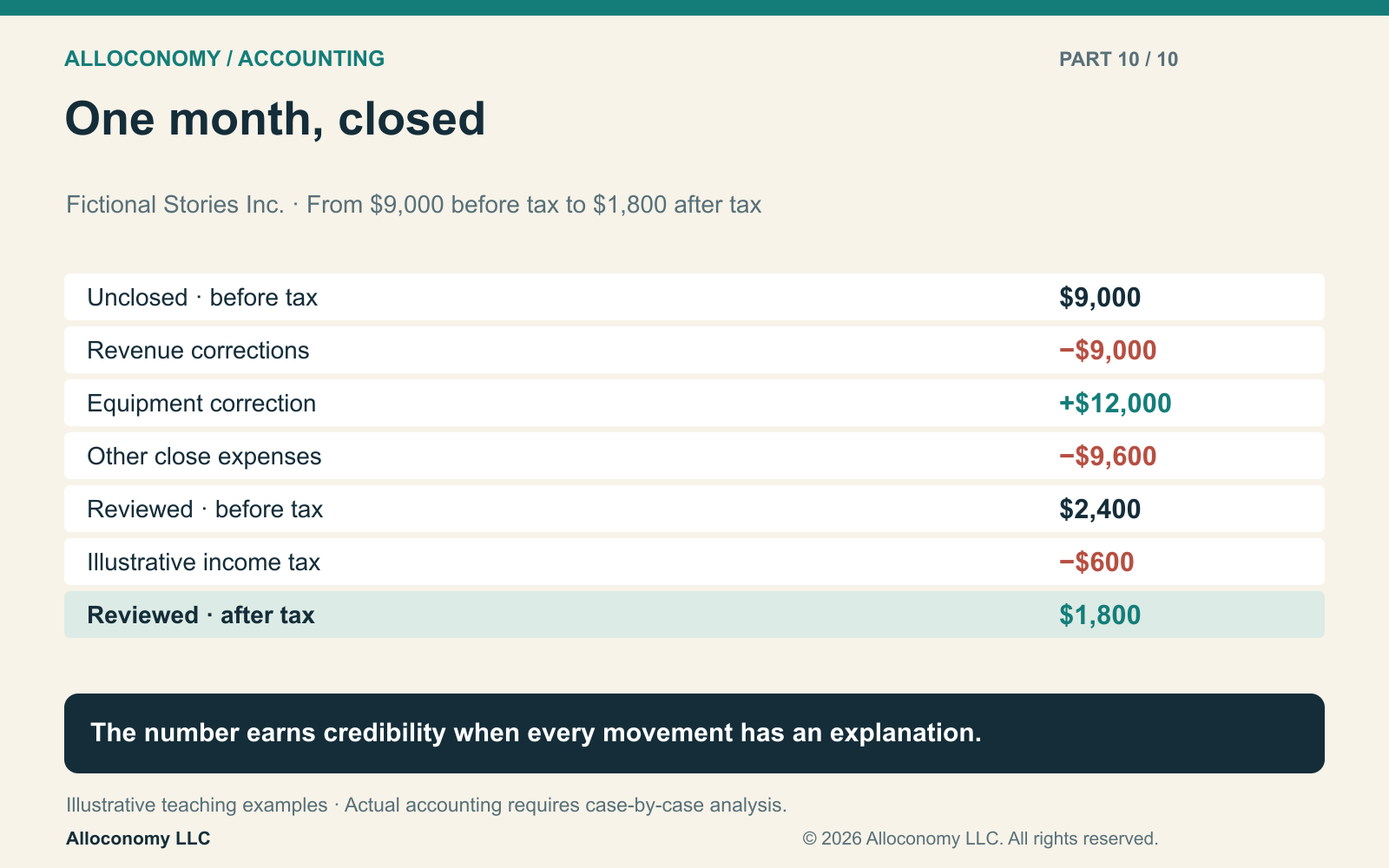
Maya's first October report showed $9,000 before tax. After the close adjustments, that becomes $2,400 before tax. The illustrative tax charge then leaves $1,800 net profit. We can now explain the difference, entry by entry, and check where it lands in the balance sheet.
This is a fictional Stories Inc. example in US dollars. It uses accrual accounting, a single entity and no foreign currency, owner contributions, distributions or other comprehensive income. For teaching only, income tax is 25% of accounting profit with no tax differences, entirely unpaid at month-end. Actual tax accounting is more complex.
The opening balance sheet contains $112,000 of assets, $35,000 of liabilities and $77,000 of equity. The detailed opening and closing balances appear below.
Read this in three passes: follow the profit adjustments, trace their counterpart balances, then reconcile cash. You do not need to memorize the figures. Use the five questions from the opening to understand why each movement belongs.
What was recorded before close
During October, the ledger recorded $60,000 of credit sales and a $4,000 customer advance as revenue. It recorded $24,000 of cost of goods sold, $10,000 of wages, $3,000 of rent, $6,000 of marketing and a $12,000 equipment purchase as expenses.
That produces $64,000 − $55,000 = $9,000 before tax.
It also recorded $50,000 of customer collections, $18,000 of inventory purchased on credit, and $20,000 of supplier payments. These affect balance-sheet accounts without automatically becoming revenue or expenses again.
Two assumptions keep the revenue example precise. The $60,000 includes a premature $5,000 bill for undelivered books. Under this illustrative contract, control passes on delivery and payment is not yet unconditionally due; the premature receivable is reversed too. No cost of goods sold was recorded for those undelivered books. The separate $4,000 advance is for November goods.
The profit bridge
| Close finding | Effect on October profit | What else changes |
|---|---|---|
| Unadjusted result, before income tax | $9,000 | Entries recorded so far |
| Remove the premature $5,000 sale | −$5,000 | Receivables fall $5,000 |
| Defer the $4,000 customer advance | −$4,000 | Contract liability rises $4,000 |
| Correct equipment wrongly expensed | +$12,000 | Equipment asset rises $12,000 |
| Record this month's depreciation | −$600 | Accumulated depreciation rises $600 |
| Use one month of prepaid insurance | −$1,000 | Prepaid asset falls $1,000 |
| Accrue customer-delivery services | −$2,400 | Accrued liability rises $2,400 |
| Reconcile the invoice received before sign-off | −$300 | Clear the $2,400 accrual; record $2,700 payable |
| Record wages earned but unpaid | −$2,000 | Wages payable rises $2,000 |
| Accrue loan interest | −$200 | Interest payable rises $200 |
| Record an omitted bank fee | −$100 | Cash falls $100 |
| Record inventory shortage and write-down | −$2,000 | Inventory falls $2,000 |
| Update expected credit losses | −$1,000 | Receivable allowance rises $1,000 |
| Reviewed result, before income tax | $2,400 | Revenue $55,000 less expenses $52,600 |
| Record illustrative income tax | −$600 | Tax payable rises $600 |
| Reviewed net profit | $1,800 | Increases the period's reported equity |
The $2,700 invoice is for October customer-delivery services, not inbound freight attached to unsold inventory. It arrives before October sign-off and confirms the service period and amount. The team replaces the $2,400 accrual with a $2,700 payable and recognizes only the $300 difference as an additional expense. It does not expense both amounts.
The $600 depreciation consists of $400 for existing equipment and $200 for the new equipment. The new office equipment was available for use for the whole month; the example assumes a 60-month useful life, straight-line depreciation and no residual value. The $12,000 insurance prepayment covers twelve months beginning on 1 October. These are explicit case assumptions, not default policies for every business.
The inventory adjustment combines a $500 shortage and a $1,500 write-down to net realizable value. The receivable allowance is a separate $1,000 expected loss. A loss can be recognized before a specific customer balance is written off. IAS 2 and IFRS 9 provide the respective measurement frameworks.
The bridge returns to the five questions. Period removes revenue belonging later. Completeness finds wages, delivery, interest and fees. Treatment determines capitalization, consumption and loss estimates. Evidence tests the resulting balances. Review brings the supported adjustments into one approved reporting version. A finding can involve more than one question.
Check the final income statement
| October income statement | USD |
|---|---|
| Revenue | $55,000 |
| Cost of books sold | −$24,000 |
| Gross profit before separately shown inventory losses | $31,000 |
| Wages | −$12,000 |
| Rent and marketing | −$9,000 |
| Depreciation and insurance | −$1,600 |
| Customer-delivery services | −$2,700 |
| Bank fee | −$100 |
| Inventory shortage and write-down | −$2,000 |
| Credit-loss expense | −$1,000 |
| Operating profit in this illustrative presentation | $2,600 |
| Interest | −$200 |
| Profit before tax | $2,400 |
| Income tax | −$600 |
| Net profit | $1,800 |
Expense presentation varies. The inventory losses might be included within cost of sales instead. That would change the displayed gross-profit subtotal, not this case's total profit. Naming the subtotal and the included costs matters.
Check the balance sheet and equity
| Balance-sheet account | Opening USD | Closed USD |
|---|---|---|
| Cash | $50,000 | $52,900 |
| Gross receivables | $10,000 | $15,000 |
| Less receivable allowance | $0 | −$1,000 |
| Inventory | $20,000 | $12,000 |
| Prepaid insurance | $12,000 | $11,000 |
| Equipment at cost | $24,000 | $36,000 |
| Less accumulated depreciation | −$4,000 | −$4,600 |
| Total assets | $112,000 | $121,300 |
| Supplier payables | $15,000 | $15,700 |
| Loan | $20,000 | $20,000 |
| Wages payable | $0 | $2,000 |
| Customer advance / contract liability | $0 | $4,000 |
| Interest payable | $0 | $200 |
| Tax payable | $0 | $600 |
| Total liabilities | $35,000 | $42,500 |
| Paid-in capital | $50,000 | $50,000 |
| Retained earnings including current-period result | $27,000 | $28,800 |
| Total equity | $77,000 | $78,800 |
| Liabilities plus equity | $112,000 | $121,300 |
The closing equation is $121,300 = $42,500 + $78,800. Equity increased by exactly the $1,800 net profit. The table presents current-period earnings together with retained earnings; an actual system may show them separately until its year-end transfer.
Why cash increased by a different amount
Customer collections and advances brought in $54,000. Supplier payments, wages, rent, marketing and the bank fee used $39,100. Net cash from operations was therefore $14,900.
The equipment purchase used another $12,000 in investing cash flow. There was no financing cash flow. Cash increased by $2,900, from $50,000 to $52,900.
That is consistent with $1,800 profit. Receivables, inventory, prepayments, payables, noncash charges and the equipment purchase explain why the measures differ. Customer cash received for November helps October cash without becoming October revenue. Unpaid wages hurt October profit without yet using cash.
The same questions cover more than this example
Real closes have different schedules. Where relevant, payroll and bonus accruals and goods received without invoices extend the completeness work. Sales returns and credit notes test period and treatment. Leases, debt, prepaid costs and project work in progress need schedules that explain their opening balance, movements and closing balance. Group reporting and tax add their own adjustments.
Those are applications of the same five questions, not additional transactions in Stories Inc. A retailer, manufacturer and service business will need different detailed checklists.
What the reviewer actually signs off
A balanced equation is one check. The review also needs the delivery evidence, invoice reconciliation, payroll calculation, bank reconciliation, inventory count and valuation, asset schedule, loss estimate and tax calculation. The numbers must describe the right activity in the right period.
The reporting pack identifies the final ledger version and includes reconciliations, approved journals, estimate support and an unresolved-item list. Each significant item has a preparer, a reviewer and enough evidence for another person to follow the conclusion.
The reviewer asks why profit changed, whether the explanation agrees with operations, whether significant entries have support and approval, and what remains uncertain. Open items need a materiality assessment, a responsible person and a resolution—not a balancing entry inserted to reach a target. The PCAOB's description of annual and quarterly reporting controls illustrates why journal authorization, adjustments and financial-statement preparation all belong in the control picture.
A reviewer can approve a supported result, require a correction, or hold sign-off while significant evidence is missing. A documented bank timing difference may remain for follow-up; an unsupported accrual large enough to change the interpretation of the month needs resolution. There is no universal dollar threshold in this example.
After approval, posting access is restricted and the reporting version is preserved. If new evidence warrants reopening, the change is authorized, explained and reviewed. An internal close is not an audit opinion, and uncertainty does not vanish when a period is locked.
Maya can now ask a better question than “Is $1,800 the real number?” She can ask: “What evidence supports this result, what judgments are inside it, and who has reviewed them?”
That is what month-end close adds to profit: a reason to trust the number, and a way to investigate it.
← Define the reporting boundary | Return to the five-question cheat sheet
Fictional teaching example. Personal views based on public sources; no confidential employer information or employer endorsement. Accounting policies and business circumstances require case-by-case analysis.