Why Profit Changes Equity
Trace close adjustments into their supporting balances, then reconcile profit, equity and cash.

The missing expense leaves a missing liability
Stories Inc. missed $2,000 of October wages. Recording them reduces October profit and creates a liability. The reviewer can therefore test the profit adjustment by testing the work and obligation behind that liability.
That is why closing the P&L involves so much work on the balance sheet. The task is not simply to produce a plausible margin. It is to establish what resources and obligations remain at the reporting date, and whether the month's income and expenses follow from the underlying activity.
This essay assumes the accounting equation and double entry are already familiar. We will use them to follow where a close adjustment lands—and what evidence it leaves the reviewer to examine.
Follow both sides of an adjustment
Three October corrections show different routes into the same set of statements. All figures belong to our fictional Stories Inc. case.
| Close adjustment | P&L effect before tax | Balance-sheet effect | Evidence to test |
|---|---|---|---|
| Record earned but unpaid wages | Expense +$2,000 | Wages payable +$2,000 | Work dates, payroll records and whether it was recorded elsewhere |
| Correct equipment charged entirely to expense | Expense −$12,000 | Equipment at cost +$12,000 | The purchase, control, qualifying use and asset-recognition policy |
| Move a customer advance out of revenue | Revenue −$4,000 | Contract liability +$4,000 | Cash receipt, customer terms and the remaining delivery promise |
Each correction changes profit and leaves a balance that needs support. A liability for wages without evidence of work is no better than omitting wages actually earned. An equipment balance without a qualifying asset is no better than expensing equipment that should have been recognized and then depreciated.
The balance sheet is therefore a way to investigate profit, not just the place where the other side of a journal goes. The Conceptual Framework's recognition links connect income and expenses to changes in assets and liabilities. The practical review follows those links back to the transaction.
Some close entries leave profit unchanged
Before sign-off, Stories Inc.'s $2,400 delivery accrual is replaced with a confirmed $2,700 supplier invoice. Clearing the existing $2,400 accrued liability into accounts payable does not create another $2,400 expense. Only the supported $300 difference adds to expense.
That distinction helps a reader interpret a close-adjustment list. A large journal can be mostly a movement between balance-sheet accounts. Its size is not necessarily its effect on the month's profit.
Similarly, paying a recorded supplier bill reduces cash and the payable. The expense, or the inventory purchase, was recognized through the earlier transaction. Following the balances prevents counting it again.
Reconcile the result to equity
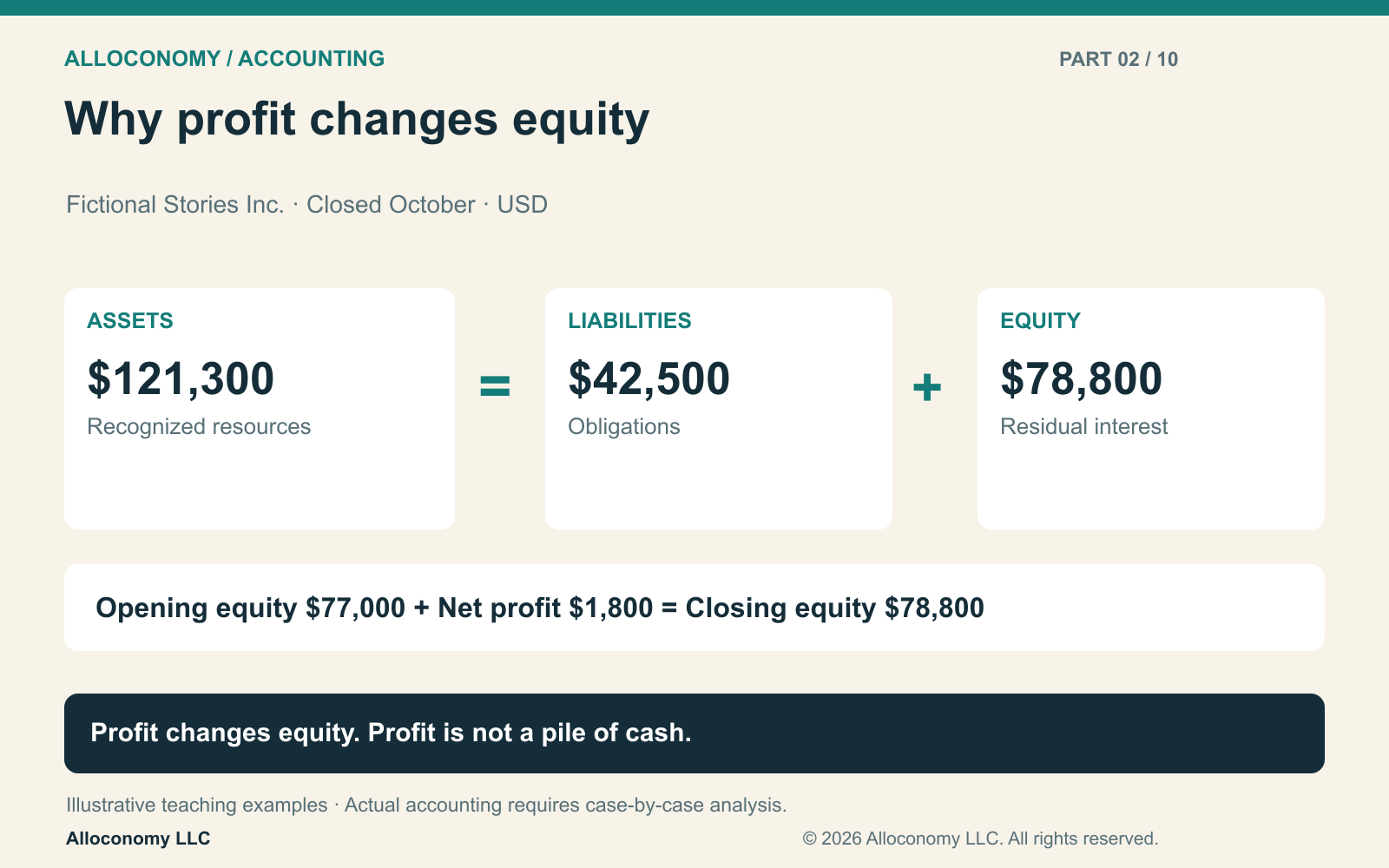
In our case, the reviewed revenue, expenses and tax produce $1,800 net profit. Stories Inc. begins October with $50,000 paid-in capital and $27,000 retained earnings. There are no owner contributions, distributions or other direct equity movements during the month.
Opening equity $77,000 + October net profit $1,800 = closing equity $78,800.
The closed balance sheet gives the same answer: assets $121,300 − liabilities $42,500 = equity $78,800. Part 10 builds every balance behind that reconciliation.
Revenue and expense accounts retain the period's explanation separately before their net result is accumulated in equity. It is reasonable to think of them as temporary accounts explaining equity movements, provided “subaccounts of equity” does not become a claim about every software chart of accounts. Expense is the important word: some incurred costs still qualify as assets.
A monthly close need not reset the P&L accounts
Completing and reviewing October, then restricting further postings, is different from formally transferring temporary income-statement balances into retained earnings.
A system can keep year-to-date revenue and expense balances, display current-year earnings within equity, and perform the retained-earnings transfer at fiscal year-end. Microsoft's year-end process is one implementation of that approach.
The $1,800 already affects reported equity through October's performance. A later transfer does not create another $1,800 of profit. The reviewer needs to understand the system's presentation so that current-period earnings are neither omitted nor counted twice.
Keep the equity and cash bridges separate
Outside this simplified case, owner funding, distributions and other permitted equity movements mean that the change in total equity is not itself a complete profit calculation. Book equity is also not a valuation of the entire business.
October cash increases by $2,900, while profit is $1,800. The final essay reconciles the difference through collections, payments, working-capital balances and equipment spending. Retained earnings is not a separate cash reserve. Repeated losses erode it, but the timing of a financing need depends on cash availability and obligations as well.
Bring two requests to a close discussion: show me what supports the balances behind the profit, and show me the separate bridge to cash. They test different parts of the same result.
← The five-question cheat sheet | Choose the right period →
Fictional teaching example. Personal views based on public sources; no confidential employer information or employer endorsement. Accounting policies and business circumstances require case-by-case analysis.