How central banks work: learning from India and the US
Explore how central banks work by comparing India and the US: the price of money, bank reserves, access to funding and the different clocks behind 19 policy tools.
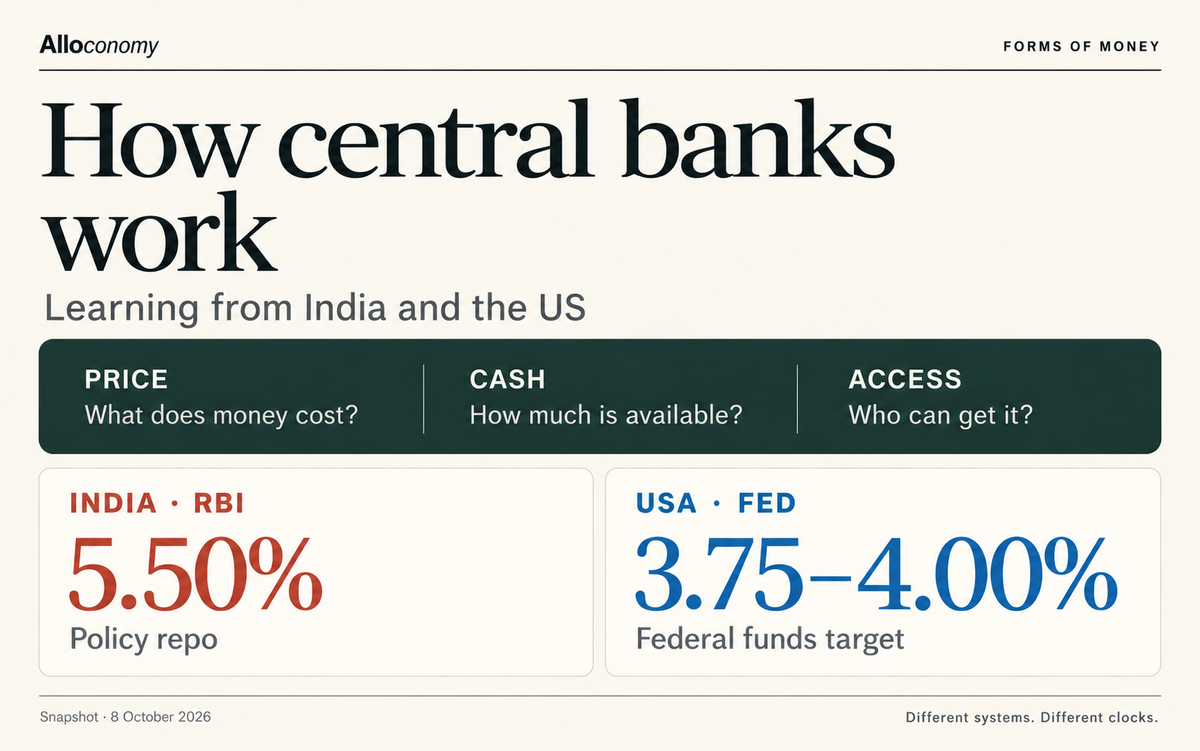
A comparative guide to the RBI and the Fed: the price of money, the cash behind it, and the clocks on which each changes.
Policy settings checked through 8 October 2026. Historical tables distinguish announcement dates, effective dates and operations.
Why can two central banks raise rates by the same amount and still leave their financial systems in different conditions? Comparing the Reserve Bank of India with the US Federal Reserve helps us see what a rate headline reveals—and what else we need to ask.
These are two examples among the world's central banks. Their different operating frameworks offer a way to explore how monetary policy works in practice. An Indian home loan, a US savings account, Treasury bills or a family remittance can make that comparison personal.
On 7 October, the Reserve Bank of India raised its repo rate from 5.25% to 5.50%. Three weeks earlier, the Federal Reserve raised its federal funds target range to 3.75–4.00%. Both moved by 25 basis points: one quarter of a percentage point. But these headlines describe only one setting on a much larger control panel. RBI decision, with a readable reproduction; Federal Reserve implementation note.
To read monetary policy across both countries, ask three questions: What does overnight money cost? How much settlement cash is available? Who can get it, against what collateral, and for how long?
The answers often change on different days.

Read the comparison as text
India + USA · Snapshot: 8 October 2026
Central banks compared.
Three questions to ask.
- SDF · deposit floor
- 5.25%
- MSF / Bank Rate
- 5.75%
- CRR · cash at RBI
- 3.00%
- SLR · liquid assets
- 18.00%
- IORB · paid on reserves
- 3.90%
- ON RRP · supplementary floor
- 3.75%
- Standing repo / primary credit
- 4.00%
- Required reserve ratio
- 0%
Repo / Fed target
6 / 8 scheduled decisions yearly; a meeting can hold rates.
Repos, reverse repos, bond operations
Daily access; operations and programmes vary.
Backstops, swaps, reserve rules
Eligibility and terms change by announcement.
How often did headline rates actually change?
RBI: 4 changes / 6 meetings
Fed: 3 changes / 8 meetings
RBI: 1 change / 5 meetings
Fed: 1 change / 6 meetings
Policy rates, reserve ratios and auction amounts measure different things. Daily facility use is not a new policy decision. These rates are not retail deposit or loan quotes.
RBI current rates · Fed rate history · Fed implementation note
Start with the money underneath the money
Your bank balance is a commercial bank's promise to pay you. A bank's balance at the central bank is a different form of money: reserves, used to settle payments within the banking system. Currency notes are another central-bank liability.
When a bank makes a loan, it generally creates a matching deposit. It must then manage the funding, reserves, capital and risks needed to support that business. Banks do not simply pass central-bank reserves into your savings account, and additional reserves do not mechanically produce a fixed multiple of loans. Demand for credit and the willingness and ability to lend matter. Bank of England's explanation of money creation.
This distinction makes the toolkit easier to understand. Central banks influence the conditions under which banks and markets create, price and exchange money. A bigger central-bank balance sheet, cheaper overnight money and faster bank lending are related outcomes; they are separate things to check.
The RBI draws a corridor; the Fed pays an anchor
India's overnight framework has three visible landmarks:
- SDF, 5.25%: eligible banks can place surplus funds with the RBI without receiving collateral. This is the standing deposit facility and the corridor's floor.
- Repo, 5.50%: the policy reference rate for collateralised RBI lending. Variable-rate auctions have their own auction rates.
- MSF, 5.75%: eligible banks can obtain overnight funds against eligible securities through the marginal standing facility. This is the corridor's upper standing-facility rate. The Bank Rate is also 5.75%.
The RBI seeks to align the weighted average call rate, or WACR, with repo. The corridor is an operating framework, not a guarantee that every overnight transaction stays inside it. Eligibility, collateral and distribution of liquidity matter. The old fixed reverse repo rate remains listed at 3.35%, but the SDF replaced it as the floor in April 2022. RBI's October resolution; RBI account of the SDF's introduction.
The US operates with ample reserves. The Fed sets a target range for the effective federal funds rate, an overnight market rate; it does not lend all dollars at that range. Its main implementation anchor is interest on reserve balances, or IORB, currently 3.90%, paid to eligible banks. The overnight reverse repo facility, or ON RRP, pays 3.75% to eligible counterparties, including money-market funds, providing a supplementary floor mechanism. Access differs, so these are not interchangeable deposit accounts. Federal Reserve policy tools; latest implementation instructions.
On the lending side, the standing repo facility is 4.00%, as is the primary credit rate at the discount window. The first supports eligible money-market counterparties against specified securities; the second lends to eligible depository institutions against a broader collateral set. Neither is a universal hard ceiling on borrowing costs.
The useful translation is functional: RBI repo and the Fed target range communicate policy; SDF and IORB/ON RRP anchor overnight pricing through different machinery; MSF and US lending facilities provide backstops. The plumbing differs enough that a one-to-one acronym dictionary would mislead.
Their objectives also differ. India targets 4% CPI inflation, within a 2–6% tolerance band, renewed through March 2031, with price stability taking priority while keeping growth in mind. The Fed pursues maximum employment and stable prices, defining its longer-run inflation goal as 2% on the PCE price index. CPI and PCE are different baskets. A higher nominal Indian policy rate does not, by itself, establish tighter policy: expected inflation and the uncertain neutral real interest rate also matter. RBI deputy governor on the renewed framework; Fed's current policy strategy.
The headline clock is the slow one
The RBI ordinarily schedules six MPC meetings a year. The Fed schedules eight FOMC meetings. Either can act between meetings when circumstances require it. A meeting can also leave every rate unchanged.
In the same full calendar year, 2025, the RBI changed repo at four of six scheduled meetings; the Fed changed its target at three of eight. Through 8 October 2026, the corresponding counts are one of five and one of six. These are counts of actual headline-rate changes, not forecasts or a permanent tendency for one bank to be more active. RBI 2025–26 schedule; RBI 2026–27 schedule; Fed calendars; Fed rate-change history.
The daily clock runs underneath those announcements. India's variable-rate repo auctions, or VRR, lend cash temporarily; variable-rate reverse repo auctions, or VRRR, absorb it temporarily. Amount, maturity and auction price can change from operation to operation. The daily VRR programme introduced in January 2025 ended on 11 June 2025; it is misleading to describe daily VRR as a permanent feature. Initial RBI announcement; RBI discontinuation notice.
Communication is another tool. Forward guidance influences expectations about future rates and therefore today's longer-term borrowing costs. Read the RBI's stance and the Fed's statements and projections alongside the current rate; a projection is conditional information, not a promised future rate. Fed explanation of forward guidance.
Standing facilities can be available every day while their rates remain unchanged for months. Likewise, daily auction activity is not a succession of policy-rate decisions. In the US, daily ON RRP and standing repo operations implement the framework; the amount counterparties take up is a separate observation from the rate the Fed offers.
The slower levers change the balance sheet or the rules
Outright bond purchases and sales change reserves more durably than a repo that reverses on a specified date. RBI open market operations, or OMOs, inject rupees when it buys securities and absorb rupees when it sells. “Durable” is more accurate than “permanent”: maturity, later sales and other balance-sheet flows can reverse the effect.
Purchases also change which assets private investors hold. Buying longer-dated bonds removes duration risk from the market and can influence term premiums and long-term yields. The security bought and the programme's purpose matter alongside its size.
For the Fed, distinguish quantitative easing, intended to ease broader financial conditions through asset purchases, from quantitative tightening, which reduces holdings through runoff, and from technical purchases that maintain reserves or reinvest maturing assets. A purchase headline alone does not tell you which policy is operating.
The Fed ended securities runoff on 1 December 2025. Its current 15 September–14 October 2026 Treasury purchase plan provides about $15.6bn of reinvestment purchases and zero additional reserve-management purchases. Replacing principal received on other assets with Treasury bills changes portfolio composition; it does not establish a new QE programme. Fed's decision to end runoff; New York Fed purchase plans.
India also has CRR, currently 3.00% of net demand and time liabilities, or NDTL, held as non-interest-bearing cash at the RBI. SLR, currently 18.00% of NDTL, is a requirement to hold specified liquid assets, including eligible government securities, generally on a bank's own balance sheet. NDTL is a statutory liability measure; it is broader and more precise than “deposits”. SLR assets can earn income; CRR balances do not. RBI CRR circular; RBI SLR schedule.
The Fed's reserve requirement ratios are 0%, effective since March 2020. That does not abolish reserves, bank capital requirements or liquidity regulation. US liquidity rules are not a direct monetary-policy counterpart to India's SLR. Federal Reserve reserve requirements.
Reserve ratios can remain unchanged for years and then move in several implementation steps. India's four CRR reductions in September–November 2025 came from one June announcement. Counting them as four separate decisions would exaggerate how often the RBI pulled that lever.
A currency bridge has its own plumbing
In an RBI USD/INR buy/sell swap, the RBI buys dollars and supplies rupees now, then reverses the exchange later. A sell/buy swap initially supplies dollars and absorbs rupees. Amount, tenor and forward premium matter; there is no single standing “FX swap rate”. The two legs can affect funding conditions and the spot/forward markets.
The Fed's central-bank dollar swap lines instead supply dollar funding through partner central banks. They are financial-stability infrastructure, rather than a routine tool for managing USD/INR. The RBI is not one of the five counterparties in the Fed's standing swap-line network. Federal Reserve dollar liquidity swap lines.
India's 2026 special swap scheme shows why programme details matter. The FCNR(B) deposit arm, offering qualifying swaps at par, closed for new access on 11 September, while existing swaps continue. The separate eligible external/overseas foreign-currency borrowing arm remains open, with a 1.5% annual swap premium compounded semi-annually and qualifying inflows through 31 December 2026. These are institutional funding and hedging arrangements; the premium is not a retail deposit yield. FCNR(B) terms; closure update; borrowing-arm terms.
Special term lending, targeted lending and emergency facilities change who receives funding, its maturity and the assets supporting it. RBI LTRO/TLTRO and the Fed's past crisis programmes belong in this part of the toolkit. They have programme-specific terms and activation dates, rather than a common percentage that changes at every meeting. The history companion treats these as programme events.
Read today's conditions as a combination
India illustrates why one headline is insufficient. The RBI has raised the price signal and adopted calibrated tightening, while reporting substantial surplus liquidity. Since its August policy meeting, it conducted 55 VRRR auctions and ₹1 lakh crore (₹1 trillion) of OMO sales. It is absorbing excess settlement cash while trying to bring overnight market pricing closer to repo. Those actions address connected but distinct settings. October governor's statement, reproduced with the RBI text.
The US also has a higher policy rate, alongside an ample-reserves framework and reinvestment purchases. Maintaining functioning money markets does not by itself signal cheaper credit for households.
For a financial life spread across both countries, translate the control panel into four checks:
- Loans: Indian repo-linked floating loans respond according to their contract's reset timetable. In the US, prime-linked loans and adjustable-rate products transmit differently from an existing fixed-rate mortgage, whose payment does not rise simply because the Fed hikes. New mortgage rates also reflect expected future rates, bond yields and mortgage-market spreads.
- Cash savings: newly offered FD, CD, money-market and Treasury-bill yields respond to market pricing and banks' funding needs. Existing fixed deposits keep their contracted terms. A policy rate is not a retail savings quote.
- Bonds: higher expected yields generally lower the prices of existing fixed-rate bonds, with longer duration increasing sensitivity. A bond fund can lose value while the yield available on a new bond improves.
- Currency: compare returns in the currency in which you will spend. Taxes, inflation, conversion costs and hedging can change the apparent yield advantage.
Here is a hypothetical currency calculation: an INR investment earns 6%, but USD/INR rises 5% over the same year. Its dollar return before tax and costs is 1.06 ÷ 1.05 − 1 = about 0.95%. The higher rupee yield did not become the same dollar yield. Forward hedging has a price, which can absorb much of an interest-rate gap.
After the next RBI or Fed announcement, read in this order: the policy decision, the overnight market rate, the liquidity operations, then your own contract and spending currency. That sequence turns a headline into an explanation of your financial conditions.
Explore the tools and their histories
The companion below records the last five actual changes for the main rate groups and Indian reserve/liquidity ratios. Auction amounts and monthly purchase plans are recorded as operations or plans, not rate changes. Older or non-comparable programme histories are explicitly labelled; a missing fifth comparable event is not filled with an unrelated announcement.
19 tool groups · 87 dated records
Choose a tool to compare its current setting, how often it can change, and its history. Programme histories with fewer than five comparable events show the records available.
19 tool groups available
India · PriceRepo, SDF, MSF and Bank Rate
Repo 5.50% · SDF 5.25% · MSF / Bank Rate 5.75%
Use and change clock: Six scheduled MPC decisions yearly; repo can change between meetings. RBI sets associated facility rates, normally alongside repo. Facilities have daily access windows.
Latest effective setting: 7 Oct 2026. The table contains actual changes, excluding holds. SDF is the floor; the legacy fixed reverse repo is a separate series. Repo is a policy reference, not the rate guaranteed on every auction.
Actual setting changes · 5 records
Dates are YYYY-MM-DD. Scroll the table horizontally where needed.
| Effective / announced | Repo before → after | SDF after | MSF / Bank after | Repo move | Source |
|---|---|---|---|---|---|
| 2026-10-07 | 5.25% → 5.50% | 5.25% | 5.75% | +25 bp | Record |
| 2025-12-05 | 5.50% → 5.25% | 5.00% | 5.50% | −25 bp | Record |
| 2025-06-06 | 6.00% → 5.50% | 5.25% | 5.75% | −50 bp | Record |
| 2025-04-09 | 6.25% → 6.00% | 5.75% | 6.25% | −25 bp | Record |
| 2025-02-07 | 6.50% → 6.25% | 6.00% | 6.50% | −25 bp | Record |
- 2026-10-07: Effective immediately; MSF and Bank Rate shown together.
- 2025-12-05: Effective immediately; MSF and Bank Rate shown together.
- 2025-06-06: Effective immediately; MSF and Bank Rate shown together.
- 2025-04-09: Effective immediately; MSF and Bank Rate shown together.
- 2025-02-07: Effective immediately; MSF and Bank Rate shown together.
USA · PriceFederal funds target and administered rates
Target 3.75–4.00% · IORB 3.90% · ON RRP 3.75% · primary credit / standing repo 4.00%
Use and change clock: Eight scheduled FOMC decisions yearly; intermeeting action possible. IORB is Board-set; discount rates require Board determination; operational rates can receive technical adjustments.
Effective 17 Sep 2026. Main anchor: interest on reserve balances. ON RRP supports a supplementary floor for eligible counterparties. Primary credit and standing repos have different access/collateral. EFFR observed 3.88% on 6 Oct 2026, not a policy setting. In Dec 2024 ON RRP fell 30 bp; all other displayed rates fell 25 bp. Later rows moved 25 bp.
Actual setting changes · 5 records
Dates are YYYY-MM-DD. Scroll the table horizontally where needed.
| Effective | Decision | Target before → after | IORB after | ON RRP after | Credit / repo after | Target move | Source |
|---|---|---|---|---|---|---|---|
| 2026-09-17 | 2026-09-16 | 3.50–3.75% → 3.75–4.00% | 3.90% | 3.75% | 4.00% | +25 bp | Record |
| 2025-12-11 | 2025-12-10 | 3.75–4.00% → 3.50–3.75% | 3.65% | 3.50% | 3.75% | −25 bp | Record |
| 2025-10-30 | 2025-10-29 | 4.00–4.25% → 3.75–4.00% | 3.90% | 3.75% | 4.00% | −25 bp | Record |
| 2025-09-18 | 2025-09-17 | 4.25–4.50% → 4.00–4.25% | 4.15% | 4.00% | 4.25% | −25 bp | Record |
| 2024-12-19 | 2024-12-18 | 4.50–4.75% → 4.25–4.50% | 4.40% | 4.25% | 4.50% | −25 bp | Record |
- 2026-09-17: All administered rates moved 25 bp.
- 2025-12-11: All administered rates moved 25 bp.
- 2025-10-30: All administered rates moved 25 bp.
- 2025-09-18: All administered rates moved 25 bp.
- 2024-12-19: ON RRP fell 30 bp (4.55% → 4.25%); other displayed rates fell 25 bp.
India · RulesCash reserve ratio (CRR)
3.00% of NDTL · no interest paid
Use and change clock: RBI can revise by notification, including outside MPC meetings; phased changes follow reporting fortnights. Maintenance is on a fortnightly average, with separate daily minimum rules.
Five effective steps from TWO announcements. The first four rows all implement the single 6 Jun 2025 decision. CRR affects required reserve demand; it does not guarantee extra loans.
Last five effective steps · 5 records
Dates are YYYY-MM-DD. Scroll the table horizontally where needed.
| Effective | Announced | Before | After | Move | Source |
|---|---|---|---|---|---|
| 2025-11-29 | 2025-06-06 | 3.25% | 3.00% | −25 bp | Record |
| 2025-11-01 | 2025-06-06 | 3.50% | 3.25% | −25 bp | Record |
| 2025-10-04 | 2025-06-06 | 3.75% | 3.50% | −25 bp | Record |
| 2025-09-06 | 2025-06-06 | 4.00% | 3.75% | −25 bp | Record |
| 2024-12-28 | 2024-12-06 | 4.25% | 4.00% | −25 bp | Record |
- 2025-11-29: Part of a pre-announced phased reduction.
- 2025-11-01: Part of a pre-announced phased reduction.
- 2025-10-04: Part of a pre-announced phased reduction.
- 2025-09-06: Part of a pre-announced phased reduction.
- 2024-12-28: Part of a pre-announced phased reduction.
India · RulesStatutory liquidity ratio (SLR)
18.00% of NDTL · qualifying liquid assets
Use and change clock: RBI can revise by notification; no automatic recurring adjustment. Usually a structural/prudential rule.
Assets generally remain on banks’ own books and eligible securities can earn income. These five effective steps share ONE 5 Dec 2018 announcement. There is no direct US SLR equivalent.
Last five effective steps · 5 records
Dates are YYYY-MM-DD. Scroll the table horizontally where needed.
| Effective | Announced | Before | After | Move | Source |
|---|---|---|---|---|---|
| 2020-04-11 | 2018-12-05 | 18.25% | 18.00% | −25 bp | Record |
| 2020-01-04 | 2018-12-05 | 18.50% | 18.25% | −25 bp | Record |
| 2019-10-12 | 2018-12-05 | 18.75% | 18.50% | −25 bp | Record |
| 2019-07-06 | 2018-12-05 | 19.00% | 18.75% | −25 bp | Record |
| 2019-04-13 | 2018-12-05 | 19.25% | 19.00% | −25 bp | Record |
- 2020-04-11: One pre-announced reduction roadmap.
- 2020-01-04: One pre-announced reduction roadmap.
- 2019-10-12: One pre-announced reduction roadmap.
- 2019-07-06: One pre-announced reduction roadmap.
- 2019-04-13: One pre-announced reduction roadmap.
USA · RulesRequired reserve ratios
0% on net transaction accounts since 26 Mar 2020
Use and change clock: Board can revise reserve requirements by rule; annual dollar-tranche indexing is a different administrative change.
These are five historical effective events across DIFFERENT liability buckets and reporting groups, not five recent resets of one universal ratio. 0% does not mean zero reserves, capital or liquidity constraints. 2020 announced 15 Mar; earlier announcement dates were not established.
Five historical effective events · 5 records
Dates are YYYY-MM-DD. Scroll the table horizontally where needed.
| Effective | Before | After | Affected liabilities | Source |
|---|---|---|---|---|
| 2020-03-26 | 10% / 3% | 0% | Net transaction accounts; both applicable ratios eliminated. | Record |
| 1992-04-02 | 12% | 10% | Transaction deposits above low tranche. | Record |
| 1991-01-17 | 3% | 0% | Quarterly reporters: nontransaction liabilities. | Record |
| 1990-12-27 | 1.5% | 0% | Weekly reporters: nontransaction liabilities. | Record |
| 1990-12-13 | 3% | 1.5% | Weekly reporters: nontransaction liabilities. | Record |
India · PriceLegacy fixed reverse repo
3.35% · unchanged since 22 May 2020
Use and change clock: RBI-administered setting; no mandatory change schedule. It ceased to be the operating floor in Apr 2022.
Do not use 3.35% as today’s corridor floor; that is SDF at 5.25%. These are five actual historical setting changes.
Actual setting changes · 5 records
Dates are YYYY-MM-DD. Scroll the table horizontally where needed.
| Effective / event date | Before | After | Change | Source |
|---|---|---|---|---|
| 2020-05-22 | 3.75% | 3.35% | −40 bp | Record |
| 2020-04-17 | 4.00% | 3.75% | −25 bp | Record |
| 2020-03-27 | 4.90% | 4.00% | −90 bp | Record |
| 2019-10-04 | 5.15% | 4.90% | −25 bp | Record |
| 2019-08-07 | 5.50% | 5.15% | −35 bp | Record |
- 2020-05-22: Effective immediately.
- 2020-04-17: Effective immediately.
- 2020-03-27: Effective immediately.
- 2019-10-04: Effective immediately.
- 2019-08-07: Effective immediately.
India · Temporary cashVariable-rate reverse repo (VRRR)
Latest cutoff 5.49% on 8 Oct · size and tenor vary
Use and change clock: RBI sets auction amount, tenor and timing as needed; may conduct multiple auctions per day. 55 auctions since the Aug 2026 policy, reported 7 Oct.
Temporary absorption of rupees. Offered capacity differs from actual allotment. These are the five latest verified individual auction results, not five policy-rate changes; two auctions on 8 Oct count separately.
Last five verified auction results · 5 records
Units: ₹ crore; 1 crore = ₹10 million
Dates are YYYY-MM-DD. Scroll the table horizontally where needed.
| Auction | Operation | Tenor | Offered ₹ crore | Accepted ₹ crore | Cutoff | Source |
|---|---|---|---|---|---|---|
| 2026-10-08 | Overnight | 1 day | 200,000 | 160,664 | 5.49% | Record |
| 2026-10-08 | Term | 29 days | 200,000 | 79,655 | 5.49% | Record |
| 2026-10-07 | Overnight | 1 day | 300,000 | 255,827 | 5.49% | Record |
| 2026-10-06 | Overnight | 1 day | 250,000 | 192,357 | 5.24% | Record |
| 2026-10-05 | Overnight (second) | 1 day | 50,000 | 10,142 | 5.24% | Record |
- 2026-10-08: Notified and accepted amounts in ₹ crore; cutoff equals weighted-average rate for these rows.
- 2026-10-08: Notified and accepted amounts in ₹ crore; cutoff equals weighted-average rate for these rows.
- 2026-10-07: Notified and accepted amounts in ₹ crore; cutoff equals weighted-average rate for these rows.
- 2026-10-06: Notified and accepted amounts in ₹ crore; cutoff equals weighted-average rate for these rows.
- 2026-10-05: Notified and accepted amounts in ₹ crore; cutoff equals weighted-average rate for these rows.
USA · Temporary cashON RRP and standing repo take-up
ON RRP rate 3.75% · standing repo rate 4.00%
Use and change clock: ON RRP offered each business day; standing repos twice daily. Rates/terms can be revised separately from daily take-up.
Latest five available operation-day observations through 7 Oct 2026. Repo figures are TREASURY COLLATERAL ONLY, not total standing repo lending; may include readiness exercises. Zero take-up is an observation, not a facility closure. ON RRP limit $160bn per counterparty/day; standing repo has no aggregate cap, with $40bn per security-type proposition per operation.
Five latest published operation days · 5 records
Units: US$ billion, accepted amounts
Dates are YYYY-MM-DD. Scroll the table horizontally where needed.
| Operation day | ON RRP $bn | Repo: Treasury only $bn | Source |
|---|---|---|---|
| 2026-10-07 | 2.338 | 0.002 | Record |
| 2026-10-06 | 0.414 | 0 | Record |
| 2026-10-05 | 1.004 | 0.002 | Record |
| 2026-10-02 | 1.501 | 0 | Record |
| 2026-10-01 | 0.350 | 0 | Record |
- 2026-10-07: USD bn. Repo source: https://fred.stlouisfed.org/series/RPONTSYD
- 2026-10-06: USD bn. Repo source: https://fred.stlouisfed.org/series/RPONTSYD
- 2026-10-05: USD bn. Repo source: https://fred.stlouisfed.org/series/RPONTSYD
- 2026-10-02: USD bn. Repo source: https://fred.stlouisfed.org/series/RPONTSYD
- 2026-10-01: USD bn. Repo source: https://fred.stlouisfed.org/series/RPONTSYD
ON RRP daily results · Treasury repo daily results · Standing repo operating limits
USA · Durable cashSecurities runoff (QT) rules
Portfolio runoff ended 1 Dec 2025 · full reinvestment
Use and change clock: FOMC can change the portfolio directive at meetings or between them. Runoff executes as securities mature or principal is paid; caps are monthly maxima.
Last five effective runoff-cap changes. Zero/zero denotes cessation of portfolio runoff, rather than a currently operating cap programme. The Sep 2022 step-up was pre-announced in May 2022. Actual reserve changes also depend on other balance-sheet liabilities.
Last five effective runoff-cap changes · 5 records
Dates are YYYY-MM-DD. Scroll the table horizontally where needed.
| Effective | Announced | Treasury monthly cap | Agency monthly cap | Source |
|---|---|---|---|---|
| 2025-12-01 | 2025-10-29 | $5bn → $0 | $35bn → $0 | Record |
| 2025-04-01 | 2025-03-19 | $25bn → $5bn | $35bn unchanged | Record |
| 2024-06-01 | 2024-05-01 | $60bn → $25bn | $35bn unchanged | Record |
| 2022-09-01 | 2022-05-04 | $30bn → $60bn | $17.5bn → $35bn | Record |
| 2022-06-01 | 2022-05-04 | $0 → $30bn | $0 → $17.5bn | Record |
- 2025-12-01: QT ended; Treasury principal rolled over and agency principal reinvested into bills.
- 2025-04-01: Slower Treasury runoff.
- 2024-06-01: Slower Treasury runoff; excess agency principal into Treasuries.
- 2022-09-01: Pre-announced second phase.
- 2022-06-01: QT programme begins.
USA · Durable cashTreasury reinvestment and reserve-management purchases
15 Sep–14 Oct 2026 plan: $15.6bn reinvestment · $0 additional RMP
Use and change clock: New York Fed normally publishes monthly plans around the ninth business day; purchase operations follow the plan. FOMC authorises policy and eligible assets.
Five latest MONTHLY PLANS, not actual transaction totals or five QE announcements. Jun 2026 directive permits reserve-management purchases when appropriate. Dec 2025 introduced RMP to maintain ample reserves; bill reinvestment can replace agency principal without raising aggregate holdings.
Last five monthly operating plans · 5 records
Dates are YYYY-MM-DD. Scroll the table horizontally where needed.
| Purchase cycle | Reinvestment plan | Additional RMP plan | Source |
|---|---|---|---|
| 15 Sep–14 Oct 2026 | $15.6bn | $0 | Record |
| 14 Aug–14 Sep 2026 | $17.0bn | $0 | Record |
| 14 Jul–13 Aug 2026 | $17.6bn | $10bn | Record |
| 12 Jun–13 Jul 2026 | $16.5bn | $10bn | Record |
| 14 May–11 Jun 2026 | $16.3bn | $10bn | Record |
- 2026-09-15: Announced plan; execution totals are a different dataset.
- 2026-08-14: Announced plan; execution totals are a different dataset.
- 2026-07-14: Announced plan; execution totals are a different dataset.
- 2026-06-12: Announced plan; execution totals are a different dataset.
- 2026-05-14: Announced plan; execution totals are a different dataset.
Monthly purchase plans · June discretionary directive · December RMP introduction
India · Durable cashOutright open market operations (OMO)
₹1 lakh crore sales since Aug policy, reported 7 Oct 2026
Use and change clock: RBI can buy/sell via discretionary auctions and on-screen trading; amounts and security-specific prices can change with every transaction.
Outright purchases add reserves; sales absorb them without a contractual reverse leg. These are the last five publicly reported OMO auction results in the verified archive through 8 Oct 2026; on-screen trades are outside this five-auction ledger. Purchases also alter duration risk held in markets and can affect longer-term yields.
Last five public auction results · 5 records
Units: Face value, ₹ crore
Dates are YYYY-MM-DD. Scroll the table horizontally where needed.
| Auction | Settlement | Direction | Accepted ₹ crore | Source |
|---|---|---|---|---|
| 2026-09-28 | 2026-09-29 | Sell / absorb | 25,000 | Record |
| 2026-09-21 | 2026-09-22 | Sell / absorb | 25,000 | Record |
| 2026-09-17 | 2026-09-18 | Sell / absorb | 50,000 | Record |
| 2026-03-13 | 2026-03-16 | Buy / inject | 50,000 | Record |
| 2026-03-09 | 2026-03-10 | Buy / inject | 50,000 | Record |
- 2026-09-28: Face value accepted, ₹ crore.
- 2026-09-21: Face value accepted, ₹ crore.
- 2026-09-17: Face value accepted, ₹ crore.
- 2026-03-13: Face value accepted, ₹ crore.
- 2026-03-09: Face value accepted, ₹ crore.
USA · FX + stressStanding central-bank dollar swap lines
7-day dollar funding normally weekly · pricing USD OIS +25 bp
Use and change clock: Joint central-bank decisions can change pricing, maturity and cadence at any time; actual draws depend on demand.
Five latest changes to the cadence of 7-day dollar operations, not five pricing changes. Five standing partners: Canada, UK, Japan, euro area, Switzerland; India is outside this standing network. Pricing last verified reduced from OIS+50 bp to +25 bp on 15 Mar 2020. Latest swap stock: $207m on 30 Sep 2026, not a draw or policy setting.
Last five operational cadence changes · 5 records
Dates are YYYY-MM-DD. Scroll the table horizontally where needed.
| Effective | Announced | Before | After | Source |
|---|---|---|---|---|
| 2023-05-01 | 2023-04-25 | Daily | Weekly | Record |
| 2023-03-20 | 2023-03-19 | Weekly | Daily | Record |
| 2020-09-01 | 2020-08-20 | Three times weekly | Weekly | Record |
| 2020-07-01 | 2020-06-19 | Daily | Three times weekly | Record |
| 2020-03-23 | 2020-03-20 | Weekly | Daily | Record |
- 2023-05-01: Cadence for participating foreign central banks offering 7-day USD operations.
- 2023-03-20: Cadence for participating foreign central banks offering 7-day USD operations.
- 2020-09-01: Cadence for participating foreign central banks offering 7-day USD operations.
- 2020-07-01: Cadence for participating foreign central banks offering 7-day USD operations.
- 2020-03-23: Cadence for participating foreign central banks offering 7-day USD operations.
Fed swap-line framework · Pricing decision · Swap outstanding stock
India · Temporary cashVariable-rate repo (VRR)
No fixed standing amount or auction rate · last public auction 29 Jul 2026, cutoff 5.26%
Use and change clock: RBI can revise amount, tenor and timing as needed. Daily programme started Jan 2025 and ended 11 Jun 2025; discretionary auctions continue.
Five latest public auction results verified through 8 Oct 2026. These are temporary injections, not changes in the policy repo rate. Offered size and actual allotment can differ, including limited over-allotment.
Last five public auction results · 5 records
Units: ₹ crore; 1 crore = ₹10 million
Dates are YYYY-MM-DD. Scroll the table horizontally where needed.
| Auction | Tenor | Offered ₹ crore | Accepted ₹ crore | Cutoff | Source |
|---|---|---|---|---|---|
| 2026-07-29 | 1 day | 50,000 | 50,020 | 5.26% | Record |
| 2026-07-27 | 3 days | 75,000 | 12,720 | 5.26% | Record |
| 2026-07-22 | 2 days | 75,000 | 7,200 | 5.26% | Record |
| 2026-07-21 | 3 days | 75,000 | 34,291 | 5.26% | Record |
| 2026-07-20 | 7 days | 125,000 | 72,051 | 5.26% | Record |
- 2026-07-29: ₹ crore; cutoff and weighted-average rate both 5.26%.
- 2026-07-27: ₹ crore; cutoff and weighted-average rate both 5.26%.
- 2026-07-22: ₹ crore; cutoff and weighted-average rate both 5.26%.
- 2026-07-21: ₹ crore; cutoff and weighted-average rate both 5.26%.
- 2026-07-20: ₹ crore; cutoff and weighted-average rate both 5.26%.
India · FX + stressSpecial 2026 capital-inflow swaps
FCNR(B): at-par premium 0%, new access closed 11 Sep · eligible ECB/OFCB: 1.5% p.a., still open
Use and change clock: Terms and deadlines change by RBI announcement. Working-day access follows programme-specific schedules; the original FCNR(B) arm permitted once-weekly bank access.
Only two substantive scheme events identified; no five pricing resets exist in this short history. FCNR(B) applies to qualifying 3–5-year deposits; existing swaps remain outstanding. ECB/OFCB arm applies to eligible PSU ECBs and AD-bank overseas borrowings: inflows through 31 Dec 2026, access by 15 Jan 2027, linked tenor up to five years. 1.5% premium is compounded semi-annually; not a retail deposit yield.
Two verified substantive scheme events · 2 records
Dates are YYYY-MM-DD. Scroll the table horizontally where needed.
| Event date | Event | Before | After | Source |
|---|---|---|---|---|
| 2026-08-14 | FCNR(B) deadlines shortened | Deposits through 30 Sep / access by 16 Oct | Deposits through 31 Aug / access by 11 Sep | Record |
| 2026-06-08 | Two scheme arms introduced | No 2026 special scheme | FCNR(B) at par; eligible ECB/OFCB at 1.5% p.a. | Record |
- 2026-08-14: ECB/OFCB 31 Dec eligibility window retained; premium unchanged.
- 2026-06-08: Announced 5 Jun; circulars operative 8 Jun. Borrowing-arm terms: https://www.rbi.org.in/Scripts/NotificationUser.aspx?Id=13469&Mode=0
FCNR(B) original terms · Deadline revision · ECB / OFCB original terms
India · RulesIncremental CRR (I-CRR), 2023 episode
Nil additional requirement in latest identified episode · removed 7 Oct 2023
Use and change clock: RBI can introduce/revise by notification outside the MPC rate calendar. The 2023 unwind followed reporting-fortnight dates.
Only FOUR effective changes in the 2023 episode. Requirement applied to the specified NDTL increase between 19 May and 28 Jul 2023, not all liabilities and not the ordinary CRR base. Three unwind steps implement one 8 Sep announcement.
Four effective changes in the episode · 4 records
Dates are YYYY-MM-DD. Scroll the table horizontally where needed.
| Effective | Announced | Before | After | Implementation | Source |
|---|---|---|---|---|---|
| 2023-10-07 | 2023-09-08 | 5.0% | Nil | Final 50% of original impounded funds released. | Record |
| 2023-09-23 | 2023-09-08 | 7.5% | 5.0% | Further 25% released. | Record |
| 2023-09-09 | 2023-09-08 | 10.0% | 7.5% | First 25% released. | Record |
| 2023-08-12 | 2023-08-10 | Nil | 10.0% | Temporary requirement introduced. | Record |
RBI imposition notification · RBI annual-report unwind · Transitional percentage settings
India · Durable cashGovernment Securities Acquisition Programme (G-SAP)
No current G-SAP purchase commitment identified · halted Oct 2021
Use and change clock: RBI can announce or revise a committed purchase programme; individual auctions implement the commitment.
Three substantive programme decisions, not five changes to a continuously quoted parameter. G-SAP pre-committed amounts; ordinary OMO purchases do not automatically reopen it.
Three substantive programme decisions · 3 records
Dates are YYYY-MM-DD. Scroll the table horizontally where needed.
| Announced | Event | Commitment / regime | Source |
|---|---|---|---|
| 2021-10-08 | Further purchases halted | No further programme needed given surplus; readiness to restart retained. | Record |
| 2021-06-04 | G-SAP 2.0 announced | ₹1.20 lakh crore in Q2 FY2021–22. | Record |
| 2021-04-07 | G-SAP 1.0 announced | ₹1 lakh crore in Q1 FY2021–22. | Record |
- 2021-10-08: Historical programme decision.
- 2021-06-04: Historical programme decision.
- 2021-04-07: Historical programme decision.
India · FX + stressLTRO / on-tap TLTRO
Historical 2020–21 windows closed · no universal current quota/rate
Use and change clock: RBI can activate or amend term-lending programmes at any time. Borrowings have specified tenors, collateral and, for TLTRO, deployment conditions.
The five rows concern the ON-TAP TLTRO programme, not all long-term repo auctions. Original LTRO announced 6 Feb 2020: up to ₹1 lakh crore, 1/3-year maturities. TLTRO 1.0 announced 27 Mar 2020: up to ₹1 lakh crore; TLTRO 2.0 on 17 Apr: ₹50,000 crore. On-tap TLTRO provided up to three-year floating repo-linked funding with targeted deployment.
Five on-tap TLTRO programme changes · 5 records
Dates are YYYY-MM-DD. Scroll the table horizontally where needed.
| Event / effective | Event | Terms after event | Source |
|---|---|---|---|
| 2021-08-06 | Availability extended | Window through 31 Dec 2021. | Record |
| 2021-04-07 | Availability extended | Window through 30 Sep 2021. | Record |
| 2021-02-05 | Deployment expanded | Bank lending to NBFCs included. | Record |
| 2020-12-04 | Sectors expanded | Stressed sectors identified by Kamath Committee included. | Record |
| 2020-10-22 | On-tap programme starts | Up to ₹1 lakh crore; initial window through 31 Mar 2021. | Record |
- 2021-08-06: Previously through 30 Sep.
- 2021-04-07: Previously through 31 Mar.
- 2021-02-05: Expanded eligible deployment.
- 2020-12-04: Expanded eligible deployment.
- 2020-10-22: Announced 9 Oct; operational release 21 Oct.
Last TLTRO extension and earlier changes · Original LTRO · Original TLTRO 1.0
USA · FX + stressBank Term Funding Program (BTFP), historical
Closed to new loans after 11 Mar 2024
Use and change clock: Emergency programme under section 13(3), requiring statutory process and Treasury approval; terms can be amended by Board announcement.
Three key programme events; no five comparable changes. Historical BTFP lent up to one year against qualifying securities valued at par. It was distinct from the standing discount window, which continues to serve eligible institutions. No current BTFP retail or new-loan rate exists.
Three key programme events · 3 records
Dates are YYYY-MM-DD. Scroll the table horizontally where needed.
| Event date | Event | Regime after event | Source |
|---|---|---|---|
| 2024-03-11 | Final day for new loans | No new loans after expiry. | Record |
| 2024-01-24 | Pricing floor added | New-loan rate cannot be below IORB on origination day. | Record |
| 2023-03-12 | Programme announced | Up to one-year loans against eligible securities valued at par. | Record |
- 2024-03-11: Deadline reiterated 24 Jan 2024.
- 2024-01-24: Effective immediately.
- 2023-03-12: Treasury-approved emergency funding.
India · FX + stressUSD/INR buy/sell swap auctions
No fixed standing rate · last auction 26 May 2026: $5bn, three-year cutoff 910 paisa per USD
Use and change clock: RBI can announce auction size, direction, maturity and terms at any time; counterparties bid forward premiums. Bilateral dealing is distinct from public auctions.
Last five public auction results, verified through 8 Oct 2026. All five are three-year buy/sell swaps: rupees supplied on the near leg, reversed later. Cutoff is a TOTAL three-year premium in paisa per USD, not an annual percentage rate; 100 paisa = ₹1. Dates below are actual settlement legs, including the revised Jan 2026 result. This ledger excludes special-scheme access and bilateral sell/buy swaps.
Last five public swap auction results · 5 records
Units: US$ bn; total three-year premium in paisa/USD
Dates are YYYY-MM-DD. Scroll the table horizontally where needed.
| Auction | Offered $bn | Accepted $bn | Cutoff paisa/USD | WA paisa/USD | Near leg | Far leg | Source |
|---|---|---|---|---|---|---|---|
| 2026-05-26 | 5.00 | 5.00 | 910.00 | 920.64 | 2026-05-29 | 2029-05-29 | Record |
| 2026-02-04 | 10.00 | 10.00 | 748.00 | 751.66 | 2026-02-06 | 2029-02-06 | Record |
| 2026-01-13 | 10.00 | 10.00 | 728.00 | 731.12 | 2026-01-16 | 2029-01-16 | Record |
| 2025-12-16 | 5.00 | 5.07 | 765.00 | 777.57 | 2025-12-18 | 2028-12-18 | Record |
| 2025-03-24 | 10.00 | 10.04 | 586.00 | 592.32 | 2025-03-26 | 2028-03-27 | Record |
- 2026-05-26: US$ bn accepted; total three-year premium in paisa per USD.
- 2026-02-04: US$ bn accepted; total three-year premium in paisa per USD.
- 2026-01-13: US$ bn accepted; total three-year premium in paisa per USD.
- 2025-12-16: US$ bn accepted; total three-year premium in paisa per USD.
- 2025-03-24: US$ bn accepted; total three-year premium in paisa per USD.
Latest public auction result · RBI public press-release archive
How to read the records. Rate/ratio changes, effective implementation steps, daily observations, auctions, monthly plans and programme events are distinct units. The policy snapshot is checked through 8 Oct 2026; observation dates vary and are retained next to each figure. A scheduled decision is not a change. No operation count is compared across unequal windows. Five-event histories do not imply a common time span. Public RBI auction histories were checked against monthly press-release archives; bilateral FX dealing and on-screen OMO trades are outside those five-auction lists. Source URLs identify originals or explicitly readable reproductions.